The art of Wura-Natasha Ogunji
Beauty, stillness, and connection in Lagos, Nigeria.
By Wura-Natasha Ogunji.
Splitting her time between Austin, Texas and Lagos, Nigeria, Wura-Natasha Ogunji is part of a movement of first-generation visual artists of the African diaspora who have chosen to relocate their art practice to the home country of their parents. Ogunji’s work consists of mixed media work on paper, performance art and video, and explores homeland, diasporic identity, the role of women in Nigerian society and figures from Yoruba folklore.
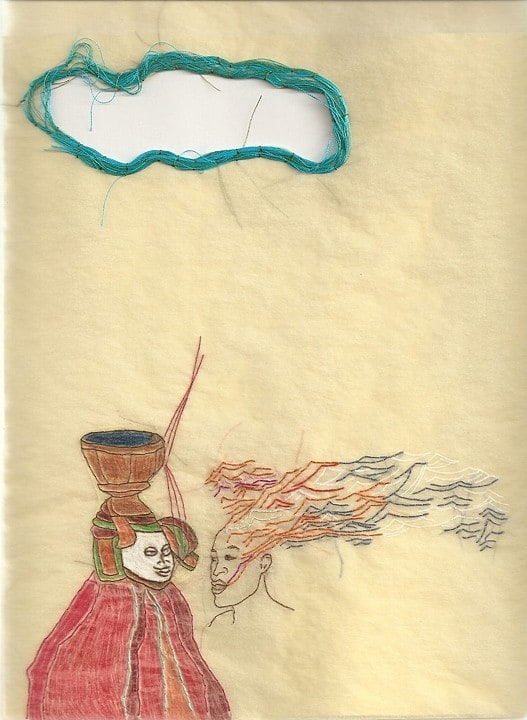
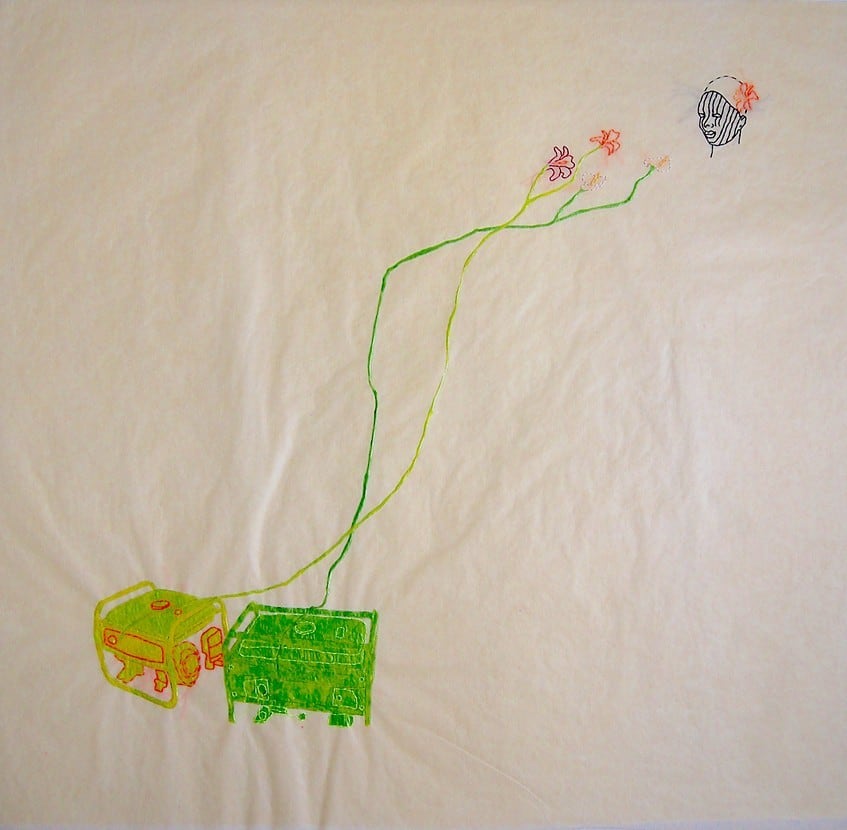
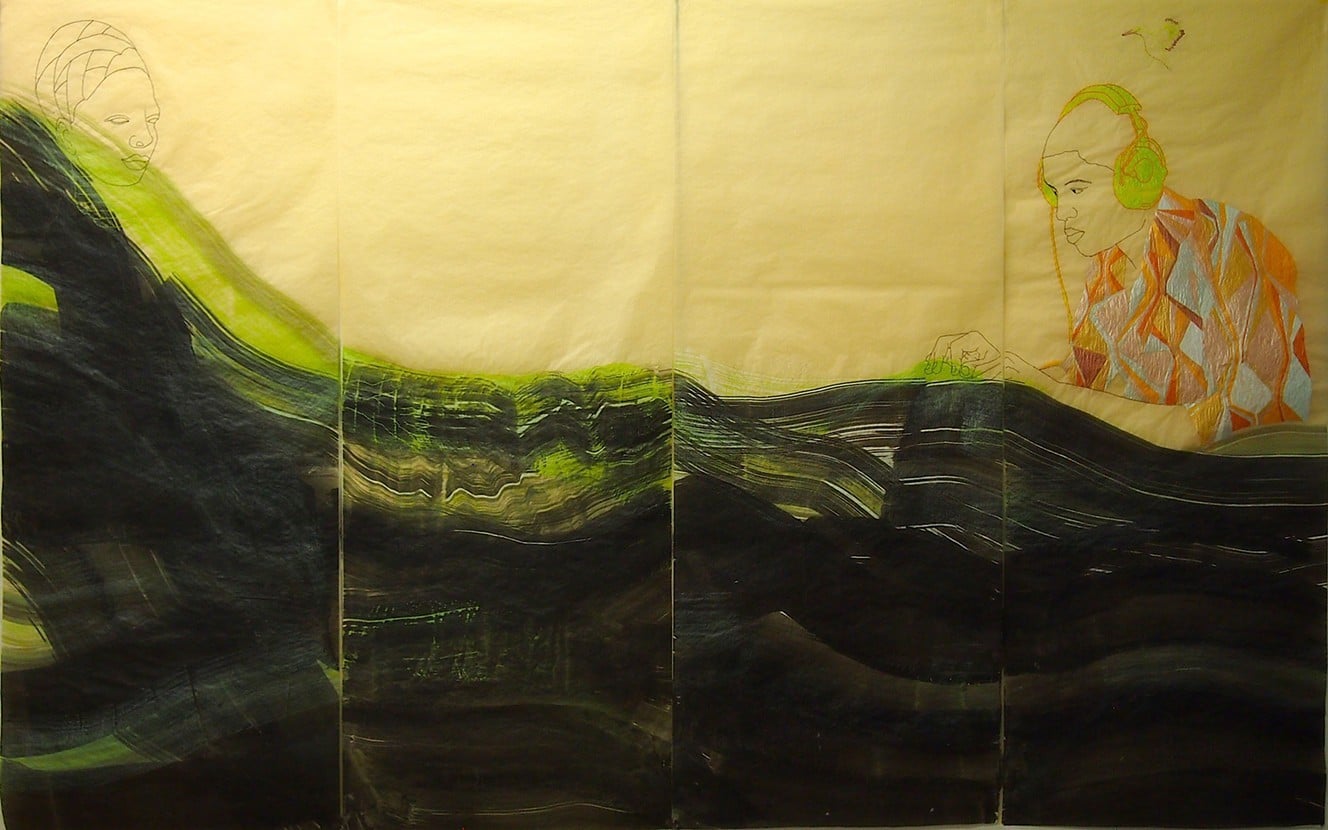
Fascinated by the ways in which people negotiate the city using little to no words and how simple gestures incite actions, Ogunji attempts to capture snippets of all that goes unsaid. Creating complex, dreamlike scenes on architectural tracing paper, which appears almost cloth-like against the thread, graphite and ink, Ogunji’s drawings are weightless in material and ethereal in theme. The forms in her illustrations seem to have a life of their own,conspicuously attached to diverse sources of energy: Disc jockeys don vibrant Ankara prints, beams of neon blues and oranges radiate from figures, the Ife heads give (or take) energy from plants at the bottom of the sea, and humming generators give life to blossoming flowers. In four panels Sound Man and the Sea (2015) depicts a man who wears headphones manipulating what could be a sound system or turntable just below the surface of thrashing ocean waves, rendered with gestural dark blue and electric green brush strokes.
Opposite the figure is an Ife head partially submerged in the water, perhaps keeping a watchful eye. In Generators Flowers Ife (2014), two neon green generators power the growth of four orchids. Attached to electrical cords that double as stems, the flowers hover in front of a seemingly live Ife head that has a flower tucked behind her ear. The drawing is likely a comment on the ubiquitous presence of generators in Nigeria, which suffers from frequent electrical outages, but also acknowledges the incredible influence generators have on the lives of modern Nigerians and the role they play in sustaining modern culture.
In these works, as in other drawings from the series, the traditional is never far from the modern, and machines are inextricably linked to human, plant and spiritual life. These relationships are hardly antagonistic but sophisticated and graceful in their chaos. Ogunji reveals oft-overlooked aspects of Africa’s most populous city and asks viewers to see Lagos as an afro-futuristic dreamscape, where beauty survives in the contradictions and the possibilities are endless.