AFP/Getty Antisemitism and the age of civilizational panic |
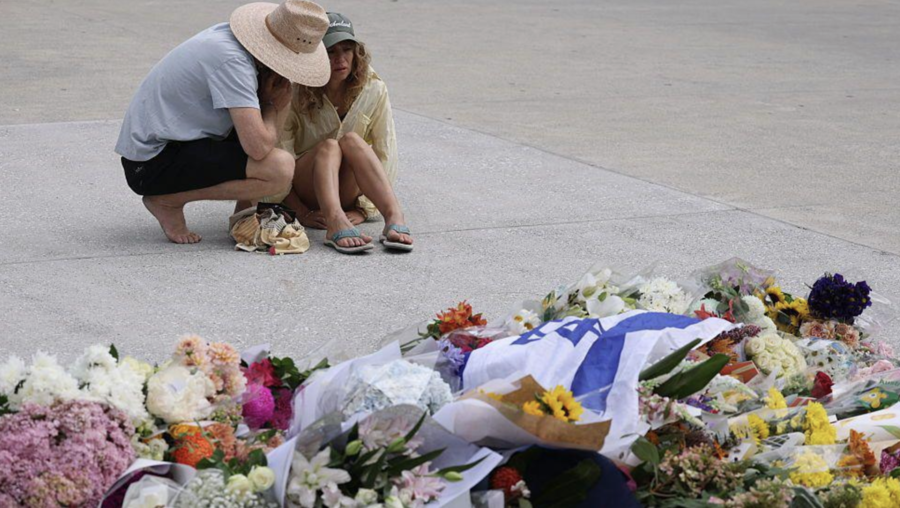
The attack this weekend at Bondi Beach in Australia was an antisemitic act of terror. It should be condemned plainly, without caveats, and without the ritual hesitation that now so often accompanies the naming of racist violence. Jews were targeted because they were Jews. That fact is neither ambiguous nor negotiable, and any politics that flinches from saying so has already abdicated its moral responsibilities. There is a tendency, especially on the left, to approach moments like this defensively—worried about how condemnation will be instrumentalized, or about which bad actors might benefit from clarity. That instinct is understandable (the attack is already seized upon to justify a backlash against anti-Zionism and to thicken an already volatile atmosphere of Islamophobia), but it is also mistaken. Antisemitic violence is real and lethal. And, it does not become less so because it is politically inconvenient to acknowledge. Naming it is not a concession to power, but is the minimum condition of ethical seriousness. Condemning an antisemitic attack does not commit one to endorsing Israel’s actions, to endorsing Zionism, or to accepting the cynical equation of Jewish safety with state violence. It commits one only to the proposition that no people should be attacked, terrorized, or murdered on the basis of who they are. When condemnation is hedged or delayed, it feeds the corrosive idea that some lives require prior political qualification before they can be mourned. At the same time, moral clarity is not the same thing as political understanding. Condemnation tells us what is wrong; it does not tell us why such violence keeps recurring. Treating the Bondi attack as an eruption of irrational hatred, sealed off from the political world in which it occurred, leaves us with nothing but shock and repetition. The harder task is to hold two thoughts together: antisemitic violence must be condemned without hesitation, and its conditions of possibility must be examined without fear. This is where a familiar objection usually appears. Any attempt to explain antisemitic violence, we are told, risks excusing it. The objection has intuitive force, but it rests on a confusion. Condemnation and explanation answer different questions. One names a crime; the other asks how that crime became thinkable. Collapsing the two is not a safeguard against violence, and only ensures that it will recur. We have navigated this distinction before. After September 11, it was possible—necessary—to say that the attacks were crimes and that they produced a wave of Islamophobia that reshaped global politics, policing, immigration, and war. Observing that relationship did not blame Muslims for 9/11, nor did it rationalize mass murder. It recognized that racist violence does not end with the event itself; it reorganizes the world that follows. The same logic applies here. Antisemitism is not an eternal force floating above history, flaring up at random. It is a political and ideological formation that is activated under specific conditions, given new objects, and redirected by existing structures of power. Refusing to examine those conditions does not protect Jews. It leaves antisemitism intact, mysterious, and therefore harder to confront. Much contemporary debate oscillates between two sterile positions. On the one hand, antisemitic violence is treated as proof of an immutable hatred, to be managed through surveillance, policing, and moral denunciation. On the other, any effort to trace causality is dismissed as suspect “contextualization.” One mystifies violence and the other forecloses analysis. Neither does much to prevent the next attack. Understanding antisemitism today requires grappling with the political environment in which it is being reconfigured. That environment includes Israel’s genocide on Gaza and the ideological framing used to defend it. Saying this is not to suggest that Jews are responsible for that war, nor that antisemitic violence is a rational or legitimate response to it. It is to note that Zionism’s long-standing fusion of Jewish identity with a sovereign state has global consequences that do not stop at Israel’s borders. From its inception, political Zionism sought to transform Jewishness from a dispersed religious and cultural identity into a national one, anchored in territory, sovereignty, and armed self-defense. Over time, and especially after 1967, this project hardened into a state that increasingly claimed to act not only for Jews, but as the political expression of Jewish life itself. In moments of relative calm, this claim already carried risks. In moments of mass violence, it becomes combustible. When Israel wages war in explicitly civilizational terms—casting itself as an outpost of the West against barbarism and existential threat—it saturates the global imagination with an association between Jewishness and a particular regime of power: militarized, punitive, and unaccountable. Antisemites did not invent this association, but they exploit it eagerly. When Jewish institutions and symbols are mobilized to defend Israel’s actions, when dissenting Jews are denounced as traitors, when the language of Jewish safety is yoked to siege warfare and collective punishment, Jews everywhere are rendered visible as symbols rather than neighbors or citizens. Racism does not operate through careful reasoning. It operates through pattern, abstraction, and displacement. It targets symbols rather than structures. By insisting that Israel acts in the name of all Jews, and by treating criticism of its actions as an attack on Jewish existence itself, Zionism’s defenders universalize risk. Jewishness becomes a global political signifier, available for adoration or attack depending on circumstance. At the same time, another danger needs to be confronted. There is a wrong way to explain the West’s steadfast support for Israel, and it is a way that has done immense historical damage. To attribute that support to Jewish power, Jewish influence, or hidden Jewish control is not only false; it reproduces the core fantasy of antisemitism itself. The United States does not support Israel because Jews “run the world” or manipulate governments behind the scenes. That explanation belongs to a long tradition that imagines Jews as omnipotent agents standing behind history’s machinery. It resurfaces whenever power feels distant and unaccountable. It also performs a fatal displacement, shifting responsibility away from states, militaries, corporations, and ruling classes, and depositing it onto Jews as such. The reality is more banal and more damning. Western support for Israel is rooted in imperial utility. Israel has functioned for decades as a regional enforcer, intelligence hub, military outpost, and ideological ally for the United States and its partners. This has been stated openly. In 1986, Joe Biden infamously remarked that if Israel did not exist, the United States would have to invent it—because it served American interests in the region. That logic has never really changed. Arms manufacturers, security elites, and diplomatic establishments have benefited materially and institutionally from this arrangement. No conspiracy is required. This is how empire operates. It is also sustained by forces that have little to do with Jewish safety at all. Christian Zionism—particularly in the United States, but increasingly in the global South—has been one of the most durable and politically consequential pillars of support for Israel. Rooted in apocalyptic theology rather than concern for Jewish life, it treats Israel as a prophetic instrument, not as a political community accountable for its actions. Its influence is a reminder that Western backing for Zionism has never been primarily about Jews exercising power, but about non-Jewish actors projecting meaning, strategy, and fantasy onto Jewish existence. This distinction matters because antisemitism thrives precisely when power is personalized and mystified. A serious opposition to Zionism and to the West’s enabling of Israel’s violence has to refuse conspiratorial explanation entirely. Otherwise, a critique of empire collapses into the very myths that have historically made Jews targets. There is another reason this matters now. Israel’s utility to the West is no longer as stable as it once was. Its actions have become diplomatically costly, morally corrosive, and strategically destabilizing. As that utility wanes, the ideological frame that once justified unconditional support begins to strain. History suggests that when a group’s symbolic usefulness erodes, affection can harden into resentment with frightening speed. This is where the concept of imperial philosemitism becomes indispensable. Philosemitism, in this sense, is not genuine solidarity with Jewish life or safety. It is a conditional admiration for Jews insofar as they are imagined to serve a civilizational function. As the old joke has it, “a philosemite is often just an antisemite who likes Jews.” Philosemitism and antisemitism are not opposites. They are adjacent positions within a worldview that instrumentalizes identity. Jews have long been alternately despised and embraced, excluded and elevated, depending on what they were thought to represent at a given moment. What matters is not affection, but utility. When Jews are cast as bearers of Western values or civilizational resolve, they are temporarily incorporated into power’s self-image. When that image cracks, incorporation gives way to blame. Contemporary Western support for Israel is saturated with this logic. Israel is celebrated as a moral symbol—the “only democracy in the Middle East,” a frontier of enlightenment. Jews, by extension, are embraced as avatars of that story. Their suffering is foregrounded; their fears amplified. But this embrace is conditional. It depends on performance. It turns Jewishness into a principle rather than a lived identity, and makes safety contingent on geopolitical alignment. Seen in this light, antisemitism and Islamophobia appear less as rival pathologies than as structurally related forms of civilizational racism. They operate differently, draw on distinct histories, and attach to different figures of fear. But both reduce complex political worlds into moralized abstractions. Both displace questions of power onto imagined enemies. Antisemitism has often functioned as a warped critique of modernity, imagining Jews as abstract, omnipresent, and excessively powerful. Islamophobia casts Muslims as an invasive mass, culturally backward and demographically threatening. One figures power as too hidden; the other figures threat as too present. In both cases, politics is replaced with identity, and structure with essence. Violence becomes thinkable because targets are no longer understood as situated people living within specific social relations. This symmetry matters because we are living through a year of civilizational panic. Across Europe, Muslims are framed as an existential problem. In the United States, Somali communities are singled out as uniquely alien and disloyal. In Nigeria, the language of “Christian genocide” flattens a complex security crisis into religious apocalypse. In South Africa, the myth of “white genocide” launders inequality into victimhood. In each case, structural explanations give way to identity war. This brings us to a final, uncomfortable truth. Antisemitism today is being dangerously misdiagnosed. Public attention has focused overwhelmingly on policing the left, while the most coherent antisemitic projects flourish on the right. Many far-right movements openly admire Israel as a model ethno-state, even as they traffic in conspiracy theories about globalists and hidden elites. These positions are not incoherent. They reflect a worldview in which Jews are tolerated so long as they serve civilizational power, and resented when they do not. Jewish safety cannot be secured through alignment with empire, surveillance, or repression. Those tools have never protected minorities for long. What the Bondi attack exposes is not only the persistence of antisemitism, but the exhaustion of a political order that explains itself through civilizational myth. Resisting antisemitism under these conditions requires rejecting the civilizational turn itself. It requires a politics that names power where it actually resides—in states, markets, militaries, and empires—rather than projecting it onto racialized abstractions. – William Shoki, editor |