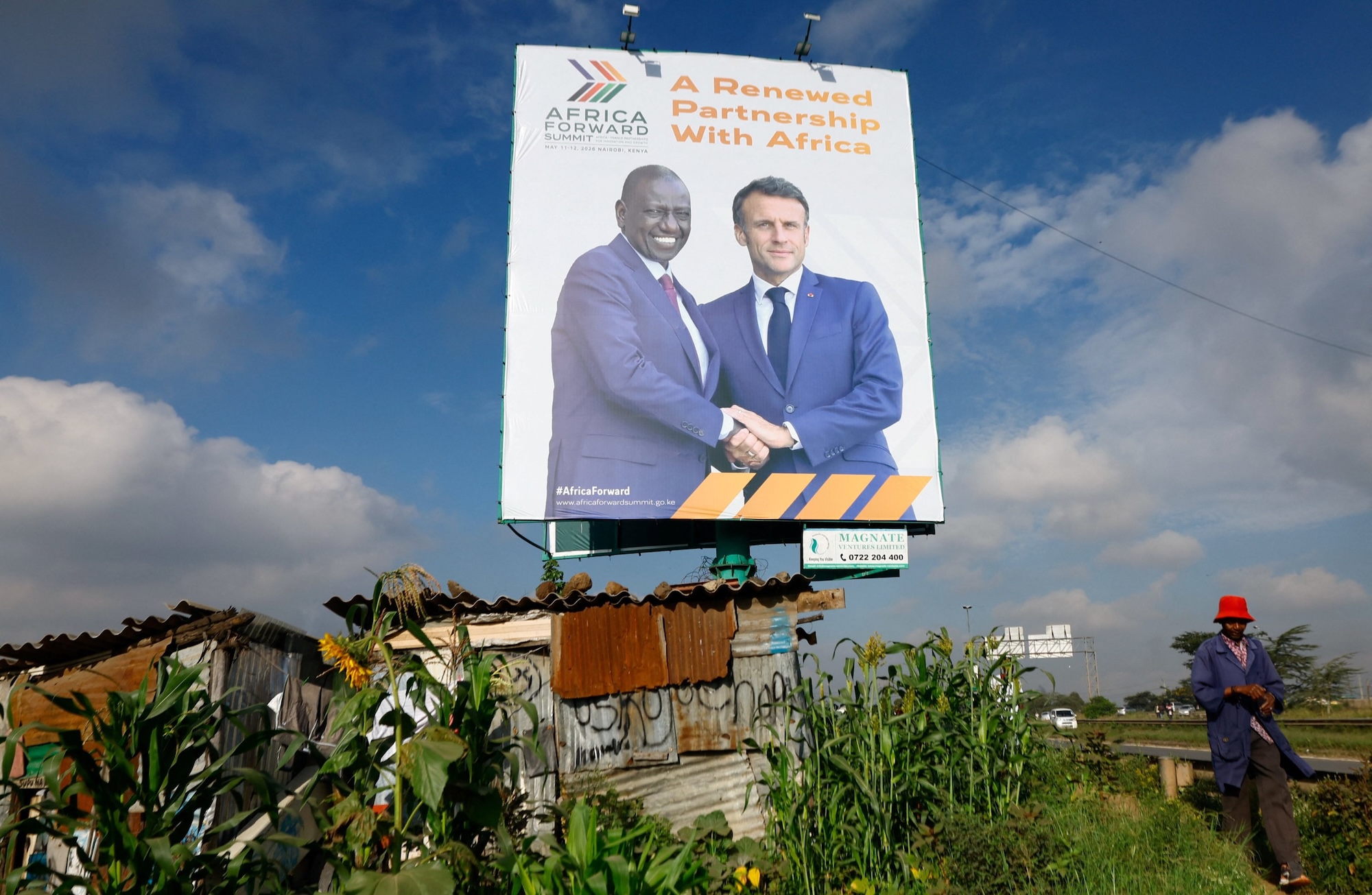
Photo via Reuters When French President Emmanuel Macron arrived at the Africa Forward summit, much of the pomp and circumstance felt achingly familiar. Macron’s presence in Nairobi was carefully staged as both statesman and companion: jogging alongside Kenya’s celebrated marathon champion, swaying to “Jerusalema” at a cultural reception, and opening his remarks at the Africa Forward summit in the requisite nominal phrases of Swahili. There was the standard parade of empty rhetorical flourishes—from speeches about innovation and sustainability to promises of mutual growth between France and Kenya—all under the false glow of diplomatic optimism. But beneath the choreography of familiarity was a more familiar exercise of power. The summit was intended as a vehicle to promote France’s new policy for the continent, publicly shifting from a paternalistic colonial power to a purported “partnership of equals.” This evolution in rhetoric is not one borne of humanitarian empathy and atonement, however, but more of a transition of necessity, as for much of the last decade, France has gradually watched its authority collapse across the Francophone African world that once formed the backbone of its postcolonial influence. Across West Africa, young people have openly rejected the architecture of Françafrique and its inextricable bind of financial dependency and military presence through which France maintained colonial power long after formal independence. In countries like Mali, Burkina Faso, and Niger, French troops have been expelled amidst mass anti-French protests and military coups. And as France no longer possesses the political authority that once allowed it to openly dictate the political terms of African sovereignty, it must now present itself as collaborative, progressive, and post-imperial in rhetoric, regardless of whether this has materially changed in practice. Empires, however, are often most dangerous when they begin speaking the language of intimacy. The genius of French paternalism in Africa has long been predicated on the country’s ability to reframe domination as stewardship. Macron’s arrival in Kenya was an explicit attempt to reinforce that rehabilitation, seeking friendlier inroads in East Africa with the full support of Ruto’s administration. Yet, even under more amicable milieus, the thin veil between rhetoric and values would occasionally make itself plain during moments of frustration: Macron publicly rebuked Mali’s leaders, accusing them of “ingratitude,” and chided audiences for their “lack of respect” during presentations—tonal missteps that only reinforced local mistrust over France’s diplomatic entreaties. The most astonishing moment, was perhaps Macron’s open declaration of France as “the true pan-Africanists,” which he defined as “believ[ing] that Africa is a continent, and that this continent has an enormous amount to build.” A former colonial empire claiming proximity to pan-Africanism is nothing short of grotesque. It was an invocation that evacuated the term of all meaning beyond a mere geography lesson. Pan-Africanism did not emerge from development forums funded by European capital; it was a radical political vision that emerged from the violence of colonialism itself, rooted not merely in continental unity, but in liberation from Western political control. Macron’s outreach to Kenya arrives at precisely the moment when France faces the terrifying possibility of geopolitical irrelevance. The French Republic has long imagined its relationship to Africa as evidence of its global importance. The current unraveling of that relationship is a potent threat to its national myth and sense about its place in the world. The French president’s pan-Africanism must therefore be understood as a strategic adaptation in an attempt to contain the collapse of France’s political authority on the continent and in the world. Africa matters to the story France tells itself, however, one does not become pan-African by investing in African startups or hosting development summits in Nairobi. The failure to recognize this is proof that the French president seeks symbolic legitimacy without relinquishing the material privileges that empire continues to provide. It is incumbent upon our political leaders to reject shoddy efforts at ideological capture in favor of a continent that can reclaim political futures beyond the frameworks Europe continues to offer. – Shamira Ibrahim, Francophone regional editor |