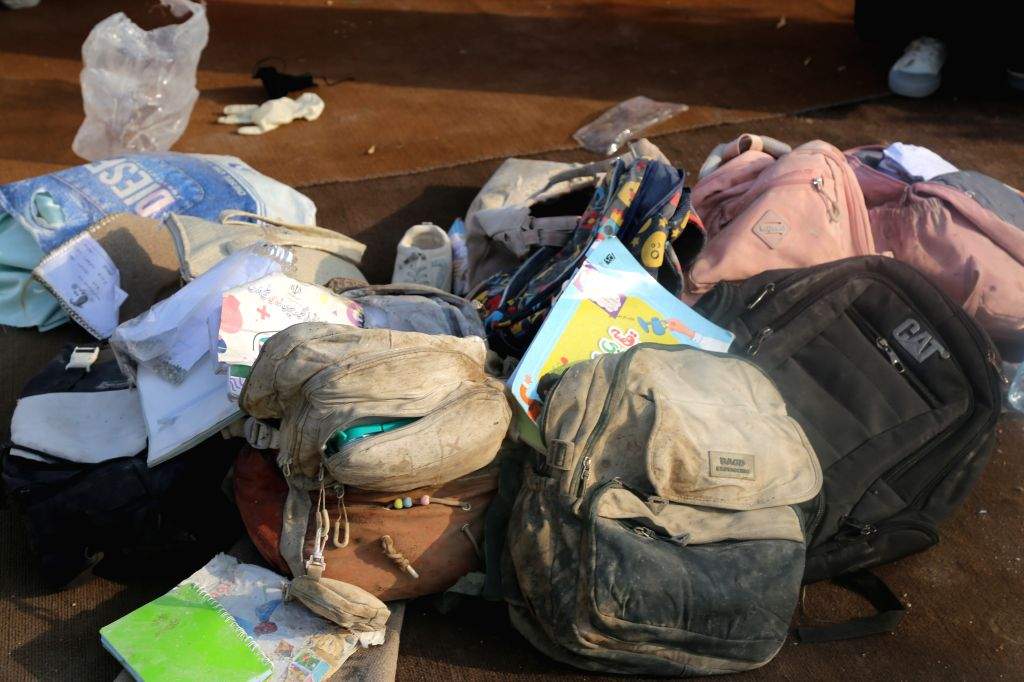
Xinhua / IANS In Minab, a small city in southern Iran, 170 children arrived at school on an ordinary morning. By the time the dust settled, at least 148 of them were dead. The missiles that killed them were American. The intelligence that selected the target may have been Israeli. The justification, delivered later from podiums in Washington and Tel Aviv, was security. Freedom. The familiar words. What is there left to say about a freedom that looks like this? We should be precise about what happened. In the early hours of February 28, the US and Israel launched a coordinated air campaign against Iran—hitting nuclear sites, military installations, and the homes of its leadership. The Supreme Leader, Ali Khamenei, was killed. Within hours, Iran’s Revolutionary Guard Corp (IRGC) closed the Strait of Hormuz, through which one-fifth of the world’s oil passes. Missiles struck US bases across the region. Three American service members died. In Iran, the Red Crescent counted 201 dead and 747 injured across 24 provinces by the end of the first day—a figure that will only have risen since. The world, predictably, has been told to brace for escalation. And yet here is the detail that should stop us cold, the one that renders every stated justification to ash: the day before the bombs fell, Iran’s foreign minister sat in Geneva and agreed, in principle, to zero uranium stockpiling. An Omani diplomat described a peace deal as being within reach. Negotiations were not stalled; in fact, they were progressing. But the bombs fell anyway. This is not a failure of diplomacy. This is the deliberate murder of diplomacy. And it tells us something essential about what this war is actually for. The playbook is old. Thirty years of warnings about an Iranian nuclear weapon that never materialized. An “imminent threat” conjured to satisfy the requirements of international law, never mind that the law’s requirements have been met with such contempt in recent years that the requirements themselves feel like a quaint inheritance. The lies before the 2003 Iraq invasion at least required a Colin Powell and a vial of something and a performance of sincerity before the Security Council. This time, a social media post and a 45-minute ultimatum were considered sufficient. The performance has been stripped back because the audience no longer needs convincing. Or rather: the audience has been determined to be irrelevant. Consider that 75% of Americans opposed the strikes, according to a Reuters/Ipsos poll. Consider that the European powers—with the honorable exceptions of Spain and Norway—abandoned any pretense of independent judgment and issued statements framing the crisis as Iran’s failure to capitulate, rather than an illegal act of war against a UN member state. The French, German, and British governments, those custodians of the rules-based international order when Russia is the aggressor, discovered remarkable flexibility when the aggressor is their patron. As one analyst put it, not even hypocrisy remains—just irrelevance. The point is not that the Iranian government is beyond criticism. It is not. The point is that none of the stated reasons for this war bear the weight of a single fact. A nuclear program that was being negotiated toward resolution. A supreme leader whose death, far from decapitating a system, will likely consolidate it. Iran’s constitution was designed precisely for this moment, built from a revolutionary generation’s careful study of how states collapse and how to prevent it. An axis of resistance that was already severely weakened. A war whose architects have no theory of victory, no ground forces, no plan for the morning after. Nothing but the confidence that the consequences will be borne by others. They will be borne, as they always are, by children in Minab. By families in Tehran, Isfahan, and Ahvaz. By workers across the Global South who will pay higher prices for food and fuel as the Strait of Hormuz closure reverberates through commodity markets. By Africans who did not start this war, were not consulted about this war, and whose governments’ protests will be noted and ignored. This is the point at which a newsletter like this one is supposed to gesture toward resistance, toward solidarity, toward the long arc of history. We have done so before, and meant it. Today it feels more difficult. Not because the solidarity is less real, but because something has shifted—something about the relationship between what ordinary people think and want, and what actually happens in the world. There is no anti-war movement. There are individuals who are horrified, intellectuals who are writing, citizens who are calling their representatives. But the mechanisms that once translated popular opposition into political constraint—the mass protest, the casualty count that brought the war home, the draft notice that made the cost personal—have been systematically dismantled. This is imperialism perfected: wars waged by aircraft carriers and precision munitions and signals intelligence, with three body bags coming home rather than three thousand. Not enough to disturb the domestic peace. Not enough to generate the kind of grief that stops governments. Every life lost to war matters. But especially the 148 children of Minab, whose names we will mostly never know, and whose deaths will be processed by the Western news cycle as an unfortunate but perhaps unavoidable consequence of a complex operation, before the cycle moves on. There is a question worth sitting with as this war settles into whatever it becomes—a ceasefire imposed by the logic of economic catastrophe, a grinding continuation, something worse. The question is not whether World War Three is coming. It may not be. What feels more likely, more suffocating, is something without the resolution of a genuine historical rupture: a permanent, low-intensity barbarism that simply continues. Wars that cost their authors almost nothing. A world that absorbs each shock and degrades a little further and goes on. We have reached a point where the end of the world is easier to imagine than the end of the status quo, because they feel like the same timeline. That feeling—the sense that the horizon has closed, that the feedback loops have been severed, that the consent of ordinary people has been rendered not just irrelevant but unnecessary—that is what is truly new. Not Trump, who is a symptom. Not Netanyahu, who is another. But the structural fact that power has found a way to wage war without paying the price that once made war politically costly. The freedom they are offering the people of Iran is the freedom of the grave. The dead do not organize. The dead do not demand self-determination. The dead have nothing to say to us. That is what the bombs in Minab were really for. And there is almost nothing left to say about it. – William Shoki, editor |