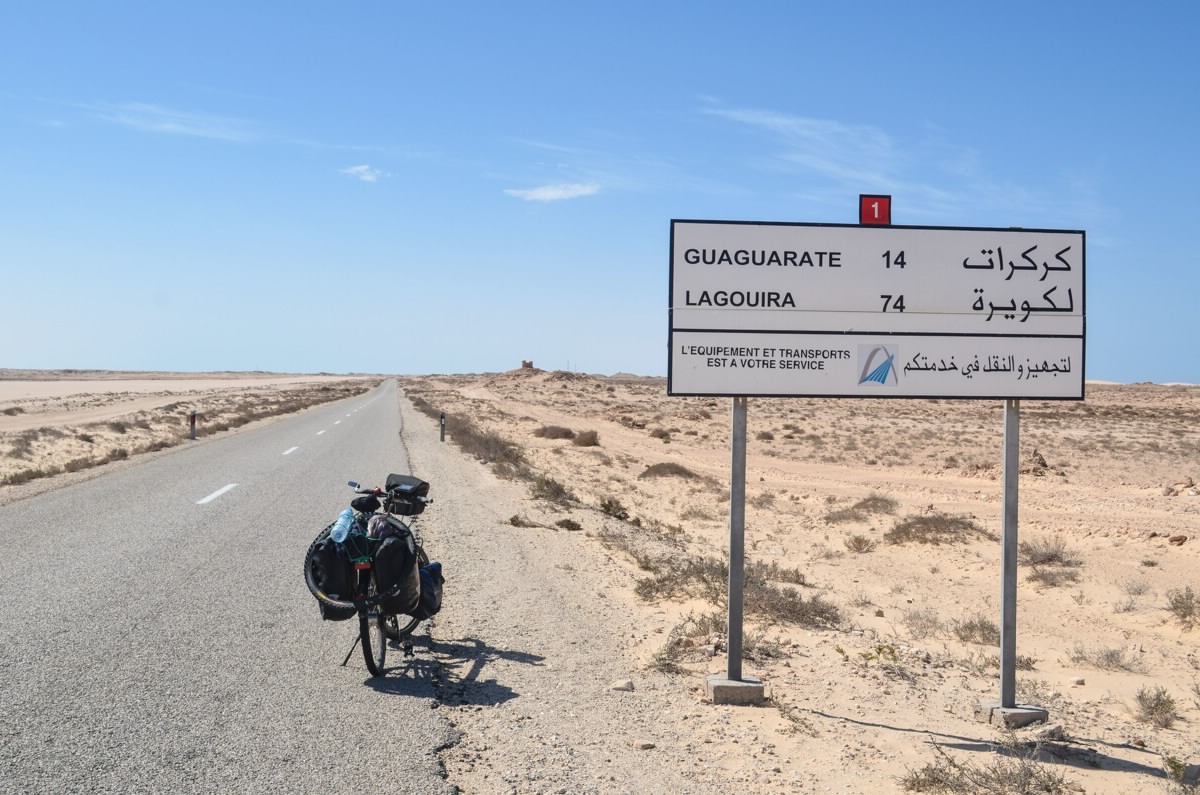
Western Sahara / Mauritania border. Credit jbdodane via Flickr. Last week, Mali’s foreign minister Abdoulaye Diop announced that his country would no longer recognize the Sahrawi Arab Democratic Republic, throwing Bamako’s weight, instead, behind Morocco’s autonomy proposal for Western Sahara. The decision is not especially surprising—Mali is locked in a bitter dispute with Algeria over a drone incident near the shared desert border, and endorsing Morocco’s position in the Western Sahara conflict is, among other things, a useful way to signal displeasure with Algiers, which backs the Polisario Front. Geopolitics, in this case, works through the available instruments. But the timing and the accumulating pattern behind Mali’s move—Kenya and Ghana endorsing Morocco’s plan last year, Burkina Faso among more than two dozen states operating consulates in the territory, and a November 2025 UN Security Council resolution that, for the first time, explicitly framed Morocco’s autonomy framework as the most feasible basis for negotiations—marks something more significant than a single state recalibrating its alignments. It marks another stage in the slow administrative burial of Western Sahara’s status as a decolonization question. Western Sahara has been listed by the United Nations as a non-self-governing territory since 1963, and it remains the only such territory in Africa for which decolonization is still formally incomplete. The Sahrawi people’s right to self-determination was reaffirmed by the International Court of Justice in 1975, and has been affirmed repeatedly in UN General Assembly resolutions since. A referendum was brokered in 1991 as part of a ceasefire agreement between Morocco and the Polisario Front, and a UN mission—MINURSO—was established specifically to organize it. The referendum never happened. Morocco rejected independence as an option. The Polisario demanded it. The voter registry became a site of endless contestation. And what began as a temporary technical stalemate hardened over decades into a permanent political fact: the principle of self-determination was formally intact while being practically inoperable. The autonomy framework now being consolidated internationally does not rescind that principle—it simply moves the goalposts until the principle no longer applies to any real decision. Morocco’s proposal would devolve some legislative, executive, and judicial authority to Western Sahara, while Rabat retains control over defense, foreign affairs, and religion. It is sovereignty at the local level and occupation at every level that matters, a.k.a, Bantustanization. The problem here is not simply Morocco’s intransigence or the weakness of the Polisario Front. It is that the hollowing out of self-determination in Western Sahara is structurally consistent with how these concepts are functioning—or rather failing to function—across the contemporary global order. The gap between the formal recognition of a right and its material realization is not a malfunction; it has become something closer to the normal operating condition of international politics. In Gaza, Palestinian self-determination is invoked (well, used to be) as a goal in virtually every diplomatic statement while Palestinian territory is being systematically depopulated through apartheid, genocide, and ethnic cleansing. In Lebanon, a sovereign state recognized by all parties has found its sovereignty violated by Israel seven times in 50 years, with Israeli lawmakers now openly calling for occupation and annexation of the south up to the Litani River—a territorial aspiration that long predates current hostilities and has roots in early Zionist claims made at the 1919 Paris Peace Conference. Even in the US, nominally the world’s most powerful sovereign state, a population that voted for no wars finds itself leading military operations against Iran. Formal sovereignty and the actual exercise of political authority over consequential decisions have drifted so far apart that it is worth asking whether they are still meaningfully connected. Sovereignty, as many scholars have argued, has always been what Wendy Brown calls a “powerful fiction”—an idea that structures political reality precisely because people and states act as though it were true, not because it accurately describes where power actually resides. The Westphalian ideal of the sovereign state as supreme within its borders and free from external interference has always coexisted awkwardly with the reality that powerful states do not reciprocate the sovereignty of weak ones. Strong states invade, occupy, sanction, structurally adjust, and otherwise override the domestic authority of weaker states while claiming the same principle as their own shield. This is not new. But something has shifted in the current conjuncture: the fiction is becoming less powerful, less capable of structuring expectations and behavior, less able to perform its organizing function. The sovereignty regime—the shared set of assumptions about what sovereignty means and who is entitled to invoke it—is in visible disarray. This is where the discourse about states’ supposed “right to exist” enters as a revealing symptom. The demand that critics of Israeli policy affirm Israel’s “right to exist” before their arguments can be heard is not a question of international law, which recognizes no such right for states. Mehdi Hasan, in a characteristically forceful recent intervention, dismantles the framing with a simple observation: states do not have a right to exist. People do. States change all the time—their borders, their governing structures, their ideological character. The Soviet Union dissolved. Yugoslavia fragmented. Czechoslovakia split. What happened to their right to exist? The question functions, as Rawan Abhari has also argued, as a political litmus test—a rhetorical precondition that substitutes abstract assurances for engagement with material realities of occupation, displacement, and unequal rights. More importantly, the framing shifts attention away from the only subjects that actually bear rights in international law: people. The Israeli state does not have a right to exist. The Jewish people between the Jordan River and the Mediterranean Sea have a right to live, to security, to material wellbeing. The Palestinian people on that same piece of land have precisely the same rights, but it is currently only Israeli Jews whose unqualified right to live on that land is being recognized, protected, and enforced by the international community. The confusion of these two categories—the abstract entity of the state and the concrete human beings who inhabit it—is precisely what allows political discourse to circle endlessly around the survival of institutions rather than the conditions of actual lives. Return this logic to Western Sahara. The Sahrawi people have a right to self-determination. This is not contested in international law; it is simply being practically foreclosed by the diplomatic momentum around Morocco’s autonomy plan. But self-determination is only meaningful if it reflects the freely expressed will of the people concerned, and the Sahrawi people are being systematically excluded from the very deliberations that will determine their future. As Zahra Rahmouni reported for us last year, at the UN’s annual Western Sahara debates, Sahrawi voices are largely absent from international coverage and from the negotiations themselves. Journalists who document the issue face surveillance and harassment. Activists in the occupied territories face imprisonment and torture. The Tindouf camps in Algeria house more than 170,000 refugees whose right to participate in determining their political future is not defined in the autonomy framework, which does not even specify who counts as a Sahrawi with a stake in the outcome. A political process that excludes the people it purports to resolve is not self-determination. The contradiction that all of this forces into view is one that neither the critics of the current order nor its defenders have yet resolved. The nation-state is, as an analytical category, an inadequate container for lived social reality. It papers over class, regional, ethnic, and gender differences within its borders while manufacturing a fiction of shared national interest. The Malian junta that endorsed Morocco’s position this week does not speak for all Malians in any meaningful sense; it speaks for a military regime navigating its own survival. The Moroccan monarchy that claims sovereignty over Western Sahara does not represent the Sahrawis who live there. And yet—and this is the tension that should not be dissolved too quickly—the nation-state and its apparatus remain the primary terrain on which rights are actually secured or denied. The right to healthcare, to education, to labor protections, to political participation: these are, in practice, delivered or withheld by states. Without a capable and functioning state, populations are left to the mercy of markets, military forces, and international organizations that are themselves constituted by states. The class politics that once provided an alternative organizing framework for cross-border solidarity have, for now, been substantially weakened as a mobilizing force. The nation may be analytically obsolete and politically insufficient, and it may still be the only collective container through which people can practically assert claims on resources and power. What this means for Western Sahara—and for the wider crisis of self-determination it exemplifies—is that we need a more precise account of what is actually being demanded when we affirm that the Sahrawi people have a right to determine their future. It is not primarily a demand for a particular flag or a seat at the UN. It is a demand that the people most affected by a political arrangement have a genuine say in making it; that their material conditions, their security, their cultural life are not determined unilaterally by an occupying power or settled in negotiations in which they have no voice. That is a grounded claim about democratic agency, about who has standing to make decisions that affect them, about the relationship between political authority and the people it governs. International law has the vocabulary for this—self-determination as the freely expressed will of the people concerned—but it lacks the enforcement mechanisms, and the diplomatic momentum is currently moving in the opposite direction. If sovereignty and self-determination are no longer functioning as reliable organizing principles, the question is not whether to abandon them but whether the concepts can be reconstructed from their foundations rather than their institutional forms. That would require, at minimum, taking seriously the distinction between a state’s claim to territorial continuity and a people’s claim to live, to be heard, and to determine their conditions. Those are not the same thing, and the history of Western Sahara is in part a long demonstration of what it costs to treat them as though they were. – William Shoki, editor |