The making of Arundhati Roy
In revisiting her relationship with her mother, Roy shows how intimacy, violence, and love forged the sensibility behind her uncompromising political life.
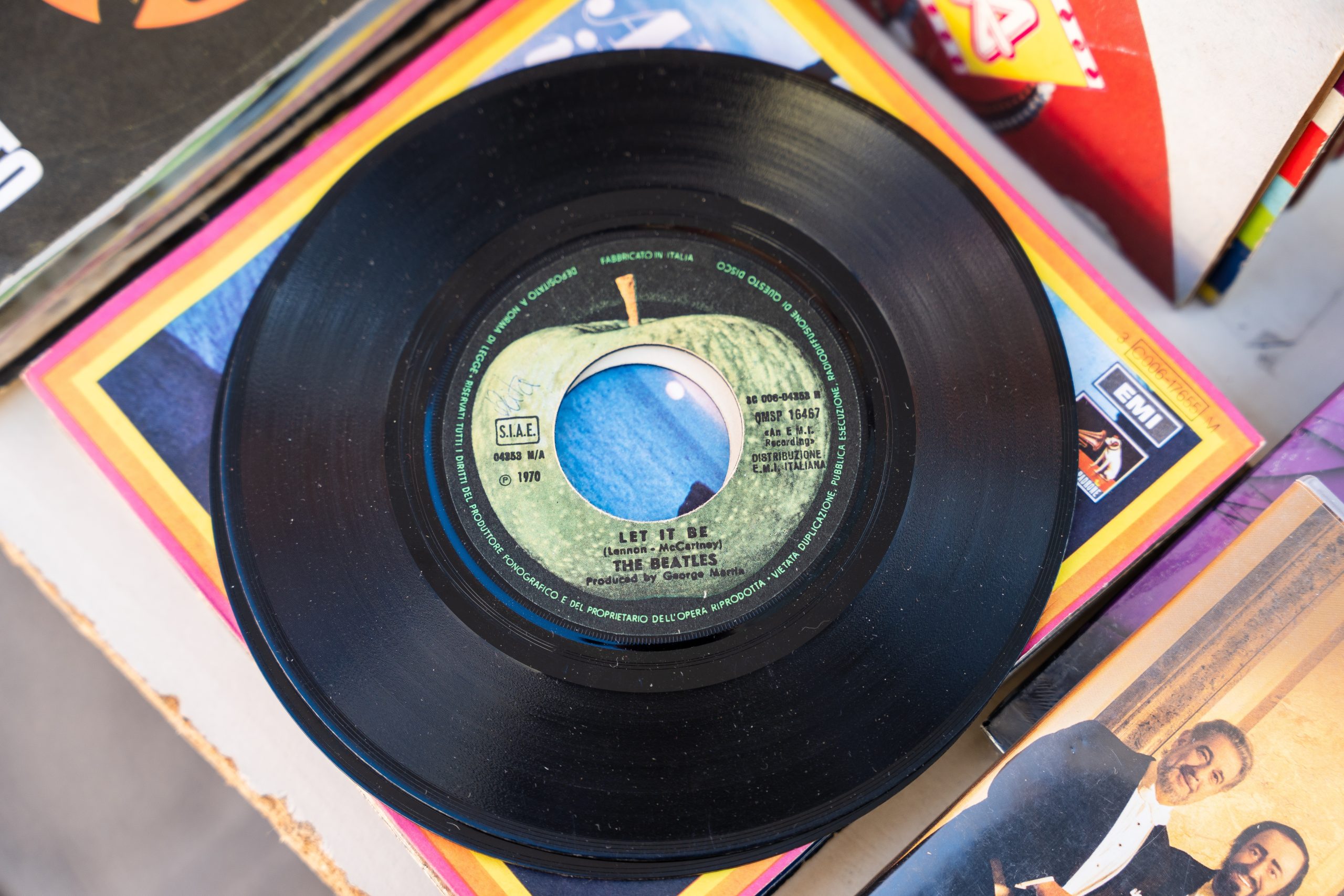
45 RPM single of The Beatles’ “Let It Be.” Image credit PHLD Luca via Shutterstock.com
In Mother Mary Comes To Me we learn that Arundhati Roy, the very same woman who spent time with Naxalite guerrillas in the Dandakaranya forest, the one who was called an “intellectual terrorist” and refused to be intimidated by India’s far-right nationalist government, is someone who grew up belittling herself, and who would a thousand times choose to disappear than cause any discomfort to her mother, her “shelter and [her] storm.” The memoir starts with her mother’s passing and takes readers through two sides of Roy that are equally true: the hypervisible and the invisible. Readers will soon realize that there wouldn’t be a Booker Prize-winner Arundhati Roy (who simply cannot not write sometimes) if she hadn’t learned about subjugation and irrational love first-hand.
Roy’s mother, Mary (or Mrs. Roy, as she demanded to be addressed), was a teacher who raised her and her brother, LKC, alone, founded a secular school in Kottayam, and famously won a Supreme Court case for equal inheritance rights for Christian women in Kerala. During her upbringing, Mrs Roy subjected Arundhati and LKC to all sorts of violent treatment: public humiliation, cruel confessions, punishments, beatings, you name it. Loved and feared by her students, the phrase “walking on eggshells” falls short of describing the effect this woman had on others. On bad days, she would call Arundhati a “bitch,” a “millstone around her neck,” and remind her she had wanted to abort her with a wire hanger. But things aren’t always clear-cut, and Mrs. Roy also encouraged free writing and provided an education and a platform for her “baby girl” to be prepared for the world. Mrs. Roy had herself a story of abuse with her father, but that was something she would never dwell on. Through the mere observation of her mother, Arundhati learned that a woman in India could build her dreams brick by brick—quite literally in the case of Mrs. Roy, who expanded her school campus by “[m]aking people offers they couldn’t refuse.” Notably, the author does not once describe her mother as abusive, giving us a clue to her unresolved feelings toward her. As if she were still trying to wrap her head around the context and pain behind her mother’s cruelty and eclectic entrepreneurship, Roy intentionally avoids cataloging her in a one-dimensional way.
The memoir’s title, the famous line from The Beatles’ song “Let it Be” is somewhat puzzling at first, as whoever has read Arundhati’s non-fiction work (think Walking with The Comrades or Azadi) knows she is not the type of writer who can “let it be.” Readers will quickly figure out that Mrs. Roy also isn’t, something preempted in the memoir’s dedication that reads “For LKC Together we made it to the shore. For Mary Roy Who never said Let It Be.” The Beatles are actually present throughout the book. Starting when Arundhati listened to “She’s leaving home” on repeat while deciding she wouldn’t be returning to her hometown any time soon, followed by when a friend gifted her the color negatives of Yellow Submarine (1968), and even when she describes falling in love with who would be the love of her life Pradip Krishen, highlighting “he knew the Beatles backwards.” This recurring mention does more than situate Arundhati’s teenage years and early 20s in a global cultural context; it locates her looking toward the West as a sort of respite, similarly as she did with Janis Joplin, Jimi Hendrix, and others. Like many other thousands worldwide, Arundhati’s rebellion against mainstream political paradigms and first experiences of love all had a Beatles soundtrack.
Many know about Roy’s fiction and non-fiction writing, and of her political battles in India, but it was a wonderful surprise to learn about her background in architecture and film. After reading the memoir, I watched the 1989 movie In Which Annie Gives It Those Ones, directed and produced by Kirshen, and written by Roy, where Arundhati is also one of the protagonists. The film follows a group of architecture students who are preparing their final theses while smoking, listening to music, pulling all-nighters and keeping a light-hearted attitude toward life in general, making it incredibly popular among students in India at the time. Watching Arundhati play the defiant, fun, and effortlessly seductive Radha gives a vivid image of what the author describes in the book about her own experience as an architecture student in the 1970s in New Delhi. Toward the end of the film, Radha presents her final project, a post-colonial take on how architects keep “non-citizens” in New Delhi at bay. This was Roy’s own architecture graduate thesis, included in the film’s screenplay. “It’s a way of establishing territory, you know. Like animals,” says Radha while critiquing the city’s segregation in her presentation to the jury. Shot at the School of Planning and Architecture in New Delhi, the film references several of the Beatles’ songs, too. (A restored version of the film was screened earlier this year at the Berlinale, where Arundhati quit the jury because of disagreements with other members about Palestine and the political role of films.)
One of the key revelations of this book, and perhaps the most personal, is how the author struggles to stay in places that have brought her joy. This is something particularly evident in her love life; in her relationship with filmmaker-turned-environmentalist Krishen, and previously with her first boyfriend, “JC.” At times, what appears to be an inevitable self-inflicted heartbreak was a response to her being unsettled with the comforts that come with class or certain cultural expectations with being a woman in India; either way, things too big to ignore. Like when Krishen inherited his parents’ house and swiftly began to give instructions to the domestic staff, a role she couldn’t get herself into and something that made her judge him and his daughters harshly. But readers might be left thinking if this insistence on a principle-led life is the real reason why she couldn’t choose love, or if it is because of something deeper—an incapacity to depend on someone or a sort of mirror of her mother’s way of doing life on her own. Arundhati painfully writes: “like a suicide bomber, I had blown myself to smithereens, too. My life. My home.”
As the book progresses, it becomes clear that Roy’s empathy toward others often caused her to downplay her own life circumstances and difficulties. These included all sorts of hardships: like when her mother, brother and herself had nowhere to live and were undernourished, or when she had to silently witness her mother call her brother a “chauvinist pig” and beat him up because he hadn’t done well at school, when she was harassed on trains, followed when cycling in Delhi, and when she unfairly had to go to jail. To this day, Arundhati sustains that her own sufferings are irrelevant compared to the bulldozed homes, the sterilization of Muslim communities, the public lynchings carried out by Hindu nationalist mobs, and the ever-present caste system and its respective ruling on who is pure and who is not. And this is perhaps a key to understanding her walking away from romantic love and making her own feelings look unimportant in the greater scheme of things. She writes: “I have seen and written about such sorrow, such systemic deprivation, such unmitigated wickedness, such diverse iterations of hell, that I can only count myself amongst the most fortunate. I have thought of my own life as a footnote to the things that really matter. Never tragic, often hilarious.”
After 9/11, the US’s war in Afghanistan, and the Islamophobia it manufactured, served Hindu nationalism well. With this came more antagonism to Roy’s writing, which had turned away from fiction and into politics directly. Her famous essay “The Algebra of Infinite Justice” (2001), where she asked, “How many dead Afghans for every dead American? How many dead women and children for every dead man? How many dead mojahedin for each dead investment banker?” fueled Indian media and made her an easy target for public hate. A year later, the Indian Supreme Court found her guilty of criminal contempt for her writings on the Narmada Valley dam project.
Although Mrs. Roy sometimes resented her daughter for her fame, she supported Arundhati’s political writings in her own way: by subscribing to Frontline and Outlook magazines and inviting her to speak to her students. But, the persecution against Roy got more and more violent, from people finding out where she lived to op-eds explicitly asking for her death. Arundhati’s courage became a fixture in how she presented to the world, something very different to the sorrow and loneliness she often experienced behind closed doors. I still wonder if the isolation she sometimes chose was a measure to protect her loved ones, or because she couldn’t accept the guilt of stepping out of the role she had created for herself as a sacrificed, politically committed writer. Through it all, the option of becoming an intellectual critiquing India from afar wasn’t really a possibility for her: “[t]he more I was hounded as an anti-national, the surer I was that India was the place I loved, the place to which I belonged. Where else could I be the hooligan that I was becoming? Where else would I find co-hooligans I so admired? And who among us supposed equals had the right to decide what was ‘pro’ and ‘anti’ national?”
I think it would be a mistake to say that Mother Mary Comes To Me is about motherhood. I would much rather say it is about how Roy’s mother, alongside other people she loved, marked the author’s way of seeing and navigating the world in ways she can only fully understand now by looking back. By bringing both sides of Roy to the light and making them co-constitutive, the book dismantles the division between the courageous writer and the fearful girl, allowing readers to understand how this writer came to be, and at what cost. The author describes the politics of the different places in India she moves through and shares what those places mean to her, inviting readers to come closer, which is, of course, the key to any good memoir. It is through this closeness that Roy generates that we can locate her most intimate feelings geographically and emotionally.
If The Beatles served as a soundtrack for Arundhati Roy’s youth, it is safe to say she has come full circle by titling her memoir after “Let It Be.” When I searched the author’s age and found out she is 64, I remembered the Beatles’ “When I’m Sixty Four” lyrics that very aptly say: “Send me a postcard, drop me a line, stating point of view. Indicate precisely what you mean to say, yours sincerely, wasting away.” At a risk of being too literal here, I believe that it is because of how Roy states her point of view in all of its complexity and range of emotion in Mother Mary Comes To Me that she can let go of the sorrow involved in caring so much about politics in India (and elsewhere). This is not to say that I think she will stop writing or speaking about the injustices she feels for, as I doubt that will ever be the case (a few weeks ago, she spoke about the US and Israel’s war on Iran). What I mean is that this book, alongside the grieving and emotional labor it must have entailed, might very well be what allows Roy to return to the curiosity, tenderness, and freedom so well captured in In Which Annie Gives It Those Ones. And by doing so, claim a childhood innocence she never had, but one she can still imagine.