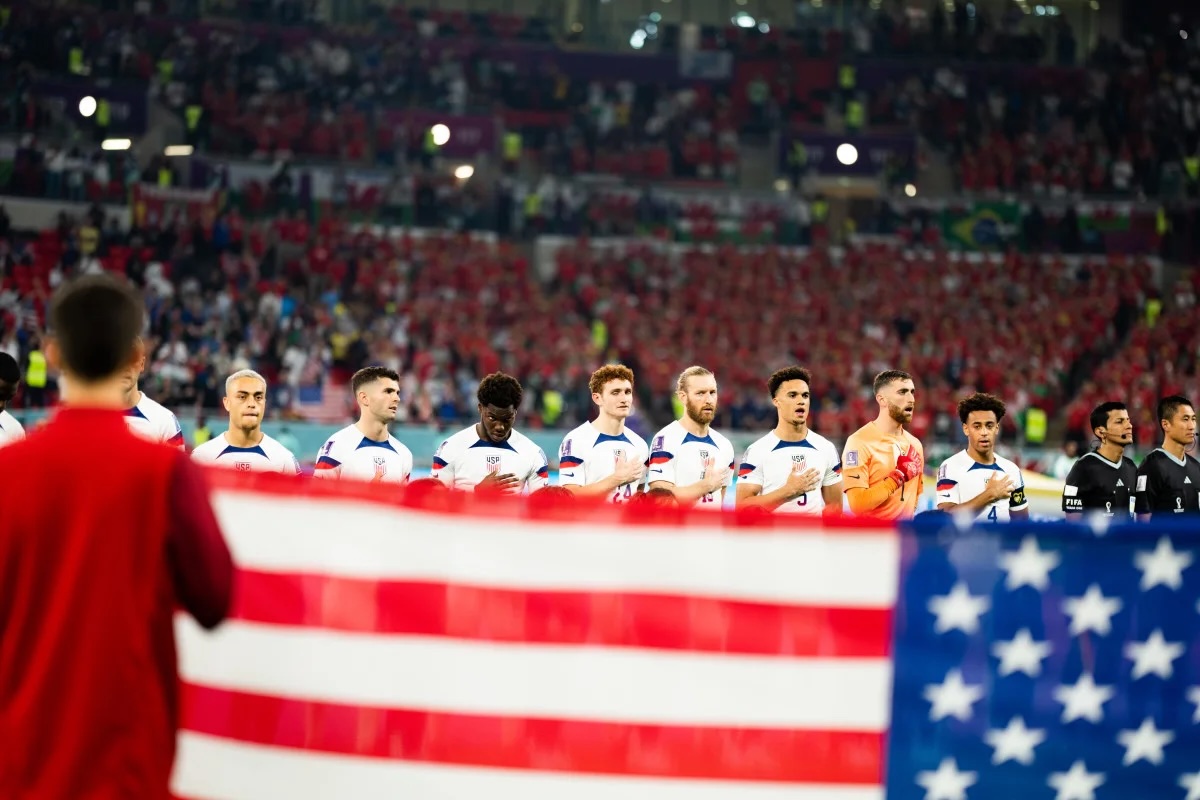
Richard Gordon/Icon Sportswire via Getty Images After three weeks criss‑crossing North America during the World Cup, I came home thinking about the United States in a way I was able to admit to colleagues privately, but which still feels strange to say in public: it is, in some sense, a miracle. Not a clean or innocent one. The closer you get to its history, the harder it is to believe the country exists at all. The tournament was supposed to be a celebration of the three hosts—Canada, Mexico, and the United States—sharing a continent and showing off a certain North American ease. Instead, it often felt like a stress test. Canada tried to perform the calm, liberal sibling, the more polite and welcoming family member (even though, in the months before the tournament, it rejected close to 60% of World Cup visitor visa applications, mostly of visitors from the global South, which is a harsher rate than Washington managed). Mexico staged its usual mix of warmth and nationalist theater set against a much darker backdrop of mass disappearances that have become one of the first big tests of Claudia Sheinbaum’s presidency, even as her left‑populist social policies keep her approval ratings high and win her admirers abroad. And the United States, under Donald Trump, kept reminding everyone that even an event as global and as festive as the World Cup would be made to pass through the narrow gate of American paranoia and domestic political performance. And now, as the tournament wraps up this week, wholly centered on that boisterous middle country, I can’t help but reflect on those thoughts I had about that existential miracle. I’ve always known, in the abstract, about the ethnic cleansing and genocide of Native Americans. It is one of those facts you carry as background noise: reservations, broken treaties, the occasional statistic. Walking through the First Americans Museum in Oklahoma City, as well as driving through the state of Oklahoma itself (“Indian Territory” until 1907), was the first time my body caught up with that knowledge. Room after room insists on the simple thing that mainstream tellings glide over—that the United States only exists because somebody decided the people already there did not. Maps track each forced removal. Displays reconstruct the bureaucracy of extermination. You leave with the sense that “America” is less a country than a crime scene, a site of active, grave wrongdoing. And then, of course, there is slavery and the afterlives of slavery: Jim Crow, lynching, redlining, mass incarceration. None of this is news. The more you excavate, the less plausible the whole project looks. Which is why, in a perverse way, the country feels miraculous in spite of these beginnings. For a territory as big as it is, with as many people as it has, as varied and heterogeneous as they are, it is surprising that the United States is not even more violently ungovernable than it already is. On the one hand, you are haunted by a low‑grade fear—especially in small towns in the rural hinterland or crowded places in the urban metropolis—but I realize I feel the same in Cape Town, if not for different reasons. At some point, then, the question stops being “What is wrong with America?” and becomes: aren’t the problems of the United States just the problems of the world, condensed and amplified? What is unique about the country is that, in many ways, it simply is the rest of the world. Every language, every history, every kind of flight and exile is there, bumping shoulders in the subway or moving slowly through traffic. Of course, this rich diversity is heavily concentrated in the country’s urban centers. But who would’ve thought that the largest Cabo Verdean population outside Cabo Verde would be in sparsely populated towns in New England? Or that some of the best Indian food in the country can be found in Punjabi‑owned “dhabas”—truck stops serving Punjabi food along service routes—dotted across the American landscape? In his speech commemorating the US’s 250th birthday, Zohran Mamdani—himself an immigrant to the US, naturalized only eight years ago—described America as an argument more than a nation, something with no fixed shape. That line has stayed with me. It bears repeating that the one continuous presence on the land was Native Americans, but even they refused the kind of fixity the settlers tried to impose—moving with the seasons, treating land as something shared rather than owned. This is not an invitation to romanticize a pre‑colonial harmony; there were conflicts and hierarchies there, too. The point is just that “belonging” looked very different before it was fenced off, titled, and turned into a tool of power. The Europeans who remade the continent imported their own colonial modernity, but they also stole some ideas. The much‑celebrated American innovation of a confederation of semiautonomous states drew, in part, on the Haudenosaunee, whose political organization Benjamin Franklin and others openly admired. Even the bits of the US that get put on posters were hybrid from the start. Talking to migrant communities on our road trip, what struck me is that people are not simply washed up in the US by accident. Whatever pushed them away from home, they were also pulled towards here. Of all the rich, cruel countries in the world, this is still one of the few that feels, to many, like a place where life could be otherwise. Whether we like it or not, a lot of the world now dreams in American. Even our fantasies of getting out of capitalism or patriarchy or racial hierarchy often borrow their images and language from the United States—from its movies and music, its protests and court cases, its stories about “starting over.” In theory at least, America is dedicated to a simple, intoxicating idea: that nothing is nailed down forever. That you are not condemned by your past, your passport, your parents; that you can arrive, pick a new name, and become someone else. The promise is unevenly distributed and often violently policed. For every person who gets to reinvent themselves, there is someone whose body is treated as the raw material for that freedom. But the promise is real enough that people still risk everything to test it. So what actually sits at the core of “Americanhood”? Is it just raw power—settler violence, slave labor, national capitalism, the dollar and the drone? Or is it something like the opposite: the stubborn insistence, written into the Declaration and repeated by every movement since, that freedom and equality belong to everyone, everywhere, without qualification. Tocqueville thought democracy in America was a kind of prophecy, a glimpse of how modern societies would organize themselves. Later radicals treated the US as a battlefield between an abstract universal (“all men are created equal”) and the concrete universal (which men, exactly, and on whose land?). Each wave of struggle has tried to drag that abstraction down to earth—abolition and Reconstruction, civil rights and Black Lives Matter, feminism and queer liberation, the present fights around Palestine, migrants, Indigenous sovereignty. It would be comforting to think that the gap between the ideal and the reality is just hypocrisy: a country that preached universal freedom while failing to live up to it at home. But sit with the history long enough and it becomes clear that empire is not a deviation from the story; it is one of the conditions for the miracle. The United States becomes “the indispensable nation” by making other places dispensable. The same republic that quotes Jefferson on liberty has sponsored coups from Guatemala to Iran, trained torturers, and flattened cities in Vietnam and Iraq. It has ringed the planet with military bases, enforced a global economic order that keeps wealth flowing towards Wall Street, and written trade rules that shield its firms while preaching free markets to everyone else. People don’t just wake up one day and choose to leave where they come from. They are often leaving economies and polities first broken open to make room for American capital. That history was there in the tournament too. Trump was not content to merely host the thing. He had to interfere with it, posture around it, make it answer to the small, mean imperatives of “America First.” When Folarin Balogun, the US’s main goal‑scorer, was sent off against Bosnia and automatically suspended for the match against Belgium, the White House treated it as a political crisis: phone calls to Gianni Infantino, pressure on FIFA’s disciplinary committee, and then an unprecedented decision to lift the ban so he could play. Even people who thought the red card was harsh could see what was wrong here. A host president leaning on world football’s governing body to save his striker is exactly the kind of off‑field power the sport keeps insisting it has outgrown. Even the World Cup—an event built on movement, noise, mixture, and the temporary suspension of borders—had to be bent back into a story about control, exclusion, and national grievance. When the US hosts the world, it does so on the condition that the world behaves itself. And then there were the semifinalists. By the last four, the tournament had acquired a symbolism that felt almost too neat: three of the teams represent North America’s old imperial powers. Spain, France, and England—different histories, different scales, but each marked by conquest, expansion, racial myth, and the long afterlife of colonial rule. A World Cup stretched across three settler states ends with the business end of the competition crowded by countries that once claimed the right to order whole parts of the world. You can overread these things, of course. But football has a way of coughing up history at awkward moments. Donald Trump was not a glitch in the system so much as an honest exaggeration of it. “America First” said out loud what US foreign policy had long practiced in smoother language: that the only world that truly matters is the one contained within American borders, and that everything else exists to service it. The tournament did not reveal something new so much as strip the varnish off. Climate policy is the clearest example. A quarter‑millennium of “freedom” has been fuelled by oil and coal, defended by an army, and now a political class that will not seriously curb it if that means touching American lifestyles or profits. I have written before that it feels like China’s relative isolation meant its civilizational model couldn’t easily be adapted elsewhere, and that America’s could—that anyone could copy‑paste the template of elections, courts and markets. But if America is, in fact, the world in miniature—if it contains everyone and everything—then there is another danger: that America is prepared to sacrifice the actual world for America. That it has no interest in the world as such, only in the parts of it that can be folded into the American project. The question then is brutal and simple: is America worth sacrificing the world for? Wherever we rank the American Revolution among the “great revolutions,” it is obvious that the road to genuine freedom in this century runs through the United States in some way. Not because the US is uniquely capable of liberation, or because the rest of us must wait for it to “lead.” We have too many other histories of revolt to believe that. It is because the US has made itself the main amplifier of both the language of freedom and the practice of domination. The slogans travel with the sanctions; the dream travels with the drone. If the universalist promise collapses in the very place that made such a loud noise about it, it becomes much easier for every other ruling class to say: none of that was ever real. All that’s left is force. In previous editions of this newsletter, I’ve written about how, even when we think we’re resisting the US, we’re often still using American categories and frameworks, and thus “dream in American.” After this trip, and after this World Cup, it feels more like we are all stuck inside America’s dream, even the parts of the world that hate it most. It’s not just that our imaginations orbit around America; it’s that we are inside a bigger American story about what the world is for. The task, maybe, is to find a way to wake up without losing everything we smuggled out of that dream: the refusal of fixity, the sense that nothing is finally settled, the belief that the people who were not supposed to count can step forward and demand to. Looking back at this tournament, that is what feels miraculous to me. Not the branding about continental unity, and not the fireworks over a republic that conquered a continent, but the fact that, despite everything, the argument inside America about who “the people” are is still open—and that the rest of us have a stake in how that argument ends. – William Shoki, editor |