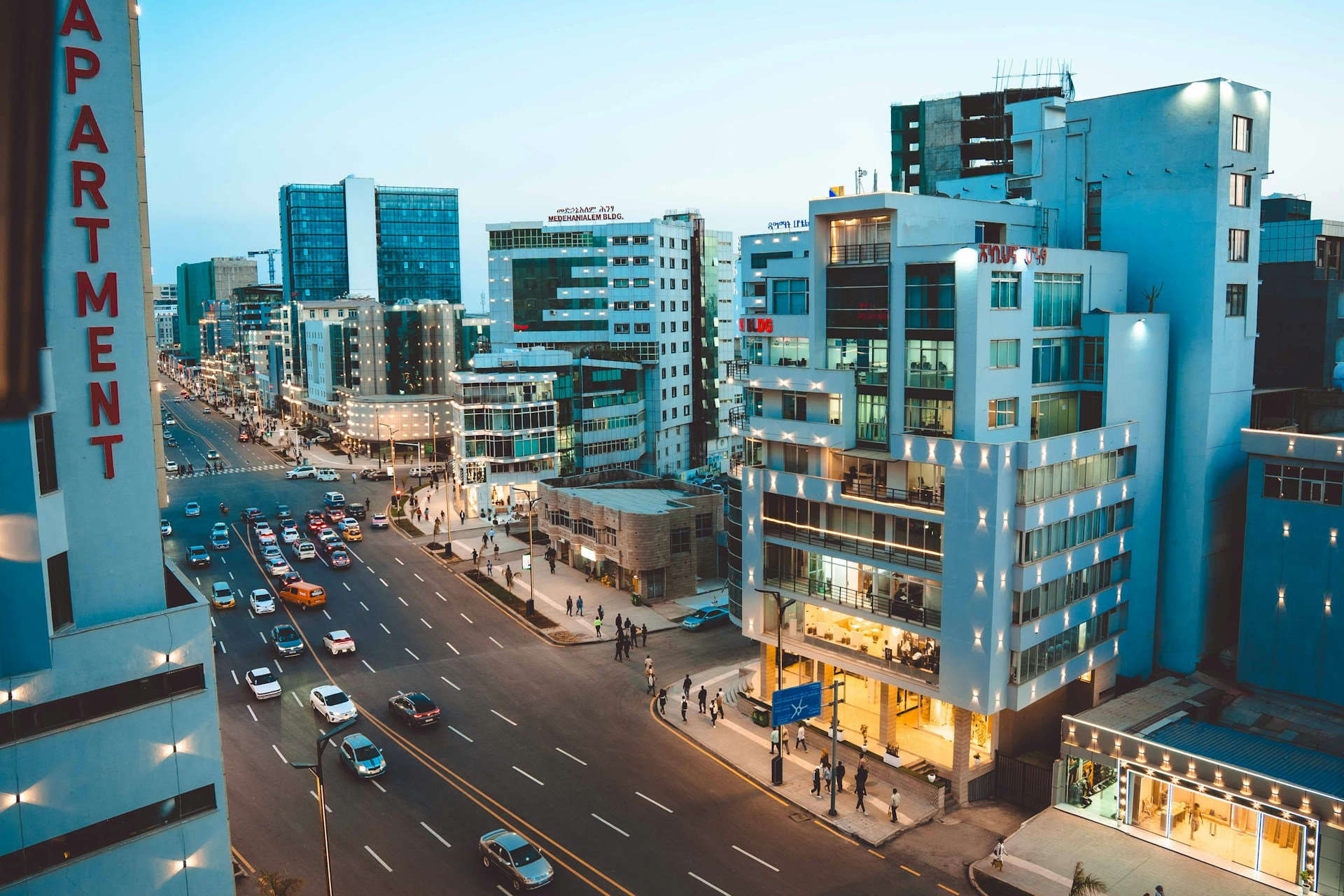
Photo by Bemnet Mesfin on Unsplash On a recent Ethiopian Airlines flight home from Vienna, I gave up on trying to find a film to watch. More than I am used to, there were dozens of interruptions to surface promotional reels about industrial parks, special economic zones, and the opportunities awaiting foreign investors in Ethiopia. That was jarring, because just hours earlier I walked through the Wien Museum’s rooms on Red Vienna, the city government that, in the inter-war years, built public housing (paying for it by taxing luxury) and pursued initiatives that would echo decades later, like distributing opera tickets to workers. The disjunct was the feeling that one city saw its key stakeholders as citizens, and the other—though to be honest, in-flight state advertising isn’t the fairest measure—saw its key stakeholders as foreign investors.
For two decades, Ethiopia was the continent’s most celebrated developmental state, led by a ruling party that planned, built dams and industrial parks, and kept banks and telecoms in public hands against the IMF’s advice. In 2024, it floated the birr under a Fund program and began selling shares in Ethio Telecom; a stock exchange opened the following year. The planners are still there, but evidently what they plan is increasingly an offer to investors. And as fighting returns to Tigray, with Addis Ababa accusing Asmara of backing a new armed alliance, the state’s capacity to decide is once again being exercised mainly in uniform. Ethiopia’s ongoing turn looks dramatic, but the habit is common. It is often said that the continent’s governing elites lack imagination, but I think the opposite is closer to the truth. Many of them are extremely imaginative, but on behalf of capital, without any capacity to imagine the state as an instrument of collective transformation, one that employs people, directs credit, plans industrialization, disciplines investors and shields households from shocks instead of passing them on. Yesterday supplied another illustration, as Nigeria marked sixty-six years of independence. In an address to the nation, Bola Tinubu told the country that “the emergency treatment is over” and that Nigeria had “passed through our own Red Sea,” citing growth above 4 percent, falling inflation and rebuilt reserves. But this morning, public-sector unions organized under the Joint National Public Service Negotiating Council began a three-day warning strike. Their demands were concrete: a wage award, negotiations on a new minimum wage to replace the ₦70,000 monthly floor that inflation has hollowed out (about $53), and petrol at ₦500 a liter (38 cents). Motorists are currently paying between ₦1,400 and ₦2,000 ($1.05 to $1.50) per liter, depending on where they live, after a year in which the Iran war and the closure of the Strait of Hormuz pushed Brent crude past $118 a barrel. Some of Tinubu’s numbers are probably accurate. But macroeconomic recovery and social recovery are different events, relevant to different people. Governments declare recovery when a currency stops falling, or a deficit narrows, but as far as ordinary households are concerned, the question is whether this means they can get to work (and that there is work available in the first place), buy food, pay school fees and keep the lights on without sliding into debt. Tinubu more or less conceded the gap, attributing Nigerians’ struggle to “decades of low productivity.” Hardship is always someone else’s fault. There is a further twist. The petrol price the strikers want cut is not, in any simple sense, set by the market. Most of Nigeria’s petrol now comes from a single private refinery at Lekki, owned by Aliko Dangote, the continent’s loudest prophet of industrialization. As Ayoola Babalola showed on this site last month, the refinery stands on a scaffolding of state decisions: tariff protection, restricted import licenses, a crude-for-naira supply arrangement, free-trade-zone status that loosens labor oversight. A World Bank report finding that Nigerians were paying roughly 12 percent above import parity vanished within 48 hours. When Iran closed Hormuz in February, South Africa, Ghana and Kenya went to Lekki to negotiate emergency supplies. The most consequential act of industrial policy in West Africa in a generation was carried out by the state, on behalf of one man. What makes this puzzling is the timing. African fiscal orthodoxy was forged in the 1990s, when there really was one acceptable set of policies. That world no longer exists in the same form. The US-centred order is less coherent than at any point in decades, with the most obvious example being that Washington itself now slaps tariffs on its allies, while Europe is also turning protectionist. China, slowing and wholly self-interested, remains a source of finance that does not arrive with a structural adjustment program attached, and mineral politics hands some states more leverage than they have had since the 1970s. To be sure, none of this amounts to freedom. But it does make the claim that there is only one viable path far harder to sustain than it was in 1995. Why, then, do so many governments still behave as if their first duty is to reassure creditors, ratings agencies and portfolio investors? The easy answers, cowardice or corruption, misread the situation. Structural adjustment did not abolish the African state so much as retool it as an instrument for capital. Finance ministries became custodians of creditor confidence, central banks acquired something close to a political theology of inflation, development was redefined as an “enabling environment” for private investment, while “good governance” supplanted political economy as the grammar of development. Seen this way, fiscal orthodoxy is less an economic doctrine than a language, and fluency in it marks a kind of class belonging. It is how a minister signals seriousness to the IMF, bondholders, domestic banks and the professional elite who read the Financial Times. The rewards for speaking it are immediate and often personal: market access, a debt rollover, a flattering profile, a seat on the panel at the next investor summit. The costs are deferred and dispersed. They land in household budgets, in clinics without medicine, in the hours women spend absorbing shocks the state has declined to absorb. South Africa shows how complete this depoliticization can become. Last November, the country’s Finance Minister Enoch Godongwana announced that the inflation target would be lowered to 3 percent. The decision has generational consequences in a country where roughly a third of the workforce is unemployed, but there is an audience for it and a respectable case in favor of it. What was striking was how few people made the case against. As the political analyst Stephen Grootes noted in the Daily Maverick at the time, the South African Communist Party’s overnight “initial response” to the budget statement did not mention the target at all. uMkhonto weSizwe was likewise silent, and inside the ANC there was no visible argument. A political choice about whose interests monetary policy serves was presented, and received, as simple housekeeping. Since then, I have been thinking about the question our West African regional editor, Sa’eed Husaini, asked in our first print edition last year: why neoliberalism has proved so durable in multiparty democracies like Ghana, Nigeria, Kenya and South Africa, when it has been challenged elsewhere, most visibly by Latin America. Borrowing Thandika Mkandawire’s phrase, he described “choice-less democracies,” where rival parties agree on almost everything that matters. His answer was not that African publics are passive. What has been missing, despite no shortage of strikes, fuel protests, and Gen Z uprisings, is the connective tissue that turned comparable energy into the pink tide: union federations that came through adjustment intact, movements with institutions that outlast each wave of protest, political education, and electoral vehicles not built around one charismatic man. Crisis alone, as Husaini put it, is not enough. I would add a corollary. Where no democratic coalition exists to make orthodoxy costly, governing elites pay no price for keeping it and run considerable risk by abandoning it. Bondholders can punish a finance minister whereas a fragmented protest movement cannot. The absence of organized counter-pressure is what makes orthodoxy feel as foregone as it does. Ken Opalo has made a sharp version of a related argument, one I’ve probably referenced too much in these pages already (a testament to its clarity). Much African policymaking, he writes, has settled into “low-ambition/muddling-through developmentalism,” in which reform becomes an end in itself and nobody asks where it is meant to lead. China’s real lesson, in his reading, is the deliberate pursuit of structural change. I agree, and would push one step further. Even where ambition appears, it tends to take the shape of what can be financed: a securitized revenue stream, a privatization, a refinery. Opalo sees promise in Kenya’s efforts to crowd in private capital and in Dangote’s refinery, and there is a serious case for both. The question I would add is who controls such projects, who carries the risk, and who captures the return.
Which brings me to Ibrahim Traoré, who has always been in the news after Burkina Faso opened its first gold refinery, and in doing so, he declared that, “Our ambition is no longer simply to be a country that extracts all its minerals and ships them abroad. We want to refine our own metals here.” Hearing that, it should be clear why his appeal, especially among young Africans, cannot be explained away as Russian disinformation, AI-generated tribute videos, or the romance of fatigues. What Traoré makes visible is something elected governments across the continent have spent three decades obscuring, which is that the state can, in fact, choose. Citizens elsewhere are told that the budget is set by creditors, inflation by an independent central bank, the currency by markets, and jobs by investor sentiment. The state becomes an interpreter of necessity, explaining why it cannot act. The necessity is partly a fiction. Elected governments are perfectly capable of choosing; Nigeria’s chose a refinery and the man who owns it, and arranged tariffs, crude and regulators around him. What they have lost is the habit of choosing in public, for the public, and saying so. Traoré stages the reverse. He expelled French troops, moved gold mines into a state company, has built a refinery, names external domination as a political problem and goes looking for other partners. That does not make the project emancipatory. Political parties were dissolved in January. Journalists critical of the junta have been forcibly conscripted. In April, Traoré told Burkinabè to “forget about democracy.” More than two million people remain displaced by a war the regime has not won. Swapping French tutelage for Russian security contractors is a change of patron, not an exit from patronage. As one youth leader told Al Jazeera in August, pride does not feed a family nor does it protect a village. But criticism that stops there misses what is being expressed. People are not necessarily drawn to strongmen because they have acquired a taste for the barracks. The longing underneath is for a state capable of deciding, and if the only people who seem willing to decide are men in uniform, that is arguably a greater indictment of the continent’s “democrats” than it is of its strongmen.
The task for all progressives, then, is to give the desire for sovereignty a different content, neither scolding it nor flattering it. That means public institutions able to plan and finish long-term projects, which requires rebuilding what structural adjustment hollowed out. It means coalitions that join public-sector workers, like those on strike in Nigeria today, to informal traders, small farmers, unemployed young people and the women whose unpaid labor is the continent’s real social safety net. It means public control over what makes sovereignty tangible, things like power, transport, housing, food and credit. And it means institutions durable enough to carry popular demands past the next election and to hold the state itself to account. This is slower than a rally and harder than a coup. It is also the only version of sovereignty that does not ask people to surrender democracy as the price of a state that acts. The choice-less democracies have taught a generation that voting changes little. The men in uniform are now teaching them that decisive government requires obedience. Neither lesson has to be the last one. – William Shoki, editor |