When the peacemaker clocks out
Kenya’s shift toward trade-led diplomacy underscores the difficulty of sustaining regional leadership under conditions of fiscal dependence.
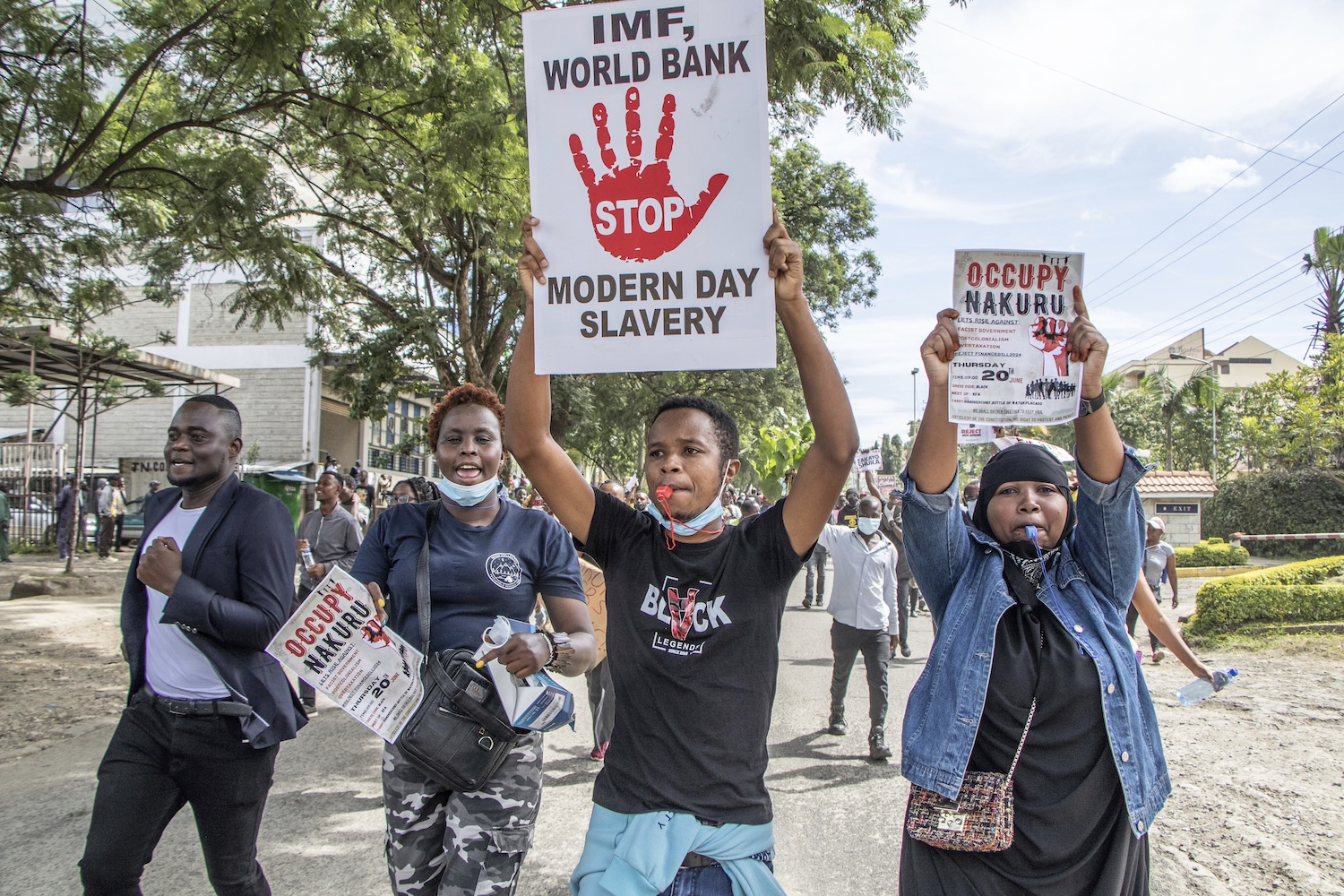
Protestors in Nakuru Central Business District, 2024. Photo © James Wakibia / SOPA Images/Sipa USA via AP Images.
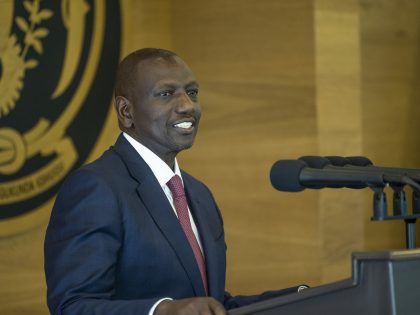
At the 19th Ambassadors’ Conference in Nairobi last month, President William Ruto told Kenya’s diplomats what they are now for. Their missions abroad must function as "frontline engines" for trade expansion and investment attraction. Embassies will be evaluated on measurable economic outcomes. The language of regional stability and pan-African solidarity was present, but ornamental, a mere paragraph after the main argument. Kenya, Ruto was saying, can no longer afford to be the Horn of Africa’s conscience. It has bills to pay.
This was not a surprise to anyone who has been following Kenya’s domestic political landscape.
As of May 2025, Kenya’s debt service to revenue ratio stood at 67.1%, which stands at 37.1 percentage points above the IMF’s recommended threshold of 30% and second-highest among major African economies, behind only Nigeria, nearly four times the rate of neighboring Uganda. For every three shillings Kenya collects, two go to creditors before a single teacher is paid, a single road is built, or a single diplomat is deployed to calm a neighboring war. This is a structural condition that makes the performance of regional leadership not just expensive but also impossible under foreign debt.
Ruto arrived at the presidency in 2022 with genuine regional ambitions. He chaired the Intergovernmental Authority on Development (IGAD) Quartet mediating Sudan’s civil war. He launched the Tumaini Initiative in South Sudan. He deployed Kenyan troops to eastern DRC and positioned Nairobi as an alternative peacemaker in the Horn of Africa, which some analysts read as an attempt to fill the vacuum left by Ethiopia’s internal collapse, In May 2024, at his peak, he was at the White House as the first Kenyan head of state to receive a full state visit in 16 years, designated a major non-NATO ally, and celebrated as Africa’s indispensable partner.
Six weeks later, his parliament was on fire.
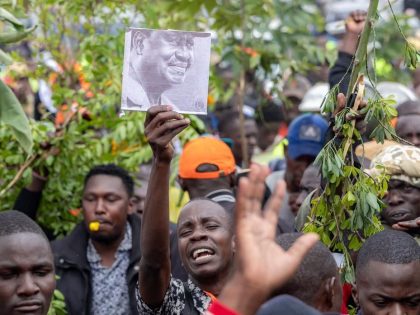
The finance bill that triggered the Gen-Z protests was not a policy error. It was a debt repayment instrument. The IMF publicly endorsed it as “an important step in correcting course,” the course being Kenya’s obligations under its Extended Credit Facility. When protesters held signs reading “IMF, World Bank Stop the Modern Day Slavery” outside a burning parliament, they were identifying the bill’s true authors more accurately than most diplomatic analysis managed. Independent human rights organizations estimated that in the crackdown there were between 60 and 65 deaths, with more than 1,200 arrests and more than 60 documented enforced disappearances. Two years on, the bill is withdrawn, and Kenya has drawn the logical conclusion: a state that cannot make autonomous fiscal decisions cannot credibly perform autonomous foreign policy. The state’s violence against its own citizens, and the IMF conditionality that provoked it, destroyed Kenya’s credibility as a neutral broker in precisely the moment the Horn needed one most. Sudan’s armed forces had already rejected Ruto’s leadership of the Intergovernmental Authority on Development (IGAD) Quartet, accusing him of commercial ties with the RSF. Kenya’s credibility as a mediator in the Sudanese conflict further deteriorated when, in February 2025, Kenya hosted an RSF-aligned political roadmap, leading analysts to describe Ruto as a “war enabler.”
It would be naive and colonial to name this as a failure of Kenya’s rather than the economic system it is hostage to. The African Union has committed to financing 25% of its own peace operations. The remaining 75% comes from Brussels, Washington, and Beijing. The Intergovernmental Authority on Development, the body through which Kenya was supposed to be mediating Sudan, runs its peace and security division on EU Trust Funds. The AU Mission to Somalia received €1.94 billion from the European Union between 2007 and 2019; when Brussels threatened to reduce contributions, AU officials were unprepared, and the mission remained donor-dependent. The EU has now replaced the African Peace Facility with the European Peace Facility, a restructuring that explicitly allows Brussels to bypass the AU’s own PSC mandate and fund African military operations directly when it judges this as more strategically convenient. The architecture of African peace and security, from the individual indebted state to the regional body to the continental organization, is structurally dependent on external money that comes with conditions, directions, and the ability to be withdrawn.
To ask why Kenya could not be a neutral broker in Sudan is to ask the wrong question. Neutrality is a luxury unavailable to states whose fiscal choices are made in a foreign capital. The more honest question is: what would genuine African diplomatic sovereignty actually require? An African peace architecture that does not depend on the European Peace Facility for 75% of its funding, and African states that do not spend two-thirds of their revenue servicing loans before they can afford to send an envoy.
The AU’s first Debt Conference, held in Lomé in May 2025, gestured toward this by proposing a Pan-African Credit Rating Agency and reforms to enforce creditor participation in debt restructuring. It is a beginning. Whether those proposals survive contact with the IMF’s next review cycle is the real question, and the answer will determine whether the Horn has any prospect of being stabilised by Africans rather than managed by the conditions attached to the money that pays for the management.
Kenya’s pivot to economic diplomacy at last month’s Ambassadors' Conference was not cynical. It reflects the colonial economic system that, like Kenya, holds so many African nations hostage to debt repayment. It is a luxury to be neutral. It is a luxury to have an independent foreign policy.