The empire strikes Iran
The US-Israeli war on Iran is the latest expression of a long imperial pattern — one shaped by opportunistic intervention, Western alignment, and the enduring racialized logic of empire.
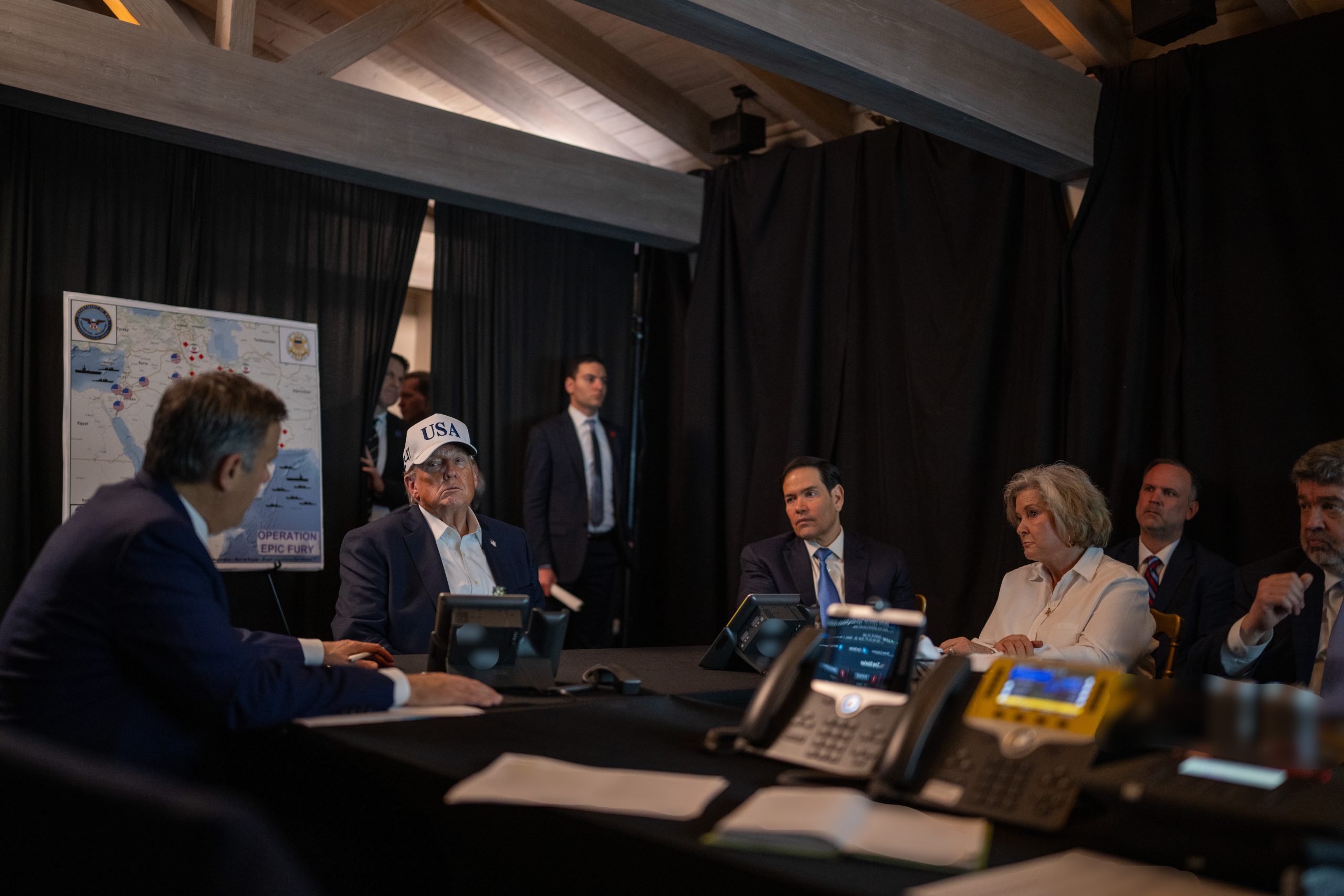
President Donald J. Trump oversees Operation Epic Fury at Mar-a-Lago in Palm Beach, Florida, February 28,
The United States and Israeli assault on Iran is not an isolated eruption but the latest expression of a long imperial pattern in which Western power is asserted through opportunistic war, racialized hierarchies, and the selective language of security. The conflict exposes the fragility of regional states, the limits of American strategy, and the enduring civilizational assumptions that shape Western responses to non‑Western autonomy. By tracing the war’s timing, its geopolitical alignments, and its deeper ideological roots, this essay argues that the current confrontation is best understood not as a break with history but as a revealing continuation of the logic of empire.
The outbreak of the joint United States and Israel attack on Iran was both predictable and premeditated, despite weeks of diplomatic theater that masked an already set course. No coherent or compelling justification has been offered for why the assault had to occur at this moment. The timing instead suggests a calculated decision to strike at a moment of perceived Iranian vulnerability rather than any urgent strategic necessity. This is a war of choice, an act of imperial aggression in a long lineage of US militarism. The absence of a triggering event, coupled with the speed with which the operation was launched, reinforces the impression that the decision was driven by opportunity rather than necessity.
Altogether, while the United States has issued only eleven formal declarations of war since 1776, it has engaged in more than four hundred military interventions. This staggering disparity underscores a pattern: the country’s most consequential conflicts rarely pass through constitutional channels but emerge from executive prerogative, shifting geopolitical anxieties, and the entrenched interests of its security establishment. The attack on Iran fits squarely within this tradition. It also reflects a broader post-Cold War pattern in which the United States initiates major uses of force without congressional authorization, international consensus, or clear strategic objectives, relying instead on claims of imminent danger or humanitarian urgency that dissolve under scrutiny.
Recent diplomatic behavior among Western allies further illustrates this dynamic. In the days preceding the attack, several European governments signaled unease in private while publicly affirming support for Washington, a pattern consistent with their voting behavior in the United Nations General Assembly, where they routinely align with the United States and Israel on Middle East resolutions even when expressing reservations behind closed doors. This disjunction between public alignment and private doubt reveals how constrained Western governments remain when responding to US military initiatives.
The international response to the new war against Iran follows a familiar pattern. Western governments have quickly fallen into line, abandoning their recent claims of strategic divergence from Washington, including Canadian Prime Minister Mark Carney’s Davos warning about a rupturing global order. Most European leaders now offer unqualified support for the attack, eager to reaffirm transatlantic unity and to blunt criticism of their muted responses to Israel’s actions in Gaza. This rapid alignment mirrors their voting behavior in the United Nations General Assembly, where European states routinely join the United States and Israel in opposing resolutions critical of Israeli military actions, even when their own diplomats privately express concern. The consistency of this pattern points to deeper habits of deference rather than any genuine convergence of principle.
This reflex is rooted in a long political inheritance. The ideologies of Europe’s former colonial powers and their settler offshoots were shaped by centuries of conquest, racial hierarchy, and civilizational entitlement. These legacies continue to structure which states are cast as threats, which are granted empathy, and which are treated as expendable. As a result, intra-Western disagreements over trade, leadership, or institutional norms tend to recede when confronting a non-Western state that asserts strategic autonomy. The speed with which European and Canadian governments endorsed the attack, despite their recent disputes with Washington over tariffs, digital regulation, and climate policy, underscores how deeply these older hierarchies continue to shape contemporary alignments.
The alignment is less a matter of immediate strategic calculation than of a shared geopolitical instinct, one that privileges Euro-Atlantic cohesion and reproduces older hierarchies in the language of security, stability, and global responsibility. The racialized civilizational lens that once justified colonial domination continues to shape contemporary judgments about sovereignty, legitimacy, and the permissible use of force. This is evident in the asymmetry of Western responses: Iran’s actions are framed as existential threats requiring military punishment, while comparable or greater violations by allied states are treated as unfortunate but manageable. The double standard is not accidental but embedded in a worldview that ranks states according to their perceived civilizational proximity to the West.
These dynamics matter for understanding the war in Iran. The attack is not simply a bilateral confrontation but an expression of a deeper Western consensus about which states may be coerced, disciplined, or destroyed with minimal political cost. The racialized logic that underpins this consensus helps explain why Iran receives little sympathy even from Western governments that disagree with the Trump administration on other issues.
Opinions in the United States are congealing along familiar partisan lines, with Democrats and Republicans split between opposition and support, and independents scattered between the two. Among self‑styled dispassionate pundits and foreign policy analysts, the central critique is the absence of clear objectives or a coherent strategic rationale. This narrowing of debate to questions of strategy rather than legitimacy reflects a broader US pattern: wars are contested not for their moral basis but for their likelihood of success. The debate, therefore, turns on feasibility rather than principle, revealing how deeply normalized the resort to force has become in United States political culture.
It is not unusual, in moments of foreign attack on authoritarian states, for domestic populations and diasporas to divide among those who welcome intervention, those who oppose it, and those who are both anti‑authoritarian and anti‑war. Iran has been a dictatorship for decades, first under the Shah and then under the Islamic Republic. The 1979 Revolution culminated long struggles against a US-backed monarchy, and the Islamic Republic has since been rocked by mass protests, including those of 2009, 2017 to 2018, 2019 to 2020, 2022 to 2023, and 2025 to 2026. These uprisings have simultaneously weakened the regime’s legitimacy and hardened its repressive instincts, creating a volatile mix of fragility and resilience. The state’s capacity to suppress dissent has grown even as its social base has eroded, producing a brittle equilibrium that outside powers may misread as terminal weakness.
The US-Israeli assault appears timed to exploit this moment of internal strain. Moreover, Iran’s network of regional proxies, the so-called Axis of Resistance, from Hezbollah in Lebanon to Hamas and Palestinian Islamic Jihad in Gaza, has been gravely weakened by Israel since the outbreak of the Gaza war in October 2023. The convergence of domestic unrest and diminished regional leverage created what Washington and Tel Aviv likely viewed as an opportune window to strike. The pattern mirrors earlier interventions in which the United States acted when adversaries appeared internally divided or regionally isolated, reinforcing the perception that Washington prefers to fight opponents at their weakest rather than negotiate with them at their strongest.
The irony is that the United States’ closest Arab partners are themselves authoritarian regimes. Regime change for democracy has never been, and is not now, a motivating principle of United States policy. Indeed, Iran retains limited electoral and social freedoms absent in the extraordinarily wealthy monarchies of the Gulf. Most of these states are heavily populated by disenfranchised immigrants and foreign nationals, who constitute over 35 percent of the population in Saudi Arabia, about 40 percent in Oman, over 50 percent in Bahrain, nearly 74 percent in Kuwait, and more than 85 percent in Qatar and the United Arab Emirates. The contrast underscores that Washington’s concern is not authoritarianism itself but Iran’s refusal to accept United States regional primacy. This selective indignation is evident in the muted US response to human rights abuses in allied states, where strategic alignment consistently outweighs democratic principles.
Iran’s geopolitical sin, in the eyes of the United States, Israel, and their Gulf allies, lies in its resistance to US hegemony since 1979. The United States and its Western partners have a long history of manufacturing casus belli. During the Cold War, governments accused of communism were overthrown. During the War on Terror, Islamic militancy became the new justification. The fate of Muammar Gaddafi in Libya is a cautionary example. Despite giving up his nuclear program and attempting rapprochement with the West, his long record as a champion of anti-Western solidarity in Africa and the Middle East made him expendable once intervention became politically convenient. His concessions did not save him from being overthrown. For Iran’s leaders, the Libyan precedent is not an abstraction but a strategic warning: accommodation does not guarantee survival, and disarmament may invite rather than deter attack. The pattern is consistent: ideological pretexts shift, but the underlying logic of intervention endures.
These dynamics illuminate why the current war is unfolding as it is. The timing, the targets, and the rhetoric all reflect a broader US and Israeli belief that Iran’s moment of internal fragility offers a rare opportunity to reshape the regional order. Whether this calculation proves accurate is another matter entirely.
The pattern of US interventionism
Afghanistan was invaded on October 7, 2001, ostensibly for its refusal to extradite Osama bin Laden, dismantle terrorist infrastructure, punish state sponsors, and address humanitarian concerns. The Iraq War, launched on March 20, 2003, was justified through allegations of weapons of mass destruction, links to al Qaeda, violations of United Nations resolutions, and the promise of democratization under the Bush Doctrine. Both wars were presented as necessary, moral, and strategically indispensable, yet both quickly revealed the fragility of their premises. The speed with which the rationales collapsed, and the absence of accountability for those who advanced them, reinforced a broader pattern in which US leaders face few political costs for initiating catastrophic wars.
The combined toll was calamitous. The fighting by the United States and its NATO allies, and the civil wars that followed, caused an estimated 4.5 million direct and indirect deaths, cost the United States $8 trillion, and produced two lost decades of development for Afghanistan and Iraq. The only clear beneficiary was the United States military industrial complex, which expanded its reach, budget, and political influence even as the wars themselves unraveled. The revolving door between defense contractors, think tanks, and government agencies ensured that the architects of failure continued to shape policy, often advocating new interventions to remedy the consequences of earlier ones.
Under the rhetoric of the America First movement, President Trump campaigned against these forever wars, criticizing the Iraq invasion, agreeing to the withdrawal from Afghanistan, and promoting a doctrine of peace through strength, in which overwhelming military power was meant to deter conflict rather than wage it. Yet the current war in Iran demonstrates how easily the United States can revert to its interventionist reflexes, even under leaders who claim to reject the excesses of the post 9/11 era.
Despite two decades of investment, the United States lost in Afghanistan, and the Taliban returned to power in August 2021. In Iraq, the mission of regime change devolved into a long insurgency and a failed attempt to build a stable democracy. The pattern is not new. The United States was also defeated in Vietnam from 1955 to 1975, and the Korean War from 1950 to 1953 ended in a stalemate that persists with the peninsula’s division. These outcomes reveal a recurring truth: overwhelming military power does not guarantee political success, especially in conflicts shaped by nationalism, occupation, and asymmetrical resistance. The United States repeatedly discovers that the capacity to destroy regimes does not translate into the ability to build legitimate political orders.
While the United States has prevailed in smaller interventions such as Grenada in 1983, Panama from 1989 to 1990, and Kosovo in 1999, its record in major wars in the global South is marked by failure. These defeats have occurred under both Democratic and Republican administrations. Yet each new president seems to inherit, and then reproduce, a syndrome of US hubris: the belief that military might ensures victory, that technological superiority can substitute for political legitimacy, and that adversaries lack the will to resist. Imperial powers consistently overestimate their hard power and underestimate the motivations of those defending their homelands. This miscalculation is not incidental but structural, rooted in a worldview that treats non-Western societies as lacking political agency or strategic coherence.
The legacies of these wars are devastating. The US intervention in Libya, another authoritarian state, left a trail of havoc across the Sahel that continues to destabilize the region. President Obama later acknowledged that the intervention was the worst foreign policy decision of his presidency, a recognition that underscored how deeply the operation had backfired despite its initial framing as a humanitarian mission. The collapse of the Libyan state unleashed weapons flows, militia networks, and regional conflicts that continue to reverberate across West Africa, illustrating how US interventionism often generates instability far beyond their immediate theaters.
The lesson is consistent across cases: United States interventions often produce political fragmentation, humanitarian crises, and long-term regional instability, even when presented as efforts to protect civilians or spread democracy. The pattern of overreach, miscalculation, and unintended consequences forms the backdrop against which the current US-Israeli war in Iran must be understood. The historical record suggests that the war will not achieve its stated aims, that its costs will be borne disproportionately by civilians, and that its long term consequences will likely undermine rather than strengthen regional stability.
There may be a lesson in this for the current US-Israeli war in Iran. Nobody can predict with certainty how events will unfold in the coming days, weeks, or months. But it is not difficult to see that the region may become even more combustible and unstable. Iran is a large and proud country of 92 million people. At best, a chastened regime may seek to recalibrate and regain legitimacy by relaxing its internal repression and reducing its regional belligerence. At worst, if the regime collapses, the country could descend into civil war. The killing of Ayatollah Khamenei on the first day of the strikes has already created a succession vacuum, and a post Khamenei landscape may convince some regimes in the region and the wider global South that their long term security lies not in accommodation but in nuclear deterrence, a path previously taken outside the Western great powers and China by India, Pakistan, North Korea, and within the region by Israel. The spectacle of a state being attacked despite decades of sanctions, inspections, and diplomatic engagement may reinforce the belief that only nuclear weapons can guarantee sovereignty in a world where Western military intervention remains a recurring possibility. Either outcome would reshape the regional balance of power and deepen the volatility that has defined the Middle East for decades.
West Asia on the brink
For the region, a rubicon has been crossed. Iran has drawn neighboring states into its confrontation with the United States and Israel. These countries may feel compelled to strengthen their alliances with the two powers. Alternatively, the widening conflict may force them to reconsider the costs of alignment with a regional order increasingly defined by coercion, instability, and the ambitions of external powers. The muted reactions of several Arab governments, many of which privately urged Washington not to escalate, reveal the constraints they face: dependence on US security guarantees, fear of Iranian retaliation, and domestic publics that overwhelmingly oppose another Western-led war in the region. The war exposes the fragility of a system in which regional states rely on distant patrons for security while navigating the pressures of domestic legitimacy and geopolitical rivalry.
The Gulf states may be wealthy, but they suffer from structural constraints rooted in authoritarian governance and demographic imbalance. Dictatorships tend to be brittle because their legitimacy is limited. This fragility is compounded by the fact that citizens constitute a small minority of the population in most of these countries, which prevents the construction of inclusive political communities capable of mobilizing broad-based national defense. The reliance on foreign labor and the exclusion of large segments of the population from political life create vulnerabilities that no amount of wealth can fully offset. The war has already prompted quiet discussions in several Gulf capitals about the sustainability of their current security architecture, especially if the United States proves unable or unwilling to manage the long term consequences of its own intervention.
These dynamics help explain the appeal of their current alliances with the United States and their growing accommodation with Israel. But the price of these alignments, especially in the face of an antagonized Iran, is deeper US and Israeli tutelage. Such dependence is unlikely to be sustainable in the long term, as the geostrategic costs of subservience may become unacceptable to more nationalistic factions within the political class and the citizenry. The war may therefore accelerate internal debates within Gulf states about sovereignty, security, and the limits of external protection. The possibility that Iran’s collapse could unleash regional chaos only heightens these anxieties, raising questions about whether the Gulf states are prepared for the unintended consequences of the very alliances they rely upon. It is likely that the war will shatter the Gulf states’ reputation as safe, stable hubs, undermining the economic and security model on which their prosperity and diplomatic leverage have long depended.
Whatever happens, the Middle East has long been one of the most combustible regions in the world, and it is likely to remain so after the United States withdraws its forces, after President Trump declares victory, and after his administration and its successors turn to another military adventure justified by the pretexts of the moment. The pattern is familiar: intervention, escalation, withdrawal, and renewed instability. In each cycle, the people of the region bear the highest costs, while the intervening powers claim short-term gains that rarely endure. The war in Iran is unlikely to break this cycle; it is far more likely to deepen it, reinforcing the very dynamics of militarism, insecurity, and geopolitical hierarchy that made the conflict possible in the first place. The societies caught in this vortex will be the ultimate losers.
The US-Israeli war in Iran is part of a much larger historical pattern. Over the years, there have been skirmishes between the two countries, including assassinations of Iranian leaders and scientists and proxy conflicts in Lebanon, Yemen, and other parts of the region. The dress rehearsal for the current confrontation was the twelve-day war from June 13 to June 24, 2025, after which both sides regrouped. The present conflict is therefore not an aberration but the latest episode in a long cycle of confrontation shaped by deeper ideological and civilizational assumptions. The speed with which Western governments endorsed the new war, despite their stated desire for strategic autonomy, reveals how enduring these assumptions remain.
Why have the powers of the North Atlantic supported the United States and Israel, some more loudly than others, yet virtually none have expressed sympathy for Iran despite their misgivings with the Trump administration over tariffs, Greenland, NATO, and the rhetoric of democracy and inclusion? The answer lies partly in the enduring racial and civilizational hierarchies that structure Western political imagination. These hierarchies help explain why Iran’s appeals to international law, sovereignty, or proportionality receive little traction in Western capitals, while similar claims by allied states are treated as legitimate concerns.
The problem of the twenty-first century
The great Black American public intellectual, civil rights leader, and Pan-Africanist W. E. B. Du Bois, whose magisterial biography by David Levering Lewis I have been listening to on Audible, offers a compelling lens. In his 1903 masterpiece The Souls of Black Folk, he wrote that “the problem of the twentieth century is the problem of the color line, the question as to how far differences of race . . . will hereafter be made the basis of denying to over half the world the right of sharing to their utmost ability the opportunities and privileges of modern civilization.” Du Bois’s insight remains disturbingly relevant, for the structures of racial hierarchy that shaped the twentieth century did not disappear with decolonization, the most consequential political event of that period. They were instead reconfigured into new vocabularies of security, civilization, and global responsibility that continue to shape Western foreign policy.
More than a century later, United States Secretary of State Marco Rubio echoed this logic in his keynote speech at the Munich Security Conference on February 14, 2026, where he romanticized Western colonial empires, lamented decolonization, rejected colonial guilt, and warned that migration threatened the integrity of Western civilization. He called for a revitalized Western century grounded in a shared civilizational inheritance and renewed Western dominance of the global economy. His remarks revealed how deeply the civilizational worldview that Du Bois critiqued continues to animate Western strategic thinking, how its fictions obscure the violent history of intra‑European conflicts, two of which engulfed the world in the first half of the 20th century, and how anxieties about demographic change and the rise of non‑Western powers shape contemporary geopolitical alignments. Rubio’s speech was not an outlier but part of a broader Western discourse that casts non-Western assertiveness as destabilizing, thereby legitimizing coercive responses such as the current war in Iran.
To update Du Bois, one could say that the problem of the twenty-first century is the problem of the demographic line, the question of how far the global majority will be permitted to enjoy the benefits and opportunities of an integrated world. The demographic line is not merely a matter of population but of political agency: who is allowed to shape global norms, who is expected to obey them, and who is punished for transgressing them. This rhetoric signals a broader anxiety about the shifting balance of global power and the rise of non-Western states that refuse to accept subordinate status. Iran’s insistence on strategic autonomy, like that of China, India, Brazil, and South Africa in other arenas, is interpreted not as a normal expression of sovereignty but as a civilizational challenge to Western authority.
Another enduring insight of Du Bois and other Black American scholar activists is that the treatment of racial minorities within the United States mirrors the way the country views the lands of their origins. Stripped of the abstractions of international relations theories such as realism, liberalism, constructivism, Marxism, and critical theory, foreign policy is fundamentally a projection of domestic politics and interests, often captured by the term intermestics, which emphasizes that the line between the two is virtually nonexistent. The same racialized logics that shape domestic hierarchies also inform judgments about which nations deserve sovereignty, sympathy, or punishment, and which can be subjected to coercion or war with little moral hesitation. The ease with which Iran is cast as irrational, fanatical, or inherently dangerous echoes the tropes historically used to justify the subordination of racialized populations within the United States.
Race functions as a kind of cosmic force in the civilizational imagination of the West, simultaneously moral, metaphysical, and epistemic. It rises, retreats, and reshapes relationships within and between racialized populations, offering, as one of my intellectual interlocutors, Ben Vinson, a renowned historian of Afro-Latin America, put it, “a clearer sense of the past, a fuller understanding of the present, and a barometer for the future.” This is why an aspiring authoritarian administration that deploys troops to Democratic-led cities, seeks to curtail civil rights, dismantles diversity and inclusion programs, restricts voting rights, weakens fair housing protections, challenges birthright citizenship, and undermines the civil rights infrastructure cannot be expected to defend the rights or interests of people of color in the global South. A government that treats its own marginalized populations as threats is unlikely to view non-Western nations as partners deserving of dignity or restraint.
The tragedy is that many leaders in the global South fail to grasp this elemental truth. Many compete for degrees of supplication to the aspiring autocrat in Washington, underscoring the fact that the global South is more a geographical designation than a unified geopolitical force, and that its fragmentation has long been exploited by the great powers. Reports indicate that many of the eight Arab countries that participated in the inaugural meeting of President Trump’s Board of Peace for the reconstruction of Gaza on February 19, 2026, appealed to him not to attack Iran. They were ignored and now face a conflagration they have always feared. Their inability to act collectively and their willingness to prioritize bilateral favors over regional solidarity have left them exposed to the very hierarchies Du Bois warned about.
They need to recall why decolonization happened in the first place and fight for a form of decolonization befitting this historical moment, lest they be remembered as collaborators in their peoples’ subjugation by future generations. The war in Iran is not only a geopolitical crisis but a civilizational reckoning, revealing how deeply the color line continues to shape the distribution of empathy, legitimacy, and violence in the international system.