The roots of our storytelling
What happens when we stop reading African fiction through European literary history and instead trace its worldmaking through indigenous cosmology?
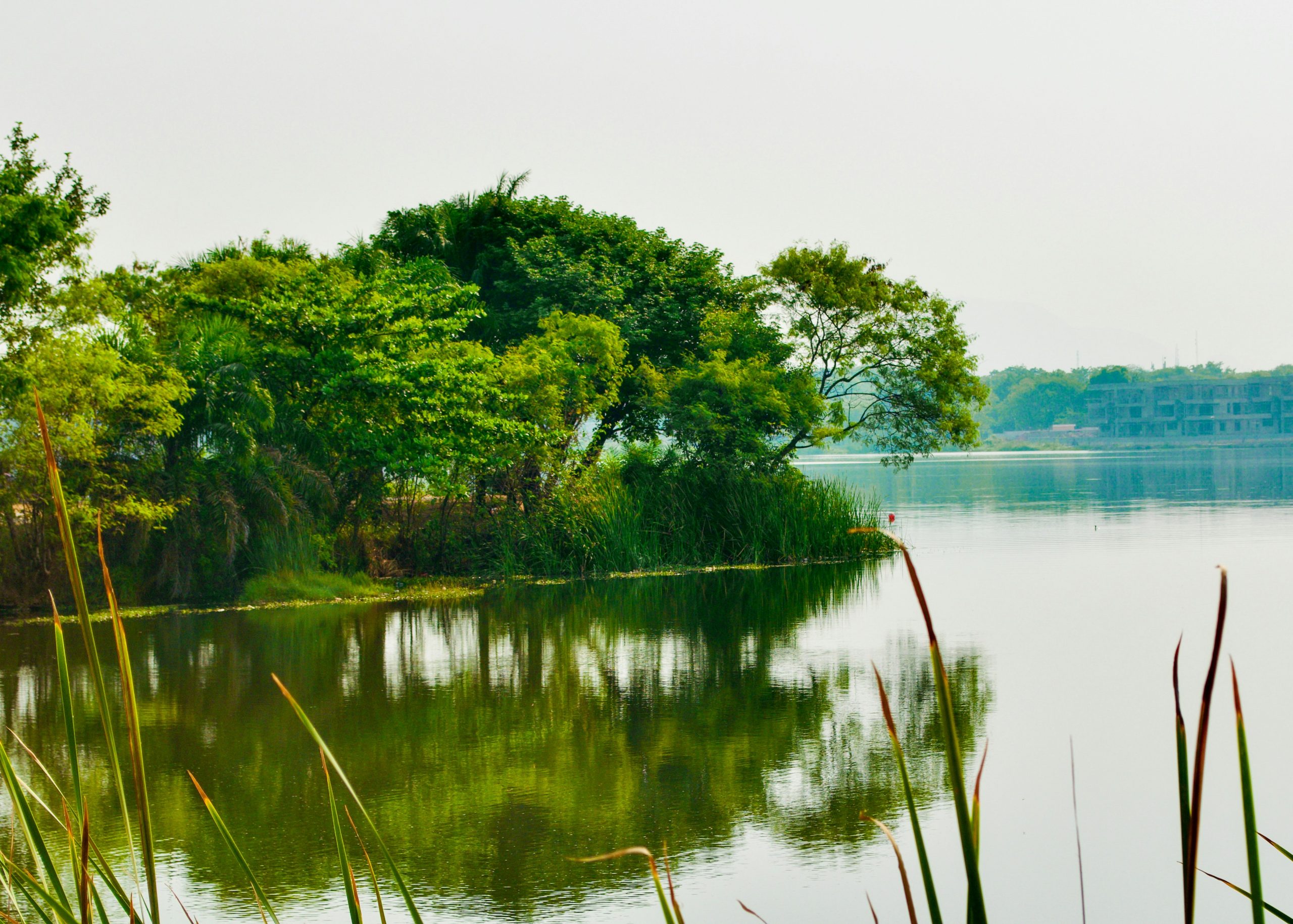
Photo by Solomon Wada on Unsplash
- Interview by
- Karen Chalamilla
A week after I interviewed writer, critic, and academic Ainehi Edoro on her debut book Forest Imaginaries: How African Novels Think, I went on a road trip from Accra to Elmina. When we drove past a sprawling green landscape, whose lushness stood out in contrast to the beige city view to its left, I was informed that the green belt was Achimota Forest, where runaway slaves hid and found refuge. It was later established as a reserve for fuelwood plantation for a nearby school. Such is the immediacy of Edoro’s book; its focus, the forest, is not only pervasive in African landscapes, but is strongly echoed in African histories. But, of course, Edoro is not speaking about real-life forests but, instead, those we find in African fiction.
Forest Imaginaries argues that analyses of the forest as a stage for magic or an allegorical tool are limiting. The more expansive and effective perspective, she offers, is that of the forest as a mechanism or “experimental laboratory” for worldmaking. If we think about the fictional forest with its mysterious and imaginative qualities as a distinct category of space, then we can push our thinking beyond spaces in African fiction like the household or the nation, towards a more radical imagination.
Edoro builds on four novels—although she references many more—to form the chapters of the book: Chaka by Thomas Mofolo, Things Fall Apart by Chinua Achebe, Amos Tutuola’s Palm-Wine Drinkard and Nnedi Okorafor’s Lagoon. All four are wild, imaginatively unbound texts where the forest is a repository for knowledge, a reengineered utopic future, or even a juridical methodology for deciding right and wrong. While Achebe’s forest is an exclusionary mechanism that keeps “abominations” out of the village, Okorafor’s aquatic forest is a refuge where all human creatures can exist safely. Through fictional forests, we can glean insights on power dynamics, and how the author suggests we might circumvent them to build better worlds.
Most significantly, the book contributes to the long-standing and necessary tradition of orienting the global form of African fiction, into something that comes from “local soil,” as Edoro puts it in our conversation. Forest Imaginaries uses indigenous storytelling and cosmology to expand what the novel—a European invention—can do. This expansion creates something new altogether; something that Edoro argues, is only visible when you cease to look at African fiction from its European genealogy.
Yes, the dissertation was an incubation space where I tested the idea that we could think about forests as machineries in fictional worlds. But the book is where I figured it out and got to work with richer archives.
You refer to the strategy for the analysis of the forest as machinery, as literary archeology. What is literary archeology?
Literary archeology is the idea that there are layers through fictional worlds. Typically when we think about stories, we think about settings, which are useful because they allow us to do symbolic work. We can say the city represents X, or the household represents X. But this kind of two-dimensionality can be limiting. The French theorist Michel Foucault had this idea that if you wanted to figure out how to define a large-scale concept like, say, power, you could do that by connecting many different kinds of things that sometimes do not even appear related to the term. He called this process archeology. This helped me understand why you could have the evil forest in Things Fall Apart, which appears to be one space, but as you go through the text, you realize that it is also connected to the ancestral space and the divine space. To figure out what the evil forest is, you have to think through spaces as being layered and connected.
Okorafor, whose work you build on in the last chapter of the book, labeled her work Africanfuturism in response to her books being misrepresented. In the book, you come up with a label of your own: spectacular fiction. I wonder if, like Okorafor, you had in mind the misrepresentation of African fiction when you came up with it?
By spectacular fiction, I mean a kind of otherworldly storytelling rooted in the Yorùbá idea of ìrán, which is often translated as “spectacle” or visionary appearance. In this tradition, a spectacle is a moment when an image or scene from another world enters into the world of the living, even if briefly. I use this idea to read Tutuola’s The Palm-Wine Drinkard but extend it to other works like Okri’s The Famished Road, Unathi Slasha’s Jah Hills, Alain Mabanckou’s Memoirs of a Porcupine, and Yvonne Vera’s Nehanda, where storytelling is essentially the staging of visionary events. These works are often described as eccentric, and they are beautifully strange, but I also want to suggest that what we read as eccentric is the pressure of otherworldly knowledges against human experience. These novels are important because they are also asking: Are there moments of collective crisis when ordinary ways of knowing fail us? When a people confront uncertainty so disruptive that inherited habits and institutions no longer suffice? Are these the moments when societies turn to ancestral memory, to cosmology, to other domains of knowledge in order to think anew?
Can you speak a little about the forest as a space of refuge as seen in Okorafor’s aquatic forest in Lagoon, as opposed to somewhere that facilitates violence like in Things Fall Apart or somewhere you pass through like in The Palm-Wine Drinkard.
The idea of the forest as refuge is something that I saw later. In Okorafor’s Lagoon, the story begins with a swordfish whose life is placed in danger by oil spills. By the end of the novel, the forest is reengineered into a space where ecological disaster has been averted and every being, whether it’s a swordfish, a plankton, a human being is protected. The type of hierarchy where humans are at the top of the food chain and so every form of life can be exposed to violence for the sake of the human has been flattened. Okorafor is not the only one doing this type of reimaging of the forest; in La Bastarda by Trifonia Melibea Obono, a queer community that is able to find refuge from a homophobic town in the forest. One of their rules is that they will be vegan and never kill animals to eat, which might seem tangential, but it makes sense with Obono trying to imagine the forest as not just a passing through space where we go to find knowledge and return, but a space where we can reimagine the world in its most radical form: as a space where life can exist on the basis of a radical openness to difference. These novels go beyond simply questioning and undermining binaries of the human and non-human, the human and the animal, and instead they argue that we have to push our thinking to the point of imagining the forest as a space where a life that is radically inclusive of all life forms can exist. In the arc that Forest Imaginaries follows, I’m happy that I ended at that point.
That radical reimagining, sounds to me, like a feminist endeavor.
It is feminist, I would say. I think in lots of the other texts that I look at, with the exception of Ben Okri’s The Famished Road, there is a division of the forest versus the world. African storytelling of the forest generally posits the binary in order to break the binary. But when I’m reading Trifonia Melibea Obono’s text, when I’m reading Veroniqué Tadjo’s Reine Pokou, when I’m reading Okorafor’s Lagoon, they reinforce the idea that forests are not just transitional spaces. We have to be able to live in the forest, in spite of all its instabilities and fragmentedness. To me, there is something very feminist about saying that we are tired of simply positing binaries and breaking them. Can we just push imagination further and reimagine a world where binaries have been completely deactivated?
When I was reading the Okorafor chapter, I felt that her conception of “non-human” is very similar to Achebe’s “abomination,” but like you said, what the authors do with that binary is where the contrast comes in.
Your hunch is absolutely right, and actually, in a very earlier version of the chapter, I wanted to close the genealogy and argue that Lagoon is the sequel to Things Fall Apart. Okarafor reverses all the ways that Achebe constitutes the world around excluded life by creating a world where exclusion is literally not possible. Okonkwo excludes his son who clearly didn’t fit into the idea of manhood in that world, and his own father was excluded based on that ground as well, by being thrown into the evil forest. There are more lives and objects that have been excluded into the evil forest and left there for as long as the clan has existed. The evil forest is its own world of excluded life forms. Okorafor’s novel to me is saying: What happens when we are able to enter into the evil forest and build a world around all these life forms that have been excluded by a human-centered imaginary? It’s almost a critique of many of the binaries that Achebe takes for granted in building his own world. It expresses a love for the forest such that it is no longer this scary place that we are going in and popping out as quickly as we can. Instead, the forest is, in a sense, the future.
In what ways did your knowledge of the publishing industry feel helpful in producing this book?
I think it made me very intentional about the way that I wanted the book to be in the world, even up to the cover. I love the cover of my book. It makes me so happy anytime I look at it. The effort that I put into it, which, for an academic book, seems inconsequential, was very important. I already existed in that mainstream space where the question of how your book looks on an Instagram feed is an important one. In social media, information circulates in a very particular way, and I think that knowledge helped in the decisions for the production of the book. Also, my experience through Brittle Paper helped me at least attempt to make the book legible to a broader audience, despite it being academic, which means the language has to be a particular way.
When I was reading Forest Imaginaries, there was a lot of debate around art’s place in the world in my corner of the internet. I wonder what your thoughts are on the conversation especially as someone that engages with fiction as a world-building mechanism.
I think what fiction is able to do is becoming even more important as so many aspects of our world are played out in media environments. We need to be able to influence culture in multiple directions. You need the brick and mortar of being out on the streets, building schools, creating literary festivals. But the media war is also very real. So, we have to keep building capacity for our worlds to be able to occupy spaces of power in media landscapes. That’s why it’s so important to me that African writers do the things that they do on social media, because we need to show up for people who exist and depend on those spaces for knowledge. We cannot abdicate those spaces. Both need to happen, which creates this very layered—again, going back to the image of archeology and the forest—understanding of spaces and power. We need to keep this in mind so that we can create archives that are living, that are durable and that are useful.
I read somewhere that you started writing Forest Imaginaries as part of your dissertation?