Morocco joins the miniskirt wars
In Morocco, the real story is once more that of women organizing, pushing back and pushing forward, creating new spaces precisely where others try to shut them down.
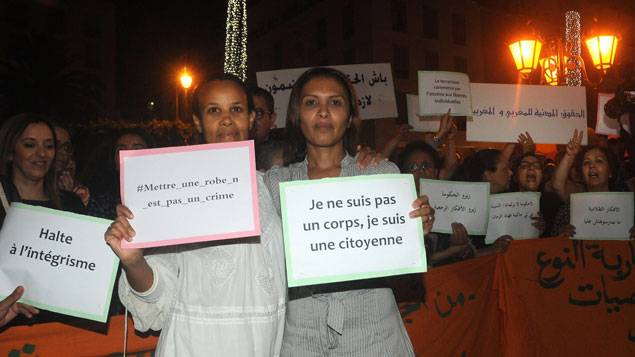
Protest in Rabat
On June 14, Sanae and Siham, 23 and 29 years old respectively, identified as students and professional hair stylists, went to shop in Inezgane, south of Agadir, on the southern part of Morocco’s Atlantic Ocean coast. A shopkeeper attacked them, claiming their skirts were too short. Soon they were surrounded by a more than threatening mob. Terrified, they sought shelter in a boutique and waited for the police to arrive. The police did arrive . . . and arrested them for “indecent exposure” or “gross indecency.” Their trial was heard Monday, June 6. If convicted, the two women face up to two years in prison. And so begins another chapter in the miniskirt front of the global war on women, from New York to Kampala to Jakarta. In May, Algeria had its “affaire de la jupe”, when a security guard barred a law student from her exams because he decided that her dress was “indecently” short. Earlier this year, it was Zimbabwe’s turn, which produced #DontMinimizeMyRights. The year before that, it was Kenya, where women organized around #MyDressMyChoice and #StripMeNot. Before that, in the same year, women in Uganda responded to an assault against women with #SavetheMiniskirt. The year before that, Namibian women responded to an anti-miniskirt campaign with “Rape is not NAMIBIAN.” And the year before that two teenage girls were attacked by a crowd of 50 or 60 `adult’ men `because’ one of them was wearing a mini-skirt. Four years earlier, Nwabisa Ngcukana was stripped and assaulted for exactly the same `crime’, at exactly the same taxi rank in Johannesburg.
In Morocco, the real story is once more that of women organizing, pushing back and pushing forward, creating new spaces precisely where others try to shut them down. Moroccan women, with male supporters, organized a campaign, using the hashtag #mettre_une_robe_nest_pas_un_crime. Wearing a dress is not a crime. First, they pushed to have the police investigate those who had harassed and threatened the two young women. Finally, the police gave in, investigated and arrested two young men. Demonstrations were organized all over Morocco. Women organized July 6 as a National Day for Our Individual Freedoms, with demonstrations in Rabat, Casablanca, Marrakech, Agadir, Tangiers, and beyond.
Women’s associations mobilized. According to Fouzia Assouli, President of the Federation of the League of Women’s Rights, LDDF, “It’s outrageous, arresting the two women rather than those who surrounded and threatened them. This is about sexual harassment and violence against women. Now, violence in public space has been institutionalized and approved by the justice system.”
Feminist activist Boutaina Elmakoudi posted a video that went viral, in which she argues that this affair touches on all Moroccan women and that it’s not only the story of these two women but rather a general threat to all individual freedoms.
The judge will render his verdict on July 13. Meanwhile, the two women are staying away from the press, because one is engaged to be married and the other is afraid of her parents. In 2001, Zimbabwean activist Tafadzwa Choto was asked about the events that had shaped her as a feminist socialist revolutionary. She answered, “The first one was when a woman at the University of Zimbabwe was stripped of her skirt. It was said to be a miniskirt and was publicly ripped off her. I was disgusted.” That happened in 1993, and fueled and informed Choto’s lifelong struggle for women’s freedom, justice, and power. Wearing a dress is not a crime.