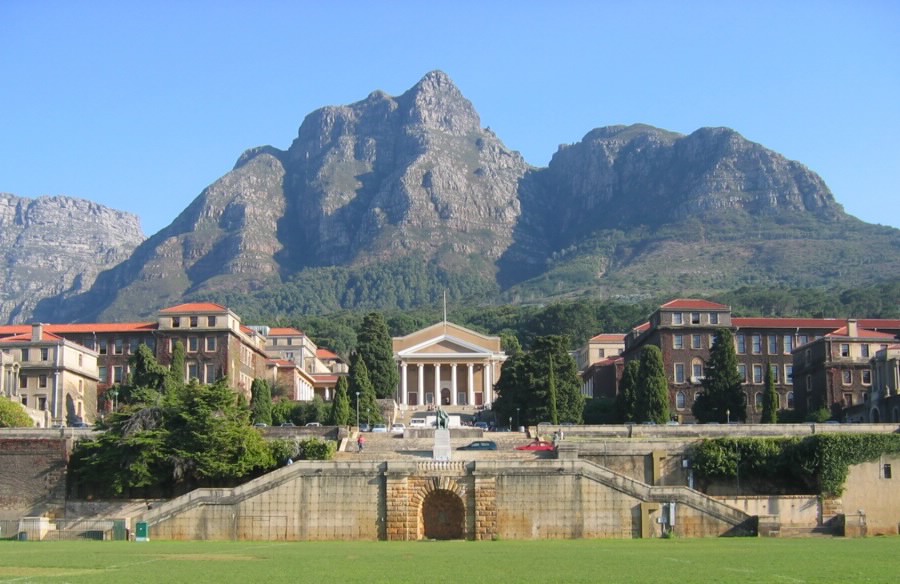
UCT via Wikimedia Commons. What comes after the university? |
Each year, as registration season begins, the same images circulate from campuses across South Africa. Students cluster outside administration buildings or the entrance to campus, chanting against “fee blocks,” and holding up cardboard signs that insist education is a right. This morning, news broke of the beginning of such a protest at the University of Cape Town, which markets itself as “Africa’s best university.” The language is familiar; so is the timing. Financial exclusion—students who have passed their courses but cannot register because of outstanding debt—becomes the first crisis of the academic calendar. A decade and a year after #FeesMustFall convulsed the sector and shook the country, after the commissions, policy shifts, and the partial expansion of state subsidies, the confrontation between students eager to learn and universities under strain has settled into the rhythm of the institution itself. The annual confrontation over fees is not reducible to a single mechanism. Sometimes it is a block on registration triggered by outstanding debt; sometimes it is an upfront, prohibitively expensive registration charge; and sometimes it is simply the steady rise of tuition and residence costs. Each is administratively distinct, but together, they reflect something more fundamental: universities rely on fee income as a structural component of their operating model. Since the democratic transition, enrolments have expanded significantly, expectations have risen, and universities have been asked to widen access, improve research output, and compete internationally. However, public funding has not kept pace. The gap between mandate and subsidy has been filled, in part, by student fees. When those fees do not materialise, the consequences ripple across the institution—budgets tighten, appointments are frozen, capital projects are delayed. Financial pressure becomes a permanent condition rather than an episodic shock. It is within this context that the language of sustainability, efficiency, and risk management has taken hold. Universities are governed through performance indicators, strategic plans, compliance regimes, and competitive rankings. Authority attaches to what can be measured and reported. Decisions must be justified in terms that are legible to councils, auditors, funders, and the state. This is what is often described, somewhat loosely, as the corporatization of the university. This does not mean that universities have simply become businesses, but rather that techniques associated with corporate governance have come to organize how universities understand themselves. What can be counted becomes what can be defended. What can be defended becomes what must be prioritized, and everything else is expendable (almost always, the humanities). The pressure that universities have been placed under in the era of neoliberal reform and late capitalism has periodically invited existential questions about what the university is for. Those questions are not new. They surfaced powerfully during #RhodesMustFall and #FeesMustFall, when students demanded not only access, but transformation: of curriculum, of language, of institutional culture, of the post-apartheid settlement itself. Yet even at the height of those confrontations, one assumption was largely held. Even though the university was criticised as exclusionary, colonial, corporatized, bureaucratic, complicit, and even though it was accused of reproducing inequality and guarding epistemic authority too jealously, it was not treated as incoherent. Its legitimacy was contested; its existence was not. The struggle was over who belonged within it and what it should teach, not whether the institution itself had lost its raison d’être. In other words, the university has long had to petition the state for resources, defend its autonomy, and negotiate its funding model. It has had to justify its priorities. What it has rarely had to justify is its own continued meaning. However stratified or compromised, it was assumed to be a site where knowledge was produced, preserved, and transmitted in recognisable ways. That assumption is now less secure. What is changing is not only the funding model, nor even the managerial logic that governs it. It is the social meaning of the university itself. Its authority as a place of formation and verification is thinning. Its practices are being displaced, supplemented, and in some cases hollowed out by forces that do not recognise its monopoly over knowledge, attention, or credentialing. The crisis, then, may not be only about access or corporatization. It may be about whether the university remains a coherent institution at all. The contemporary economy does not depend on the university in quite the same way it once did. In the postwar period, mass higher education was tied to the expansion of professional and managerial strata. The promise—however unevenly realized—was that prolonged formation would translate into social mobility and stable employment. The university was embedded in a broader developmental compact, and in many ways, Fallism in South Africa was primarily a demand from the university (and the state) to fulfil its end of this bargain. That compact has frayed as global capitalism stagnates. Economic growth is slower, and labor markets are more fragmented. Automation and platformization are reorganizing work, whatever of it remains, on precarious ground. Large numbers of graduates circulate through precarious employment or unemployment. In many contexts—especially in the global South—higher education no longer guarantees absorption into expanding sectors of the economy. It produces, instead, a surplus of credentialed subjects for whom there is no stable place. Under such conditions, the university runs the risk of appearing increasingly superfluous to the core functions of the economy, because while capital certainly still requires high-end research and specialised expertise to sustain itself, it has no particular need for the universal cultivation of critically literate, historically grounded subjects when modular skills, short-term certifications, and adaptable competencies will often suffice for the majority of roles. This does not mean, of course, that capital has any interest in abolishing the university outright, but it does mean that the broader political economy in which the institution is embedded increasingly favours speed, modularity, and flexibility over the slow, cumulative process of intellectual formation that universities have traditionally sought to provide. A shift in the way students engage with academic work is already well underway, and across the global North, faculty members are increasingly observing that many students now struggle to maintain focus on even moderately lengthy readings, let alone entire books. This pattern of decline, which significantly predates the arrival of generative AI, cannot be simply attributed to academic misconduct; instead, it reflects a broader transformation in how attention itself is trained and rewarded in contemporary culture. The widespread adoption of smartphones has gradually undermined the endurance required for deep reading, while decades of standardized testing have narrowed our collective definition of literacy, and the profound disruptions of the pandemic have only compounded these existing losses. The result is not a decline in raw intelligence but a growing fragility, a diminished capacity to hold extended arguments in view long enough to fully engage with them. It is into this already weakened cognitive ecology that generative AI has now arrived, and while it did not create the underlying crisis, it is undoubtedly accelerating its effects. When seemingly fluent, well-structured prose can be produced instantly on demand, the traditional link between performing an academic task and the intellectual formation that task was meant to cultivate begins to loosen, and while the final output remains legible and appears polished, the underlying understanding that once served as its guarantor becomes increasingly difficult to verify. From the student’s perspective, the calculus can appear entirely rational: if a university degree is marketed primarily as an instrument of employability, and if professional success seems increasingly to hinge on presentation, networking, and a certain intangible polish rather than on substantive depth, then optimizing for a defensible final product is a logical adaptation. In this light, delegating parts of the cognitive process to an AI tool is not necessarily experienced as a violation of academic integrity but as a pragmatic response to the incentives of the system itself. The university continues to certify its graduates, and students continue to submit work, but the nature of the exchange between them has begun to shift. While the institution still promises intellectual formation and personal growth, the broader system within which it operates increasingly rewards a more streamlined and measurable performance, leaving the relationship between the two fundamentally unsettled. If this pattern is visible in elite northern institutions, its implications are sharper in societies where the promise of incorporation was always more precarious, and where infrastructure constraints, cost barriers, and uneven digital access mediate the uptake of new technologies. In South Africa and across much of the continent, the university expanded rapidly in the last 30 years, but the economy it feeds into has not expanded at the same pace. Graduate unemployment in South Africa remains far lower than overall unemployment, and a degree still offers some kind of protection. Yet the trend has shifted. Since the late 2000s, graduate unemployment has roughly doubled, and it is highest among young, African, and female graduates. Across sub-Saharan Africa, only a small minority of young adults enter tertiary education at all (only one in 10), even as the number of graduates has grown faster than the creation of stable formal employment. The result is a peculiar temporal disjuncture. Access to university has widened at precisely the moment when the broader political economy has grown less able to absorb the educated at scale. The crisis of the university is not autonomous. It reflects a broader crisis in capitalism’s capacity to organize meaningful work and to justify long periods of disciplined preparation. When accumulation produces superfluousness alongside abundance, when growth fails to translate into absorption, institutions built around deferred reward lose their moral force. Until we are prepared to ask what education is for beyond employability—what kind of human good it serves, and what kind of society it presupposes—the university will continue to oscillate between managerial optimization and existential doubt. It will persist as a piece of social infrastructure, continuing to process students and confer credentials. But its coherence as an institution of formation will remain under threat. – William Shoki, editor |