Kenya’s goon economy
Across the country’s urban centers, young men are being recruited into political militias that offer quick cash, fleeting power, and little chance of escape.
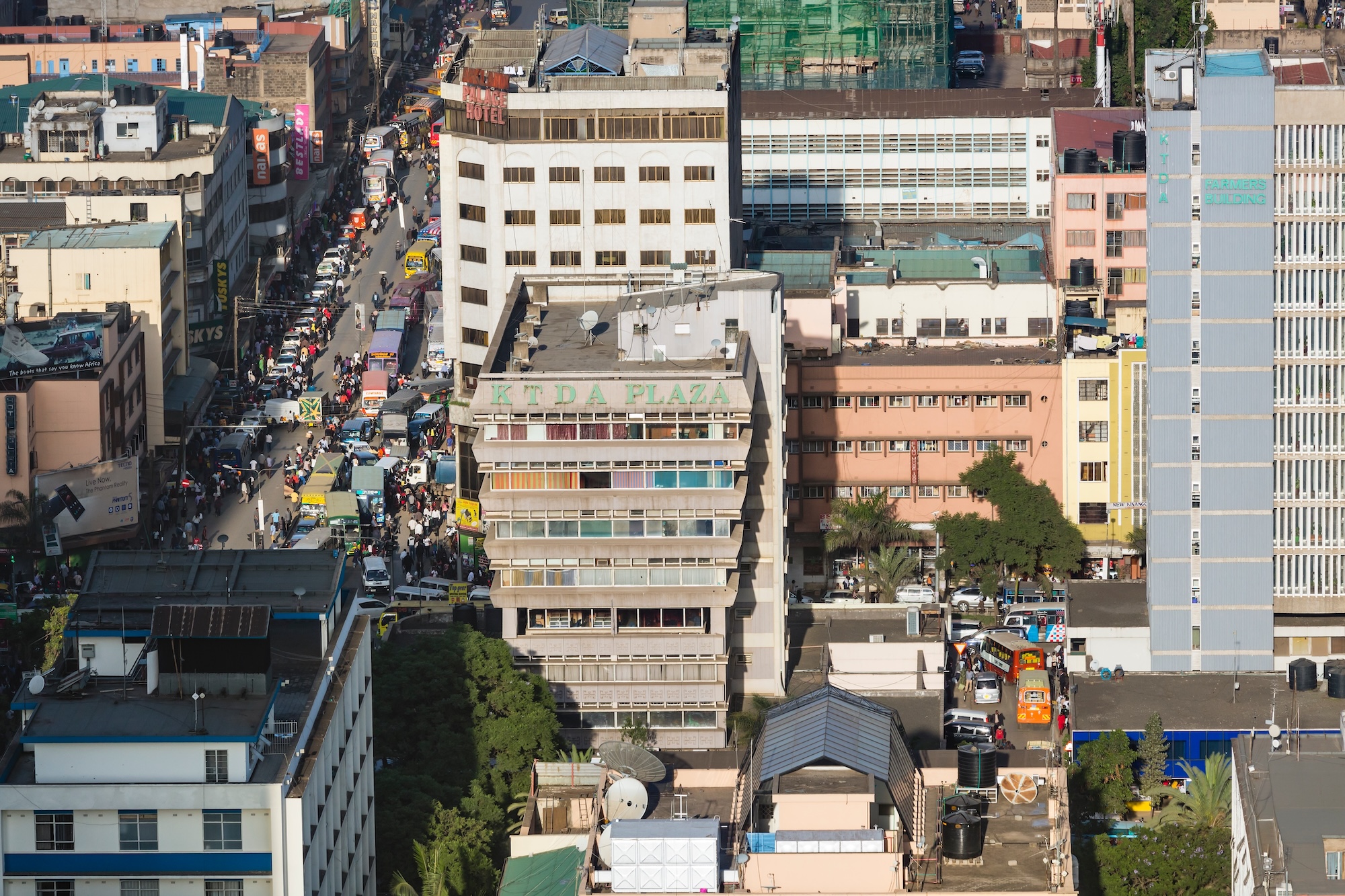
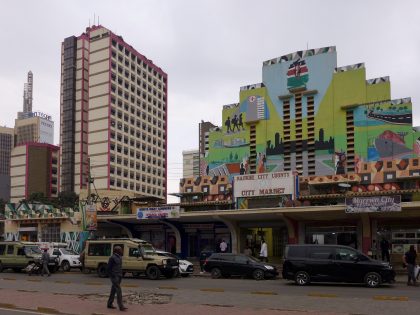
View to Ronald Ngala Street in the east of Nairobi, Kenya, 2015. Image © IndustryAndTravel via Shutterstock.
In the socio-economic underclasses around Nairobi, Kenya—a certain kind of market opens for business each day. It’s not a market for food or clothing, but for violence. The currency is desperation, and the commodities are young men whose bodies and futures are traded for quick cash. The brokers are politicians, from Members of County Assembly (MCAs), businessmen seeking to enforce market cartels, and the chain goes all the way to the top. The input is masculine anxiety; the output is chaos.
This is the world of the political militia, locally known as goons, a term our sources used with a mixture of resignation and grim pride. Over weeks in September and October 2025, Odipodev conducted a series of interviews with young Kenyan men aged 18–30. Their testimonies pulled back the curtain on a sophisticated, brutal, and deeply entrenched system—weaponized masculinities for hire. This ranges from random hooliganism to an elaborate freelance security sector for the political elite, operating on a clear price list, a defined hierarchy, and a chilling understanding of its own disposability.
The service has a fixed, depressingly low market rate, with charges increasing depending on the hierarchy of the politician who’s asking: Local council members (MCAs): 500 Kenyan Shillings (approx. $3.50 USD). “It won’t even finish your hunger,” Maurice scoffs. Members of Parliament (MPs): 1,000 KSH (approx. $7 USD)—the standard rate for most jobs. County Governors: 1,500–2,000 KSH (approx. $10–$14 USD). “When you hear the governor's name, you start shaking your head,” says Maurice. “You expect to earn well.”
Payment is per task, distributed just before the job starts. The work involves disturbing rival meetings, causing fracas, beating protesters, and land-grabbing. For specialized tasks, like what goons call “slaughtering people,” the pay can be higher.
The first thing that’s striking, beyond the violence, is the profound vulnerability that precedes it. These men are not natural-born vandals, but a group of unemployed graduates and young fathers pushed to the brink. Dennis, a university-educated garbage collector from Dandora, frames his motivation in existential terms: “What motivates me in life at the moment is the fact that I can sleep and wake up in the morning.” For others, the drive is direct. Sharif, a 24-year-old from Kiamaiko, states: “I have a little girl. So, I have to push.”
This raw need is the engine. As Maurice from Korogocho explains, the ghetto is the perfect recruiting ground because it is filled with people who are “illiterate,” “unemployed,” young men who “put money first as the priority.” He articulates the grim transaction: “As long as the money is guaranteed, we will do everything just to make him satisfied with his own needs.”
In this shadowy network of illicit wealth and performative bravado, new Kenyan masculinities are forged. This realm offers young men a perverse meritocracy, where audacity substitutes for stalled social mobility. The flaunted threats and rivalries are not mere showmanship but armor, projecting a hyper-competent virility that mainstream society denies them. This display of masculine performance exists both in the physical enclaves of Nairobi and in digital spaces where aspirational “big men” curate their conquests online, merging cyber-savvy with physical intimidation. Even then, this desire for recognition often masks a profound vulnerability: a craving for traditional respect and economic stability, redirected through dangerous channels. The goon, therefore, is both a rebel against a system and its most tragic product, his motivations a complex alloy of lack, ambition, and the desperate performance of power.
The goon economy is a structured enterprise populated by different hierarchies, each seeking to fulfill a need, all intertwined in the broader universe of bravado. At the bottom are the foot soldiers, or “goons,” who operate in crews of 20 to 50. “We call ourselves brothers,” says Dennis.
Above them are the on-ground leaders, the “representatives” or “wasangwenya.” These individuals are the crucial link, known to both politicians and gangs. They receive orders, negotiate payment, and appoint front-line leaders. They rarely get their hands dirty. Sharif notes, “He gets a big share of the money. . . . he is most respected in the ghetto.”
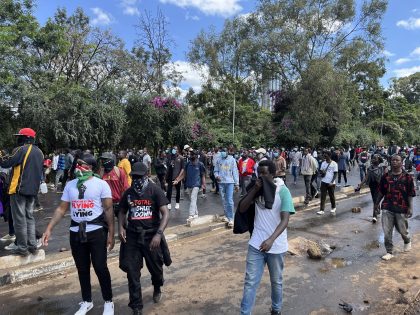
At the top are the “Kingpins” or “Big Fish.” Maurice explains their role: “Without them, we can’t operate. . . . They are the ones who meet with the politicians.” These figures insulate the political class. And then there are the clients themselves, from local MCAs to the highest county office. Dennis explicitly describes being hired by senior officials. “Sorry to say,” he states, recalling the first Gen Z protests: “he paid us to burn the county government offices so as to destroy the evidence. So, they blamed the protesters, but in real sense, he wanted it to happen.”
Politicians are not just financiers; they are quartermasters. Weapons—rungus (clubs), pangas (machetes), and slashers—are provided directly by the clients. Dennis describes being given rungus by the governor’s team to disrupt Gen Z protests.
Logistics are hidden in plain sight. Weapons are sometimes transported in county government vehicles, disguised as part of state youth programs. Crucially, weapons are meant to be ephemeral. “After being paid, we don’t see the reason for carrying these weapons anymore,” says Maurice, describing discarding blood-stained pangas in public washrooms. “They don’t want to be associated.”
The system is built on the absolute disposability of these young men. There is no insurance, no safety net. Dennis recounts fatal incidents during community disputes and protests. “My crew were like six guys. . . . one of us was captured by the protesters and was badly beaten, and he later died.”
If a goon is arrested or injured, the universal response is “you sort yourself.” The politicians vanish. “You cannot say the truth coz even the police will deal with you,” Dennis states. The police are often described as complicit. Maurice is direct: “The police know they’re on the payroll. So, they don’t want to interfere with you.”
Leaving this life is perilous. The primary barrier is economic. Sharif says, “The easiest way is getting employment.” But employment is what they lack. Pascal clarifies: “The ‘Big Fish’ who calls you for mjengo [casual labor] is the same one who calls you for shugli ya mhesh [political work].”
The secondary barrier is intimidation and the threat of violence. Dennis says refusing a job makes him a target. Maurice provides the chilling details: “Once people know that you want to leave the industry, that’s when they start to sense that the betrayal has begun. . . . People are going to kill you.” His advice is to leave Nairobi entirely for the rural home for at least six months to be forgotten.
In the end, their power is borrowed—a violent illusion that vanishes the moment the job is done, leaving them with a few hundred shillings and the scars to prove it. They are, as one respondent said, “soldiers” in a war they didn’t start, fighting for a cause that offers them no future, trapped in an economy where the only growth industry is their own misery.
From Nairobi’s slums to the suburbs of Sydney, this volatile commodity is frequently traded: the anxiety of displaced young men. Political elites broker this desperation to fuel their power.
In established democracies, the weaponization is often discursive but no less potent. Young men are lurching right, channeling precarity and alienation into support for populist, often far-right narratives. The currency is not cash, but identity and belonging.
This pattern repeats globally. In India, ethnoreligious nationalism mobilizes young men. In Nigeria and Kenya, the transaction is brutally direct: poverty is exchanged for political violence. In South Africa, grievances are harnessed, leading to communal violence. In the United States, resentments are channeled into movements that convert racial anxiety into political energy.
Globally, the story of weaponized young men is not just a story of crime; it is a story of a failed social contract with a generation of men. It is the story of how a generation of young, capable, and desperately poor people have had their masculine ambitions systematically weaponized by the political class. They are not admired in society—they are feared, exploited, and pitied, their manhood both their most marketable asset and their most fatal vulnerability.