Blackface is Okay on Peruvian TV
The shows play on the worst stereotypes associated with Afro-Peruvians and uncritically exhibits these for the whole Peruvian nation to watch.
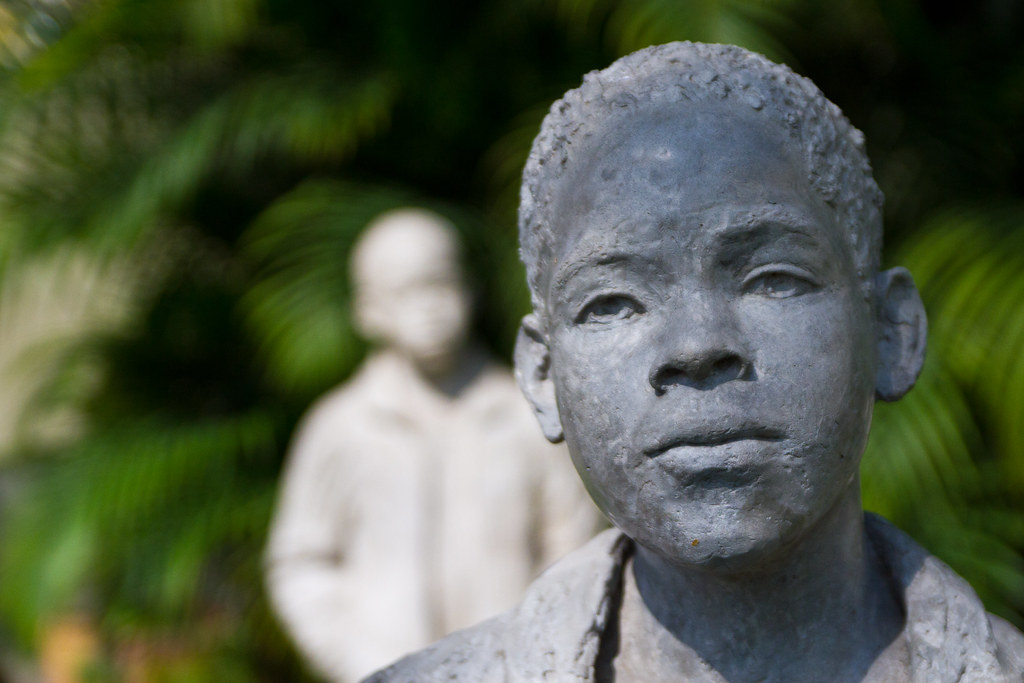
Statue of a young Afro-Peruvian boy outside the Dedalo Art Gallery in Barranco, Lima. Per (Joshua
Peruvian media have revived the debate regarding Negro Mama, a popular character of the prime time TV show El Especial del Humor. The show, aired on one of the country’s main TV channels, Frecuencia Latina, features actor Jose Benavides in blackface, wearing a prosthetic nose and lips as well as black, hairy gloves on his hands. His motto is “I might be a blacky, but I have my little brain” (Podré ser negrito, pero tengo mi cerebrito). To get a sense of his “humor,” see here and here for sketches of the Negro Mama. Despite its popularity, Negro Mama has been highly criticized by Afro-Peruvian organizations. They’ve played a key role in campaigns against Afro-stereotypes.
The most active Afro-Peruvian organization calling for an end to Negro Mama on TV, is LINDU (Centro de Estudios y Promoción Afroperuano). Last month they requested Frecuencia Latina to stop featuring the character.
So what’s so offensive about Negro Mama, apart from its black face and pronounced features? In an award-winning essay, Stanford University student Kiah Thorn argues that the more recent episodes of the show associate Negro Mama with robberies, violence, puns about herpes, the trafficking of cocaine and the penitential system. Negro Mama plays on the worst stereotypes associated to cultural and social attributes associated with Afro-Peruvians and uncritically exhibits these for the whole Peruvian nation to watch.
The public disapproval towards Negro Mama started in 2010, when LINDU filed a petition against Frecuencia Latina for the Ethics Tribunal of the National Society of Radio and Television, which in turn ordered the TV Channel to apologize to the Afro-Peruvian community. The government body stated that “the terms used by Negro Mama can be considered as authentic expression of hatred against a racial minority . . . And despite not invoking violence, the messages have a strong racist content.” (See here for a news report about the decision.) Along with a broadcasted apology, Frecuencia Latina issued a press release: “We value the people who might feel offended and Frecuencia Latina ows it to the audience and will always make an effort to serve everyone and not to offend anyone.”
Back then, Negro Mama followers started a fierce online campaign defending the character. Kiah Thorn explains that during this phase of the controversy the Que Regrese el Negro Mama (“For the Return of the Negro Mama”) Facebook page reached thousands of followers. However, you can still read dissenting comments on the group’s Facebook wall, such as this one written by professor Juan Navarro: “The bottom line is that, Peruvians of black race, feel outraged because JB (Jorge Benavides) presents Negro Mama as an “ignorant black,” in other words, he stereotypes the compatriots of color, and that is very wrong. This is why he must not return to TV, many kids see the character and make up an image in their minds, the incorrect image created by this comedian.”
In a 2010, the BBC reported “ . . . the country’s most popular comedy show–referring to El Especial del Humor and Negro Mama–abounds with racial stereotypes that are familiar to the audience, which scarcely questions what they are watching.” The reporter, Dan Collyns, added that “ . . . perhaps the biggest obstacle to ending racism is the fact that it is simply seen as a joke.”
Other media initiatives have also joined efforts to force the channel to withdraw Negro Mama from Peruvian television, such as the tumblr blog peruanista.tumblr.com, which has called attention to Negro Mama’s foul stereotypes: “On national television, a black-faced character depicting a black man, a proof that racism in Latin America is worst than imagined.” The site invites visitors to file a petition to several Government bodies.
The debate revived recently when several Peruvian online media sites quoted Monica Carillo, the founder of LINDU: “Jorge Benavides’s intention to improve his character aside, we consider that it has become a mark installed in the memory of the people 14 years ago. He–Negro Mama–is a clever one, but he is also delinquent and ignorant.” LINDU took the case further up to the Ministry of Communications and Transportation and is also working on a legislation to sanction racist attacks (see here and here for related news reports).
In the meantime, Peruvian social media continue to criticize and defend Negro Mama. The Facebook page Afro Noticias Peru recently posted an ad of the show El Especial del Humor, followed by the comment: ‘“Frecuencia Latina Thinks Big!?” No, it does not think big. The racist stereotyping by Negro Mama demonstrates the channel’s policy: the contempt toward the Afro-Peruvian people through messages that build a racist propaganda.’
But that hasn’t stopped fans of Negro Mama to continue lauding him online. Another Facebook page, “No to the censorship of Paisana Jacinta y del Negro Mama,” keeps posting tribute videos to Negro Mama. With over 19,000 followers, this page is a clear sign that the black-faced character might be with us for a little longer.