The Belgian Color Bar
The filmmaker hopes Congolese in Belgium can be given a stage to offer their own history and projections of Congo.
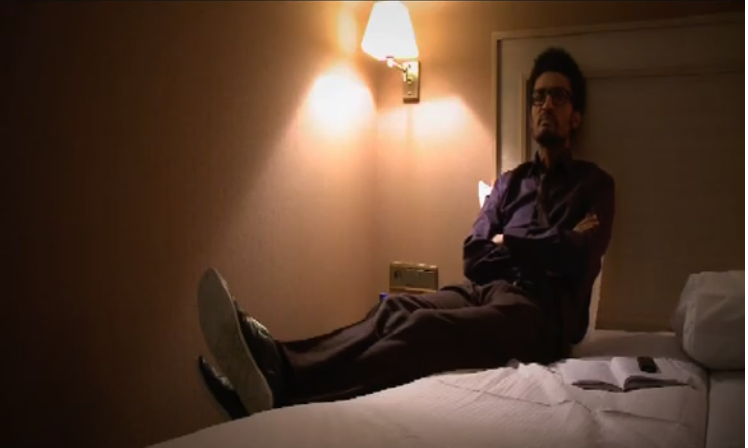
Stills from “Colour Bar.’
Roland Gust was born to a Congolese mother and a Belgian father. He grew up in Congo, believing he was white. That is, until his family decided to return to Belgium when he was twelve. Twenty years later, in a recently released documentary, Colour Bar, we follow him in his desire to find a grammar to describe his past.
Why have you waited so long to make this documentary? Why now?
It took me a long time to find the courage to talk about my being ‘métis’. Formulating my feelings felt like raising problems. As long as I kept it to myself, there was no problem. Not for the outer world, that is. I remained Roland, the perfectly integrated coloured. I didn’t want to come across as a frustrated black man who was ungrateful for what Belgium offered him. I didn’t want to be expelled after so many years of trying, because I was begging for recognition of my Belgian identity. I had to serve Belgium and remain silent.
After all those years of absolute and blind dedication to the country of Belgium, I have now crowned myself a Belgian. I have earned my place in Belgium and no longer need the Belgian’s approval to be a Belgian. As a Belgian, I make use of my freedom of speech to tell my Belgian story. I no longer lie awake about the potential repercussions following my critical discourse about Belgium and the Belgian identity. A Belgian criticizes his country out of love and concern for his country. If my experiences and reflections can add to the building of a better and richer country, I have fulfilled my duty as a Belgian.
In 2010 we celebrated Congo’s 50 years of independence. It was an opportunity to tell the Belgian-Congolese story in all its facets. It also allowed for the métis story to be told, although I fear the métis already slipping back into forgetfulness.

How do you look back to the year 2010 and the way in which Belgian media reported on Congo’s 50 years of independence?
Personally, I don’t think we can be dissatisfied with the media attention on Congo. I do find it hard to judge the general reporting here though since I’m only exposed to a handful of media. My little interest in these media has to do with the fact that most reporting is done by Belgians. They look at Congo first and foremost as Belgians. They thus also look at different interests and desires compared to the Congo-rooted people. One should rather get inspired by stories the Congolese want to relate to. This way they are given a stage where to offer their own history and projections of Congo. Maybe Belgium could have offered its own story to Congo. A series about Belgium for Congolese television and radio maybe?
Living in Belgium, how do you look at what’s happening in Congo these days?
As a member of the Congolese community, I care about what’s happening in Congo. I grew up there and lived the happiest days of my life. From the paradise I knew, little remains apart from a tiny oasis reserved for a small group of privileged people. But I know too little about what’s going on at political, social, and economic levels to say much more about this. Congo is pretty much stateless and divided by different actors with their own interests and (hidden) agendas. Congo’s not in the hands of the Congolese.
How do you relate to the African diaspora in Belgium and, more broadly, Europe?
I used to mainly consider myself Belgian since my self-image and identity were Belgian slash white. Nowadays I also feel more Congolese than ever—without necessarily having the feeling to share the same interests and needs as other Africans in Europe. We all face the same battle against intolerance and racism. We all wish to share and experience our African culture. We share a longing for our countries. But compared to other Africans in Europe I do feel at home in Belgium. I’m also Roland, the Flemish guy from a small town in Belgium.
In which works (books, music, artists) by ‘Métis’ people do you find inspiration?
Before working on this film I never really searched for the voice of a métis. Although Spike Lee is one of my greatest examples, I never wondered whether he is métis. Ever since my youth, I recognize myself in Afro-American artists because they shared a similar situation. We are non-white or half-white westerners in a white western world trying to produce an audio-visual language that can articulate our being métis in the best possible ways.