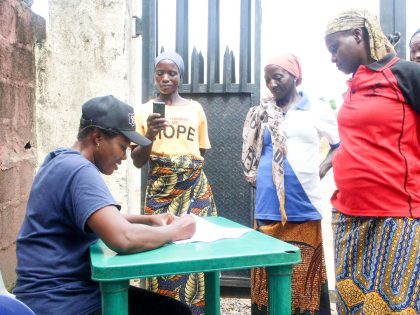
The Guardian reports: “Cash payments help cut HIV infection rate in young women, study finds: Research in Malawi finds girls who receive regular payments are able to resist attentions of older men and avoid infection.” The headline pretty much says it all … or does it?
Pay young women in Malawi to prevent HIV infection?
Sending South African miners home to die

Epidemiologist Jonathan Smith is working to complete a documentary called ”They Go to Die,” about the lives of four former mineworkers that were sent home from the mine after contracting TB and HIV in the South African gold mines. The men–like thousands of men each year–are affected by a process known as ‘sending them home to die’ that occurs in the South Africa mining industry, where migrant men who become sick with TB are sent home with little or no continuation of care, follow up, or chemotherapy (despite the fact that medical care is available on the mine premises).
Helen Zille’s ‘AIDS Gestapo’
Just as South Africa is recovering from the havoc wrought by former President Thabo Mbeki’s AIDS denialism, now there’s a new politician spouting all sorts of nonsense – this time it’s Helen Zille, the leader of the opposition Democratic Alliance. She’s been active on Twitter and in the media, calling for the criminalization of HIV transmission, and saying the state should not have to pay for treatment for those who contracted HIV through irresponsible behavior. She also recently held a lottery, where people who volunteered to get tested for HIV could win a large cash prize.
Cyril Ramaphosa and AIDS
The latest print issue of Foreign Policy Magazine has an essay by South African writer Johnny Steinberg on creative writing about the AIDS pandemic in that country. Steinberg covers the usual ground: that mainly white, gay men have written memoirs about AIDS; that memoirs about black men’s experiences with AIDS were written by white women; that popular AIDS media (like LoveLife, the AIDS education campaign targeted at teens) do not openly make connections between sex and AIDS; and that fiction writing by black writers, until recently, have shied away from themes of sex and sexuality. Nothing new here. However, the piece does get interesting when Steinberg asserts that former President Thabo Mbeki, a known AIDS denialist, “… was not necessarily the outlier he is often said to be [on AIDS]. His dabbling in quack science and AIDS denialism was symptomatic of a great unease in South Africa’s political culture, one that has translated into an eerie silence on the page.” Steinberg then makes these claims about Cyril Ramaphosa, once touted as a successor to Nelson Mandela as South African President:
Well deserved
Before we close out the year we have to give a nod to the Centre for Development of People (CEDEP) in Malawi, has won the 2010 AIDS and Rights Alliance for Southern Africa (ARASA) HIV, TB and Human Rights Award. ARASA is a partnership of over 50 civil society organisations working together to promote a human rights based response to HIV and TB in the SADC region. In 2010, CEDEP was instrumental in successfully mobilising international and regional support for the release of Steven Monjeza and Tiwonge Chimbalanga, arrested in Malawi on December 28 2009, on charges of “gross indecency and unnatural acts” after they engaged in a same-sex civil union. They were sentenced to 14 years imprisonment with hard labour, but received a Presidential pardon following pressure from regional and international bodies. CEDEP winning this award is also especially relevant in the current climate of increasing anti homosexuality in the region. Just in the last few weeks news of a wave of anti homosexuality has once again hit the region with countries moving with co-ordinated purpose to eliminate the rights of sexual minority groups. At the United Nations, African and Arab nations succeeded in deleting three words from a resolution that would have included gays in a denunciation of arbitrary killings. Surprisingly, South Africa also supported the removal of these words from the draft resolution – given that South Africa’s Constitution–as an exception in Southern Africa–protects the rights of sexual minorities.–Brett Davidson.
Can Stem Cells cure HIV?
The latest issue of the journal “Blood” includes an article reporting the effectiveness of stem cells on virtually eliminating the HI virus from a patient’s system. The HIV+ patient was being treated for acute myeloid leukemia with a stem-cell transplant combined with high-dose chemotherapy and radiation therapy: the researchers found that his HI virus levels were undetectable, subsequent to treatment. Here’s the abstract, broken down–but for the well-versed in molecular biology, read the article in PDF–by paying for a short term loan, or get it free through a library. We won’t be celebrating yet–it is an incredibly expensive treatment, out of the reach of most if not nearly all HIV+ people in sub-Saharan Africa (or anywhere, really). The researchers also cautioned that the procedure may not be safe or feasible for the wider population. But still: it’s an “advance” that we can be happy about.–Neelika Jayawardane.
African Disease
The UK charity Body & Soul (a ground-breaking charity supporting children, teenagers and families living with, or closely affected by, HIV) recently launched a campaign, In My Shoes, to educate, and raise awareness of the stigma attached to those living with HIV. The Guardian’s feature covering the campaign included “some of those affected talk[ing] candidly about living with HIV – and why all they want is a normal life.”
But it seems as though the writer focused on the “African origins” of HIV.
Witness the three stores below, and the manner in which each person is framed:
Keep Africa Alive, cont.
Today is World AIDS Day, which means you can expect the gatekeepers of Team: Save Africa to be in exceptionally fine form. In years past, Bono and (RED) have reigned supreme but this year brings a new contender in the form of Alicia Keys and her charity, Keep A Child Alive (KCA). Founded in 2003 by Leigh Blake, KCA has mostly wallowed in obscurity, only able to sit and watch as (RED) cornered the market. Not that KCA hasn’t tried. Who can forget their first attempt at grabbing the spotlight, 2006′s “I Am African” campaign?
I would file this latest stunt under the same banner but I can barely conjure up an eye roll, much less proper indignation. Better luck next year.–Sonja.