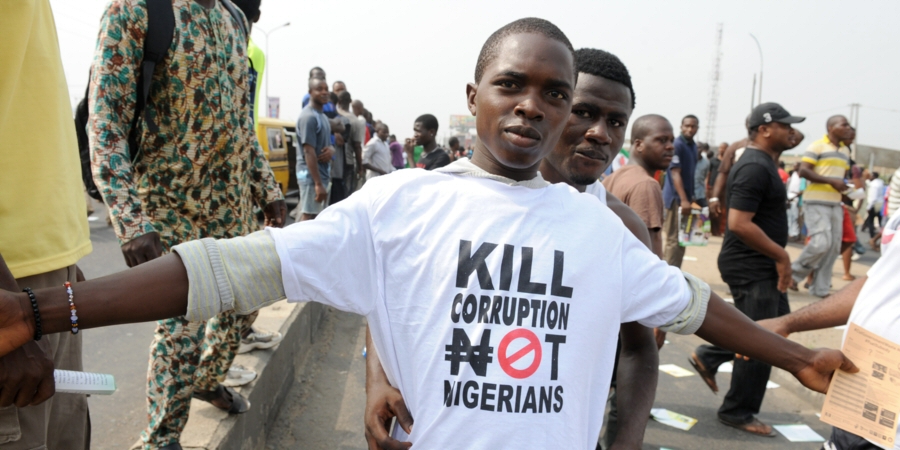
Protest in Lagos, 2012. Getty images. Nigeria’s clash of civilizations |
In 1996, Samuel Huntington published The Clash of Civilizations, a fabulist reimagining of modern society that prophesied future conflicts waged purely on reductive understandings of race, culture, and religion. Despite being theoretic sensationalism undergirded by near-comic levels of cultural determinism, the fantasy of the existence of fundamental fault lines fated to be locked in eternal Abrahamic turmoil remains an animating theory through which much of modern international affairs—from the nebulous War on Terror to the Palestinian genocide—is assessed. The not-so-implicit subtext is that the conflicts are equally cultural and moral: Christianity versus Islam becomes a righteous fight between the West versus the rest, and, more plainly said, good versus evil. In the weeks after 9/11, Edward Said published a fiery riposte in The Nation to claims that the attack was an affirmation of Huntington’s hypothesis—that all things Islamic are an existential threat. He wrote, “This is the problem with unedifying labels like Islam and the West: They mislead and confuse the mind, which is trying to make sense of a disorderly reality that won’t be pigeonholed or strapped down as easily as all that.” Rightfully deriding the paradigm as “Churchillian” in nature, the scholar of Orientalism bemoaned the insistence in adhering to sweeping generalizations in favor of tidy narratives that framed violence as an inevitability: It is better to think in terms of powerful and powerless communities, the secular politics of reason and ignorance, and universal principles of justice and injustice, than to wander off in search of vast abstractions that may give momentary satisfaction but little self-knowledge or informed analysis.” |
Despite Said’s warning, the American media continues today to fan the flames of othering hate, applying fatalistic narratives to well-documented political struggles. This is most recognizable in the framing of the Palestinian genocide as the righteous struggle of a people under siege. Embedded in this understanding is a fierce conviction of Zionist moral superiority as Prime Minister Netanyahu invokes Biblical authority for carrying out apartheid violence (a narrative that also speaks to Christian evangelicals in the West). What remains is a self-sustaining infrastructure of catastrophe in which the Israeli government justifies its genocide, invoking the moral imperative of opposition to terrorism. Annihilation, then, is not only understandable, but the expected response in the face of the Islamist threat. Remarkably similar themes have emerged recently in international coverage of the conflict in northern Nigeria, as speculations of a “Christian genocide” have reached headlines at prominent Western outlets. This is a narrative that Christian evangelicals have pushed for years. However, despite claims by religious advocacy groups, American legislators and the conservative American media that this is exclusively a war against Christians—it has been well documented that the devastating and prolonged conflict in Nigeria’s north can count both Christians and Muslims as victims in equal measure. As Ayoola Babalola wrote in Africa Is a Country, “The attempt to use religion as the primary determining factor in Nigeria’s security crises falls flat given that Muslims in Nigeria are not immune bystanders to the country’s spiraling insecurity but are themselves frequent, often brutal victims of the same violence and grim cycle of bloodshed that is portrayed elsewhere as only targeting Christian communities.” Sociologist Zoe Samudzi points out, “In the context of Nigeria, the imagination of permanent security is a localization of the civilizational question of the threat to global Christendom—which is to say to modernity—that is posed by Islam,” noting that Islam has always been a part of the Nigerian state. “In constructing Christian genocide, they are retrofitting a Christianity to Nigeria that has never uniformly existed in order to make the argument that it is Islamic terrorism that is constituting a threat to Nigerian peace.” An adherence to bombastic theological framing as the animating cause of the systemic failure is little more than a distraction that allows us to evade confronting the lingering aftereffects of British colonial administration. While documented scholarship may reflect a more indiscriminate array of victims across ethnicities and religions, trends on social media have reinforced a more distorted view. A recent flood of spine-chilling clips featuring targeted religious attacks in churches and villages even persuaded the Trump administration to invite international pop star Nicki Minaj to lend her voice to the humanitarian cause. Meanwhile, videos of brutal massacres of clerics at Mosques, and of communities that are identified as apostates by insurgents fail to attain the same reach. Attempts by journalists to offer a complete picture have resulted in intensely negative reactions online from stans, politicians, and Nigerians alike, all steadfastly resolute in clinging to a two-dimensional analysis that reinforces a lived experience rooted in religious panic. The intensity of the backlash is alarming, not only because it echoes the myopic misunderstanding of the transnational vectors of violence in favor of distortions of the proximate threat, but because it indicates how susceptible groups can become to the same virulent strain of victim-perpetrator binaries that animate Zionist thinking. Lived experience that only contends with the most visible elements of a conflict can easily give way to abstractions (such as arguing the moral imperative in a genocide) that ultimately preempt any understanding of the numerous levers of power that are responsible for a crisis. It is litigating the symptoms rather than treating the disease. Panic breeds hysteria, and while Nigerians are inarguably inspired by genuine fear of the sustained ubiquity of violence, the resulting digital frenzy has given way to a co-opted crusade, and primitive assertions that rely on inaccurate generalizations that fall short of addressing any of the root causes of the violence. Nigeria’s ethnic and religious fault lines are very much real, but so are the frayed federal power structures whose dereliction of duty breeds a sustained climate of hostility in the face of insecurity. While regressing to the mythos of preordained Abrahamic friction may offer a brief salve in the face of abject fear, as Said argues, it largely serves as a means of reinforcing defensive self-pride. If we truly seek to not only eliminate the bloodshed but eradicate the circumstances that allow it to flourish, we must commit to understanding how the imperial calculus and all its nuances therein have resulted in a messianic narrative that amplifies the evangelical cause at the expense of Nigerian safety. – Shamira Ibrahim, Francophone regional editor |