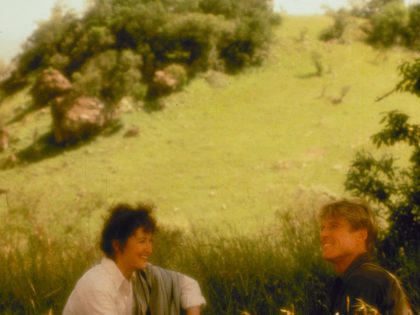
The Afrikaans movie template

The creatives at South African satellite TV channel Kyknet — which also produces movies now — not only blatantly rip off American romantic comedy plotlines, but inhabit a South Africa where there is not a single black face to be seen. On the other hand, maybe they’re being honest.

Poor White Photography

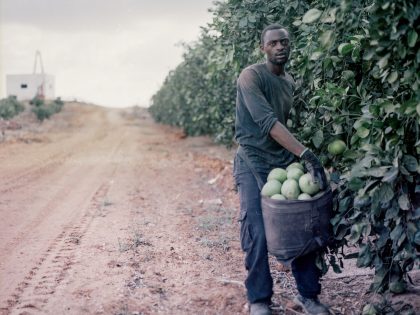
The proliferation of photographers documenting poor whites in South Africa is something to behold. This is significant since poor whites are only a fraction of the total white population — 450,000 out of  4.5 million live below the poverty line and 100,000 are struggling just to survive. We’ll spare you the numbers on black South African poverty. Of the recent ones, Finbarr O’Reilly’s series on Coronation Park is probably the most celebrated. It has been splashed all over mainstream international publications and websites. Less well-known is the work of Kim Ludbrook, Ben Krewinkel’s Toe Witmense Arm WasRiaan Labuschagne, Lisa Skinner, Jordi Burch’s Poor Boers, Dean Saffron’s Poverty has no colour, Susanne Schleyer and Michael Stephan’s Bitter Fruit and Nadine Hutton’s I have fallen. There are probably some we’ve missed. Not all of them went to Coronation Park.

[Read more...]

“You’re a South African, what’s your story?”

New Zealand is often sold to prospective (mostly white) South African immigrants as “South Africa 30 years ago” (wink, wink). That version of an Edenic idyll is not entirely what a young South African found New Zealand to be recently in a local version of Occupy Wall Street in Dunedin. In a scene captured by amateur video (which made the rounds last week on the internets), an angry drunk protesting the protesters threatens to break down tents and generally makes a nuisance of himself. One of the vocal protesters–our equality-and-justice-minded South African immigrant–leads a chant against the intruder, and then decides to reason with the drunk. “You’re a South African … What’s your story?” asks the drunk. Perhaps he is appealing to some kind of shared kinship: privilege, siding with capital or power, or disdain for protesters. Saffers and Kiwis. Maybe, the drunk New Zealander is just confused about why a white South African would be protesting capitalism’s evils, when one of the finest versions of all that capitalism engineers was what the South African republic was founded upon. Or maybe he’s wondering why so many white South Africans seek refuge in what the man deems to be his country, and now, wants to protest …what?

Whatever.

[Read more...]

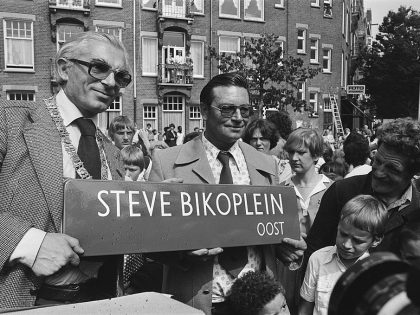
The Dutch Disease

What is it with Dutch cultural elites and South Africa?

[Read more...]

Fair and Lovely

Horrified by the skin-lightening creams you see advertised in the cityscapes of Africa?

Wait till you see the adverts people walk past daily in India or Sri Lanka. This huge billboard (above) sits somewhere on the 10-kilometre distance from Kelaniya (my family’s ancestral home) to Colombo (the city). The script below the ever-whitening out images of the model says: “For white/light skin, apply daily”.

South Asians have Africans beat on this front.

[Read more...]

White Writing

Years ago, during my first years as a hired hand in academia, I was more careful about doing The Right Thing. I’d read JM Coetzee’s Waiting for the Barbarians as a student, and something clicked for me – the colonial mentality, the hopeless fantasies of each successive militarised ‘civilisation’ – in a way that no amount of theory had done. I became an instant acolyte of the Master’s writing. In 2005, attended my first JM Coetzee conference, at Royal Holloway: the university for those sons and daughters of the wealthy who didn’t make it to the Oxbridge universities (this according to a friend who went to Oxford on scholarship).

Anyhow, it was an all-white affair. I was the token brown person there, except for a British Indian student who flitted in and out of a few sessions. (Another academic leaned over and said, conspiratorially, that this young man sends him “fawning emails”. Right. Not only was I being handed the ubiquitous racist caricature of the arse-kissing Indian, but I was being invited into the ‘club’: my sarcasm had permitted me to leap over the Indian hurdle, and into white acceptability. Goody for me.) During a couple of sessions, when some students from continental Europe were presenting (albeit somewhat poorly constructed papers), the UK-and South Africa-based white academics trashed them publicly, right there during the session. This was not a place to come to be informed, gently directed, or invited to an ongoing conversation, but a location in which territory was reinforced, and the ‘right’ of the few to belong staked out.

At the end of the conference, everyone gathered in the large auditorium to take a group photo. I didn’t get in on that. Someone asked me why I didn’t want to be in the picture, and I said that it was because I’d lose my Coloured People’s Credentials. Weirdly enough, though my own paper was quite rubbish (it was my first year as an academic, and I spent a lot of time writing drivel), I was invited to send in a revised version for a collection of essays, compiled from that conference. I never could get motivated to do it. I guess I realised, even then, that I was being asked to be the Sole Brown Representative in a book of essays about JM Coetzee. I couldn’t do it.

Instead, I wrote about how that experience taught me a thing or two about the reification of ‘white’ culture by scholars of Southern African literature, via the objectification of JM Coetzee – using his person, as well as his writing. I presented that paper at a Chimurenga Session in 2009, in Cape Town. It was a liberating experience.

[Read more...]

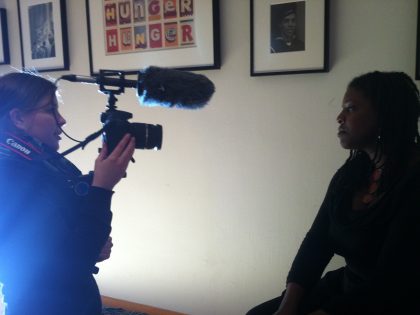
Interview: Filmmaker Yoruba Richen

Updated: Check out this brand new AIAC interview with Yoruba Richen director of the documentary film, “Promised Land,” about postapartheid land politics in South Africa. It was shot by brand new AIAC contributor, Anni Lynskaer (Danish journalist; New School student).

[Read more...]

White History Month

… So much of Black History Month takes place in the passive voice. Leaders “get assassinated,” patrons “are refused” service, women “are ejected” from public transport. So the objects of racism are many but the subjects few. In removing the instigators, the historians remove the agency and, in the final reckoning, the historical responsibility … There is no month when we get to talk about [James] Blake [the white busdriver challenged by Rosa Parks]; no opportunity to learn the fates of J.W. Milam and Roy Bryant, who murdered Emmett Till; no time set aside to keep track of Victoria Price and Ruby Bates, whose false accusations of rape against the Scottsboro Boys sent five innocent young black men to jail. Wouldn’t everyone–particularly white people–benefit from becoming better acquainted with these histories? What we need, in short, is a White History Month … The very notion of black and white history is both a theoretical nonsense and a practical necessity. There is no scientific or biological basis for race. It is a construct to explain the gruesome reality that racism built. But, logic suggests, you cannot have black history without white history. Of course, the trouble is not that we do not hear enough about white history but that what masquerades as history is more akin to mythology. The contradictions of how a “free world” could be founded on genocide, or how the battle for democracy during the Second World War could coincide with Japanese internment and segregation, for example, are rarely addressed … It would offer white people options and role models and all of us inspiration while relieving the burden on African-Americans to recast the nation’s entire racial history in the shortest month of the year. White people, like black people, need access to a history that is accurate, honest and inclusive. Maybe then it would be easier for them, and the rest of us, to make history that is progressive, antiracist and inclusive.

British journalist Gary Younge in a 2007 column in “The Nation”–that’s still worth repeating–on Black History Month (that’s every February here in the US).

Film: ‘The Killing Of The Imam’

I chanced upon this 10-minute short film, “The Killing of the Imam,” which recounts the murder of Muslim cleric, journalist (he founded the newspaper “Muslim News” in 1960) and political activist (he was closely linked to the Pan-Africanist Congress), Iman Abdullah Haron, by Apartheid police in South Africa in 1969. The police claimed he had fallen down the stairs. Made by his grandson Khalid Shamis, the film mixes “… animation, documentary and archive.”

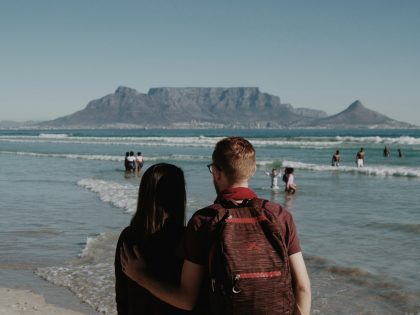
Learning Zulu

By Kristin Palitza
Guest Blogger
The plane hits the tarmac with a brief thud. I have landed in South Africa, for the first time. As I exit through the sliding doors of the baggage claim area, an elderly woman is waving at me. She works with Amnesty International, one of the organisations I have come to volunteer for, and she has kindly offered to host me for the first couple of weeks of my stay, until I find a place of my own.

She is talkative. On the way from the airport to C.’s home, I am told a variety of colourful and impressive stories about her life. I presume they are meant to give me (a) an introduction to my host and (b) an insight into the recent political history of the country. C. is not shy to talk about her achievements as a liberal white in the anti-apartheid struggle. And she has every reason not to be. She was a member of the Black Sash and had many black friends, who she didn’t hesitate to drop off in townships after curfew, when demonstrations ran late, even though her husband thought it too dangerous. To defy segregation and unfair apartheid laws, she also went swimming with black friends on a whites-only beach, risking arrest. According to her husband J., the apartheid regime soon took such a strong interest in C.’s political activities that its spies rented the house opposite their home to be able to watch her every step.

[Read more...]

Follow

Get every new post delivered to your Inbox.

Join 2,265 other followers