From Zetina Mosia’s upcoming album “The RoundAbout”, this track: ‘Lately’. We’ve said this before, but the Johannesburg label Iapetus is an exceptional breeding ground for South African artists — remember Fifi the Rai Blaster, Yugen Blakrok, Robo the Technician or Gin i Grindith — with a special mention for Kanif, the producer behind many of the songs.
Rare: Conscious Kwaito
South African kwaito house with an explicit message: we don’t get to hear it often. Shota’s Etshwaleni has been playing in clubs for months, I’m told. Its straightforward lyrics make it stand out: have fun while still respecting others (“hlonipheni abanye abantu”) and drink responsibly (“pasop ugu dakwa”) during sleepless (“asisalali”) weekends. But you figured that much from the video.
Sindiso Nyoni’s Riot Art
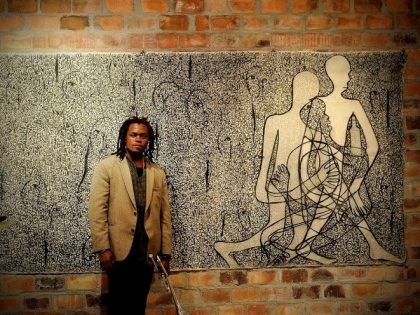
Short recent video profile by VOA’s Nico Colombant of the Zimbabwean artist, illustrator and designer R!OT (also known as Sindiso Nyoni).
Do people believe ex-prisoners can change their ways?
That was the question asked to people in Cape Town, South Africa, by the Prison Broadcasting Network (PBN), “a non-profit rehabilitation programme that teaches prisoners the skills to become employable when they are released.” I found the responses unsurprising. But the video has a twist.
Spoek Mathambo’s World
No we’re not on a mini-Spoek Mathambo marathon today. Intrigued by Spoek’s remix of Seun Kuti and the trailer for his new album, we googled Spoek anew and stumbled upon this video of a 2011 presentation Spoek gave at TedxSoweto (it was only uploaded onto Youtube at the end of last month). What I find useful about the video is that it offers a compact picture of Spoek’s biography: from Soweto via the “suburban island” of Sandton to where he finds himself now as a sort of global electro-rapper. It’s worth the 20 odd minutes if you want to get a sense of his influences. He talks about his record collections, his dad’s record collections, local and international musical influences (including Max Normal/Waddy Jones of Die Antwoord fame), South Africa’s HIV culture of fear, cultures of kwaito and party, Ghanaian and Nigerian film posters (where he referenced his last album cover), the inspiration of Nigerian DIY (horror) movie culture, making Africa a smaller place through new media, the crucial point of representation (“the more that we don’t represent ourselves, the more people will make careers out of misrepresenting us or representing us the way they want to represent us”) and his collaboration with fellow South African, photographer Pieter Hugo (and Hugo’s critics). Hugo’s work is contrasted with that of American photographer Phyllis Galembo on West African masquerades and South African artist Michael MacGarry. He also gives his interpretation of ‘Umshini Wami’, and his fundamentals: “How am I representing myself? How am I representing the people of Africa? And is accuracy [when building a ‘speculative fiction’ through his work] important?”
Necessary doses of pan-Africanism

Take it with your vitamins. K’Naan and Nas’s “Nothing to Lose” video qualifies. So does Spoek Mathambo remixing Seun Kuti. Kuti tours the US this summer and Mathambo has a new album coming out in a few weeks. This track, “The Good Leaf,” is the last track on Kuti’s latest release, “From Africa with Fury: Rise” and was posted on The Fader’s soundcloud account this week. You can download it for free, but here’s the track anyway: [Read more...]
February 11, 1990

Today, 22 years ago, Nelson Mandela walked free from a prison outside Cape Town. Four years later, in April, the ANC won South Africa’s first democratic elections and in May 1994, Mandela was inaugurated as South Africa’s first black president. These were, however, only 22 years in the 100 year history of the ANC and in the long history of colonialism, Apartheid and now brief freedom in South Africa. Last month the ANC held a massive party in Mangaung, the place where it was founded in January 1912 by a small group of activists. Hundreds of thousands people headed to the capital of the now Free State province. But this is also a different ANC. Its legacy is not so clear cut anymore and we have covered the personalities that shape it as well as some of its calamities on this blog. Amongst the thousands at the ANC celebrations in Bloemfontein was Prexy Nesbitt, a trade unionist, college professor (he’s taught for years at Columbia College) and leading figure in the US anti-apartheid movement as well as the liberation struggles in Angola and Mozambique between the 1960s and the 1980s. He has a long association with Southern African freedom movements. When Prexy returned to his home in Chicago, he jotted down his impressions of the celebrations, of the ANC and South Africa. With his permission we republish it here. We think it is a fitting reflection on the commemoration of a momentous day. –Sean Jacobs [Read more...]
Surfer dude
Surfing as leisure and a sport has historically been associated with whites in South Africa, though that’s not necessarily true in practice. In fact a few documentary films (for example, “Taking back the waves“), the new feature film “Otelo Burning” and the work of photographer Richard Johnson (scroll to the right) have pointed to a long tradition of surfing among young black people in South Africa’s coastal cities.* So, I always wondered when some creative director would pounce on the idea to commodify that history and struggle for recognition. Well, Cell C, a mobile/cell operator has done so now as part of its “Be Now” campaign targeted at young people with an ad focusing on”budding” semi-pro surfer Avuyile Ndamase from the Eastern Cape province.
* The recent documentary, “Whitewash,” interrogated similar themes in surfing in the United States.
Tech Apartheid

Our tech posts never stray from tweeting new data on Twitter and Facebook usage on the continent–but now and then–as occasional readers of Gizmodo and Kotaku–we pause:
Shameless Self Promotion

Two Africa is a Country contributors–Neelika Jayawardane and Kathryn Mathers–have pieces in the latest issue of Transition, the Harvard creative writing magazine. That’s the cover above with the theme “Blending Borders.” Neelika’s article “Everybody’s got their Indian,” (you need a subscription) is on racial politics in postapartheid South Africa. Though she’s been meaning to write about this topic for a while, I know this visit to South Africa let to the piece. Kathryn’s has a similarly provocative title, “Mr Kristof, I Presume.” (Hers you can read in full. The link takes you a PDF of the article.) Here, before you click away, is the first page of Kathryn’s article: [Read more...]