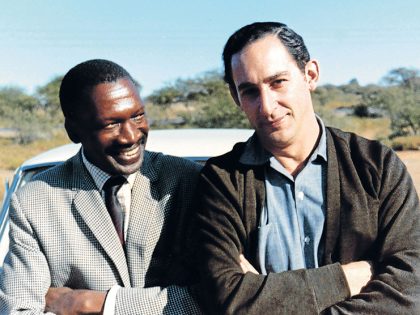
Information on famed South African photographer Ernest Cole’s decision to ‘pass’ from ‘African’ to ‘coloured’ in Apartheid South Africa’s kafkaesque “race classification system” is not readily available beyond the ready-made theories and rationalizations repeated in museum catalogues or on websites. From those sources we get glimpses of his anxiety or the stress the decision brought on his family in short scenes from the only documentary film on Cole’s life, that by the photographer Jürgen Schadeberg. But even then, Schadeberg’s film neatly sidesteps the issue of passing by not probing Cole’s motives. Like with play-whites (coloureds who passed for whites), we won’t know how many ‘play-coloureds’ there were. What the writer Zoe Wicomb has said of play-whites applies: “We don’t even know how many of them there are. There’s no discourse, nothing in the library, because officially they don’t exist [anymore].” [Read more...]
The ‘passing’ of Ernest Cole
First Lady Marieme Faye Sall: ‘The good Senegalese woman’

Joyce Banda of Malawi, the newest President of an African country–and only the second sitting African president who is a woman–is getting all the love for her achievements.* (So what if her ascendency came about due to the death of an aging president and his politically weak, colluding brother?). There is also much chatter on the internet about Malawi’s new First Gentleman, retired Chief Justice Richard Banda (with whom Madame Banda has two children). However, the Senegalese might suggest that their country’s new first lady, Marieme Faye Sall, represents a “bigger” deal in how her move to the presidential palace breaks with Senegal’s political history after independence.
The Afrikaans movie template
The creatives at South African satellite TV channel Kyknet — which also produces movies now — not only blatantly rip off American romantic comedy plotlines, but inhabit a South Africa where there is not a single black face to be seen. On the other hand, maybe they’re being honest.
‘An extra day to be black’
I know we’re already seven days into March, but visual artist Michael Paul Britto’s request for ‘an extra day to be black’ in mainstream media outlets, still holds. (For those in the dark, he is ripping into Black History Month.)
Surfer dude
Surfing as leisure and a sport has historically been associated with whites in South Africa, though that’s not necessarily true in practice. In fact a few documentary films (for example, “Taking back the waves“), the new feature film “Otelo Burning” and the work of photographer Richard Johnson (scroll to the right) have pointed to a long tradition of surfing among young black people in South Africa’s coastal cities.* So, I always wondered when some creative director would pounce on the idea to commodify that history and struggle for recognition. Well, Cell C, a mobile/cell operator has done so now as part of its “Be Now” campaign targeted at young people with an ad focusing on”budding” semi-pro surfer Avuyile Ndamase from the Eastern Cape province.
* The recent documentary, “Whitewash,” interrogated similar themes in surfing in the United States.
More Benetton Politics

I swore I wasn’t going to add a thing to the discussion about the idiotic poster campaign by the student/youth wing of South Africa’s opposition Democratic Alliance about a future non-racial love-fest. I have remained shtum (yiddish for ‘quiet’) about its horrid aesthetics, its awful family snap-shot quality. (Some have claimed it’s like a Benetton or Calvin Klein commercial which should leave said brands reeling). I have silenced myself in the face of the straight(ened) hair of the black model which, seriously DA students, is insulting. And, of course, I, like many others out there, have been annoyed at the shallowness of their vision of a non-racial future. Here in North America, it’s reported as a “racial furore” and “heated debate”. But then I heard “Q” on CBC radio the other day. And watched CNN yesterday morning. [Read more...]
Thandie Newton cast in Biafran War movie; some opposed: she’s “bi-racial” and “not Igbo”
‘
I confess that I have never been able to finish Chimamanda Adichie’s second novel, “Half of a Yellow Sun,” set during the Biafran War in the late 1960s. (Btw, it won high praise from mainstream Western critics. See here, here and here.) By the time I finally do finish it, the film version will probably be in theaters. The Nigerian-British actor Chiwetel Ejiofor (highlights: Dirty Pretty Things and Inside Man) has already agreed to star in the film adaptation, alongside with Dominic Cooper (Captain America). This week Screen Daily reported that Zimbabwean-Brit actress Thandi Newton (credits: Crash, Mission Impossible) will be a female lead. Not everyone is happy with the choice of Newton as a female lead. There’s already a strange online petition to have Newton replaced with a Nigerian actress. The petition notes, among others, that “… Igbo people do not look like the bi-racial Thandie Newton.” You can read similar comments on posts about Newton’s casting at the popular film blog Shadow and Act here and here. [Read more...]
Benetton Politics

South Africa’s Democratic Alliance, usually very slick and media savvy, have really outdone themselves with a new campaign by its youth wing. Fresh out of leader Helen Zille’s troublesome ‘AIDS Gestapo’ views and calling the ever disgruntled musician Simphiwe Dana a “Professional Black” on Twitter, the DA now give us this poster, above.
Afrikaner Bloods
Now and then I’ll scan the international media for reports about “heightening tensions between black and white South Africans.” They never disappoint. (Serious, try it.) Moreover, it seems to have become standard practice to believe and copy each other’s stories. (Incredibly, even Think Africa Press recently wrote tensions flared.) [Read more...]
‘The whole African American thing’
UPDATED: NBC’s “Late Night with Jay Leno” is hardly considered a cultural arbiter anymore (except for its baby boomer viewers and for the mostly white supporters of the Republican Party) but in South Africa the appearance of comedian Trevor Noah on the show last week is big news. Noah is a big name back home for his send-ups (more like impressions) of popular politicians and racial stereotypes, some more successful than others, and for shilling for a mobile phone company. Nonetheless, having heard so much from people in South Africa about how funny Noah is–and he is certainly talented–and happy to root for fellows from the continent, I was excited for his first appearance on American TV. Significantly, Noah was apparently also the first African comedian to appear in the stand-up slot for young comedians on the show (a few big name African-American comedians are regular featured guests already). That’s an achievement of sorts. Sadly, Noah’s performance turned out to be unfunny. [Read more...]