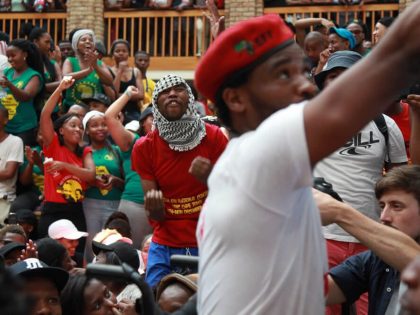
South Africa’s Democratic Alliance, usually very slick and media savvy, have really outdone themselves with a new campaign by its youth wing. Fresh out of leader Helen Zille’s troublesome ‘AIDS Gestapo’ views and calling the ever disgruntled musician Simphiwe Dana a “Professional Black” on Twitter, the DA now give us this poster, above.
Benetton Politics
What to make of Julius Malema
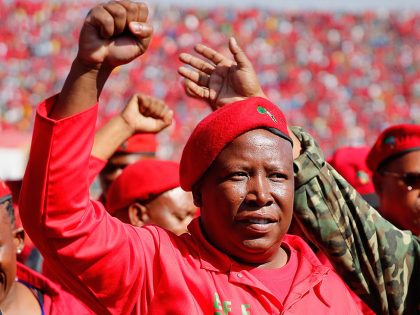
Julius Malema, the young ANC leader recently described by Winnie Mandela as “the future President of South Africa” can get a rise out of people. And he is often a stand-in for all kinds of prejudices. As comic artist Nathan Trantaal told AIAC recently: ”… The South African mainstream likes to have a black man they can laugh at, a black man who says something that is so obviously wrong they can jump at the opportunity to lampoon him. Take Julius Malema, for example. I don’t particularly like the way people talk or write about him. I mean, he’s a dumb bastard, but there’s just something very uncomfortably self-righteous about it. Don’t call a black person dumb in the media every single day. “Dom Kaffir” [dumb kaffir] is what the old government used to say. And whether it is deliberate or not, it has that undercurrent.” Which is why the blog Think Africa Press’ round-up of South African expert opinion on Malema, is so valuable. Here’s a sample from the expert comment by political economist (and former broadcaster) Hein Marias–he wrote the new book South Africa Pushed To The Limit: The Political Economy Of Change:
‘The Art of Citizenship in African Cities’
Two-day conference on May 6 and 7 on the campus of Columbia University in Manhattan’s Upper West Side :
Pushed to the Limit
Political economist Hein Marais’ 1998 book, “South Africa Limits to Change: The Political Economy of Transition,” is a classic of the late 1990s. I have described Marais before, on this blog, as “… one of the trenchant critics of South Africa’s [political and economic] transition,” and the book “a masterpiece.” This past week Marais’ follow-up book, “South Africa Pushed to the Limit: The Political Economy of Change” came out in South Africa. Zed Books will publish the international edition in January 2011. But you get a preview the introduction of the book here.
No Sense
Some rappers should just stay away from politics. Take T-Pain’s endorsement of “a conversative [Republican] victory [in] 2010.” (If you forgot, watch Jay Smooth break down T-Pain’s nonsense here.) Then there’s of course the Senegalese-American R&B singer, Akon, who imagines himself some kind of African political leader. (That’s Akon and Senegalese President Abdoulaye Wade, above, earlier this year in New York City announcing Wade’s vanity project, the World Festival of Black Arts, taking place now through the end of the month in Dakar.)
‘The new model for African democracy’
“… This model of negotiations leading to a coalition government in the wake of a violence-plagued [December 2007] election [in Kenya] is being tried in Zimbabwe and has been recommended in Madagascar. The model is an inclusive one, and has been championed in some academic and political circles as the new model for African democracy. It is no such thing. These coalitions are the result of democratic failures, not successes. Throughout Africa, uniting belligerents under one roof has resulted in policymaking paralysis and resentful voters, angry that the governments they have are not the ones any of them elected.”
Till Jesus Comes
Jacob Zuma, South Africa’s President, may not after all, rule as he promised “till Jesus comes“*.
Republic of Women
70% of Rwanda’s population are women.
Via A24media.com
Mozambican Democracy
Elections in Southern Africa is usually one big party if you’re the ruling party and if you’re not in Zimbabwe. Take Mozambique, South Africa’s small neighbor to the northeast, where the rapper MC Roger sells record on the back of the electoral campaigns of the ruling Frelimo (they’ve governed uninterrupted since independence in 1975–the opposition is so bad and tainted). You may not be a Frelimo supporter–they won the elections at the end of last year–but you’ll tap your feet to this tune, “Mocambique sempre a subir” (Mozambique is always improving). Nice beat.
Via Anne Pitcher
Democracy, Tunisian Style

Tunisia’s President, Ben Ali, wins his fifth election since 1987 by a 99 percent margin after he decided on the candidates who could run against him. Before the result is even out he threatens anyone who questions the legitimacy of the poll with libel and possibly prison. According to him the doubters are not patriotic enough and “… have forgotten their moral duty of good behavior.” Oh, and Congo’s Senate President headed the list of foreign election observers who declared the election free and fair. (One of the election monitors compared the election to one run in Surrey in the UK. Apparently Gordon Brown decides who can run against him.)
Ben Ali can’t run again in five years because of age limits. He is 73 years old.
Ben Ali’s government is “… a strong U.S. and European ally.”