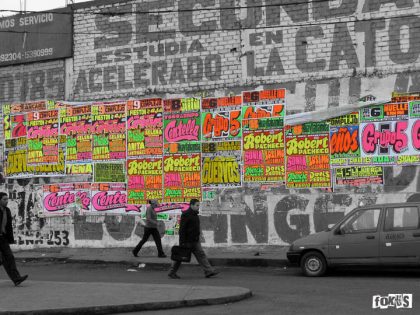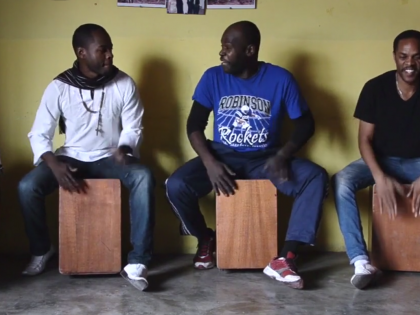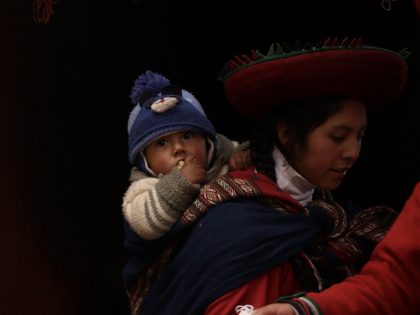
Puerto Rican band Calle 13 got their Peruvian fans talking today when they released the video for ‘Latinoamérica’ (which they partly recorded in Peru). And not just because it has their new (and first black) Minister of Culture Susana Baca in it.
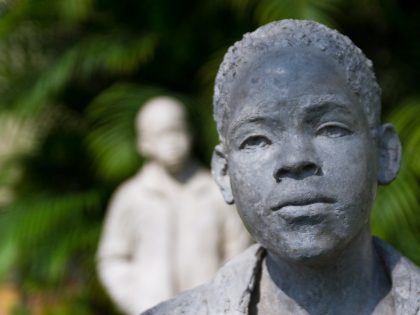
Not sure whether Peruvian author Mario Vargas Llosa’s new novel, El Sueño del Celta (The Dream of the Celt), has been published in English yet — so I might be spoiling it for some future interested readers if it hasn’t — but halfway through the story about the Irish diplomat-turned-nationalist Roger Casement, I already regretted coming across these photographs by Juan Carlos Tomasi (samples above and below) before reading the book. I couldn’t help but picture Casement (who was sent to Congo in 1883, where he met H.M. Stanley and Joseph Conrad) as a nineteenth century Vargas Llosa on a field trip. Granted, the book is much better than Sir Vidia’s.
Wired.com, which usually knows better, has a photo gallery on its site that “takes you on a tour” of “the last uncontacted people.” What drove them to publish the images are “the release … last week of a tribe in southwest Brazil.” And because publishing images of people who didn’t necessarily permit their bodies and images to be used is for our collective good. The writer notes that most of these “uncontacted tribes” (he slips between “tribes” and “people” a lot) live in the Amazon, but also India and Peru, and “are often described as living fossils of Stone Age life, flash-frozen in time.” The post contains this disclaimer: “… Such descriptions are unfair: We don’t really know how people lived in the Stone Age, and there’s no reason to think that uncontacted cultures have not continued to evolve in their own unique ways.” It also contains “an Editor’s Note” accompanying a photo of “the tribe in southwest Brazil”: the machete in the photograph was likely obtained through trade with Indians who have made contact.” I also got my bread knife from some people who made contact with the local Walmart – who made contact with some people making knives in China.
A really nice new video from the Afro-Peruvian roots-electronic crew out of Lima.
Not too many people in the U.S. (or on the African continent) are aware of the existence of the African descended cultures on the Pacific coasts of Colombia, Ecuador and Peru, even if there’s a community in the neighborhood. So I was really surprised when I saw Novalima’s song “Machete” on an Angolan chart a couple years back. If you listen close, you can hear some Kuduro-Kizomba type motifs in their style, and it’s not to hard to imagine the crossover potential. As evidenced by my obsession with the Colombia-Africa thing, it’s these types of unexpected connections I really get into.–Chief Boima
The media blog that is not about famine, Bono, or Barack Obama. Contributors are: Sean Jacobs (he started AIAC), Brett Davidson, Gregory Mann, Will Glass, Neelika Jayawardane, Kathryn Mathers, Marissa Moorman, Lily Saint, Melissa Levin, Dan Moshenberg; Caitlin L. Chandler; Dylan Valley; Abdourahman Waberi; Boima Tucker, Anni Lyngskaer, Sophia Azeb, Tom Devriendt, Loren Lynch, Basia Lewandowska Cummings, Elliot Ross, Orlando Reade and Megan Eardley; Hinda Talhaoui; ‘kola (Bukola Jejeloye); and Mikko Kapanen. Pre-August 2009 posts are archived here.