Nollywood and Hollywood


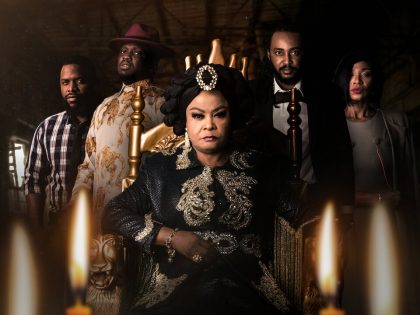
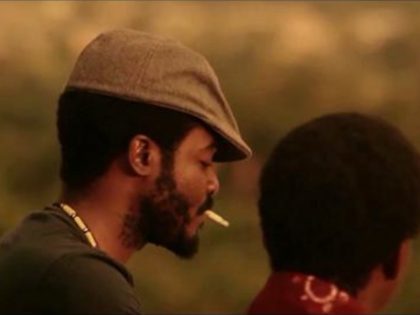
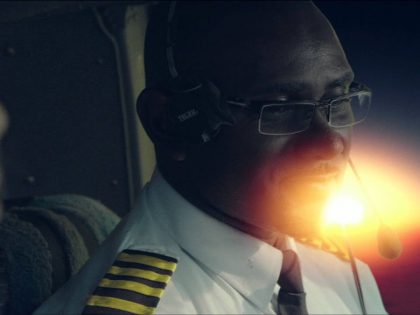
In a recent article in The Guardian, Phil Hoad writes that ‘maverick’ Nigerian director Jeta Amata is perhaps ‘Nollywood’s gift to Hollywood’, for Amata’s recent feature is a Hollywood-friendly big budget epic, delving into the horrific situation in the Niger Delta and the havoc that the oil industry leaves behind. Hoad’s article is a nice survey of Amata’s current status, yet it fails to truly explore how Nollywood could affect a wider cinematic context. Hoad is writing about Amata’s upcoming feature Black November, a gritty epic of oil-fuelled conflict, collusion and unrest, which features an all-star cast, both from Hollywood and Nollywood (Billy Zane, Vivica Fox, Eric Roberts, Mickey Rourke, Kim Basinger, Anne Heche, Hakeen Kae-Kazim and Razaaq Adoti).

[Read more...]

The first-encounter aesthetic rush

If you’re wondering what took us so long to say something about South African rapper Spoek Mathambo’s new music video — for his cover of Joy Division’s “She’s Lost Control” [corrected], well, we can’t make up our mind about it.

The video, above, got a lot of attention when it first came out in late February as it was directed by Spoek’s countrymen, celebrated photographer Pieter Hugo and Michael Cleary (cinematographer of ‘Not everything was cool back then‘). Hipster blogs and mainstream Western media love the video, though we don’t learn much from them beyond repeating the PR copy.

[Read more...]

T.I.A. (Nollywood Edition)

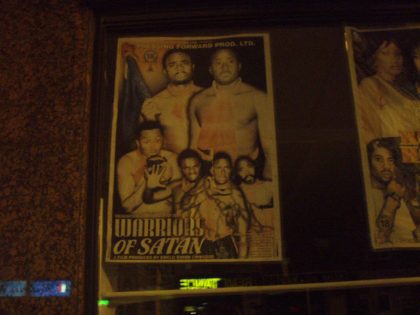
Nollywood film posters in a store window on Nostrand Ave. in the Bedford-Stuyvesant section of Brooklyn.

Photo: Boima.


The Nollywood Recipe

Nigerian director and producer, Ade Adepegba, speaking ahead of the new film festival, Nollywood Now–apparently the first entirely dedicated to the genre–that takes place in London from 6-12 October:

Nigerians are the largest group of Africans living in the UK, and the majority of them live in London … Nigerian films still hold their strongest appeal to first generation immigrants who feel a deep attachment to their homeland. So, at the moment nostalgia is the main reason for the appeal of Nollywood.

And Nollywood Now’s creative director, Phoenix Fry:

[Read more...]

Pieter Hugo’s Nollywood

Neelika Jayawardane
I first saw Pieter Hugo’s ““Nollywood” at the opening party for his exhibit at Michael Stevenson Gallery in Cape Town, South Africa, in January 2008. I went with a group of my students from the State University of New York; I suppose I wanted to terrorize them with the snobbery that is intrinsic to Capehaute events: Yes, this, too, is Africa, Dorothy.

[Read more...]

Weekend Links

Stuff I missed or was too tired to give adequate attention to over the last few days:

* Great commentary on the proposed Hollywood biopic of Winnie Mandela starring Jennifer Hudson as the mother of the nation. [Black Agenda Report]

* Why is Holland Cotter the only North American art critic that does justice to African art? Like in his piece of a new show, “Through African Eyes: The European in African Art, 1500 to Present” opening this Sunday at the Detroit Institute for the Arts [The New York Times]

* Another superlative review of Connie Field’s 7-film set about the struggle against Apartheid, “Have You Heard from Johannesburg” [Art Forum]

[Read more...]

Is this Nollywood?


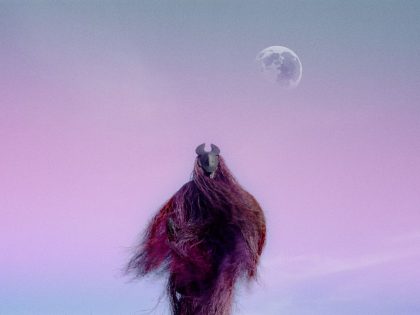
With few exceptions, I usually celebrate South African photographers. Among them is Pieter Hugo, whose most recent work, “Nollywood”– a series of portraits recreating what for Hugo represents “archetypical characters” from the southern Nigerian film industry–opens tonight (from 6:00 to 8:00 pm) at Yossi Milo Gallery in Manhattan (525 West 25th Street). Anyway, not everyone is as pleased with Hugo’s portrayal of Nollywood. I received this email last week:

I thought it [is] all [the] way off. Not in a white/black or outsider/insider way, but just off: I don’t get the feeling that Pieter [has] seen or read a single Nollywood thing. As someone who has seen, oh, a 100 of these films (which is admittedly 98 too many), I thought: (a) there are things to appreciate and things not to, and [he does not] seem to get that, (b) what’s the deal with the freaks ‘n fatties theme? particularly seeing as it is completely absent in the films themselves, (c) it’s just a strange, strange perspective on nollywood, in a really un-nice way. I guess I sound like I’m ranting unnecessarily, but it annoyed me that [he's] being celebrated mildly when in fact it seemed as if [he] should be mildly ignored.

What do you think?

Pieter Hugo’s Nollywood

You can see most the photographs from Hugo’s “Nollywood” project (now a book) on his website, along with an introduction by Federica Angelucci and an essay, “Nollywood Confidential” by Cape Town-based Stacy Hardy. The actual book also includes a short story by novelist Chris Abani (“Omar Shariff Comes To Nollywood. A Storyboard In 10 Frames”) and another essay, “No Going Back,” tracing the history of the Nigerian film business by Zina Saro-Wiwa.

THE FIRST ‘QUALITY’ NOLLYWOOD FILM?

[Read more...]

COMMENT: DISTRICT 9 AND THE NIGERIANS

district9seven_500

Nigerian-born, Brooklyn writer, Teju Cole, writing in Nigeria’s NEXT newspaper:

Even making allowances for the fact that [District 9] is a fable, with strong elements of satire and allegory, the one-dimensionality of the Nigerian characters is striking.

The Nigerians live in District 9 with the prawns, and sell cat food to them (the prawns are cat food addicts) in exchange for weapons. In addition, the Nigerians run a prostitution ring (renting out their women for sex with the aliens) and occasionally murder prawns to use for juju.

In other words, the most violent and offensive clichés of Nollywood have been grafted onto the film, without the humanising, narrative context of Nollywood.

[Read more...]

Follow

Get every new post delivered to your Inbox.

Join 1,912 other followers