Fly-by-night Journalism

In one of the oddest welcomes to the new year, Eurasia Group included South Africa as one of ten on a list of “Top Risks for 2012.”*  Other entries include North Korea, Pakistan and Venezuela. On Al Jazeera English’s program “Counting the Cost,” during an interview with 2 representatives of Eurasia, risk no.9 became “South Africa (ANC).” (See the 7.50 mark in the linked Youtube video.) The same kind of hysterical sentiment (because it is not analysis) informs media coverage of the ANC’s one hundredth anniversary celebrations this past weekend. From the media you’d get the impression that the party’s celebrations were being held to an empty stadium (with only Jacob Zuma and Julius Malema present) and that the ANC’s support (largely grassroots) had deserted it. Instead we know, as the New York Times had to point out, that “tens of thousands” filled a stadium in the Free State provincial capital Manguang. Elsewhere we learn that millions watched it live on TV. A quick scan of the hashtag #ANC100 on Twitter suggest most people who watched or talked about the celebrations got the significance of the date and the achievement as well as the ANC’s continued pull in South Africa. So did people’s status updates on Facebook. They know the ANC is not just Malema and Zuma.

[Read more...]

The Hall of Shame


Before Boima rides us out this year with West Africa’s best dance tunes, we couldn’t resist including a post with some of the lowlights of 2011.
[Read more...]

Malema time

The levels of existing poverty, unemployment and material inequality in South Africa are politically and socially unsustainable. This much has always been true. For the country to flourish, democracy –in that well worn cliché –must deliver a “dividend” through the material improvement of the lives of the poor majority.

Towards this end, the ruling ANC has failed–under often difficult circumstances of course.  Massive housing, electrification, sanitation and social grants schemes – while admirable – have arguably transformed the masses into lumpen recipients of goods; clients to a system that perpetuates aspects of destitution without changing them.  Increasingly, the ANC’s failures stretch beyond the confines of economic policy-making as the party –increasingly the preserve and battle-ground of elites–sets a course adrift from the grievances, concerns and aspirations of the very citizens they claim in their name.

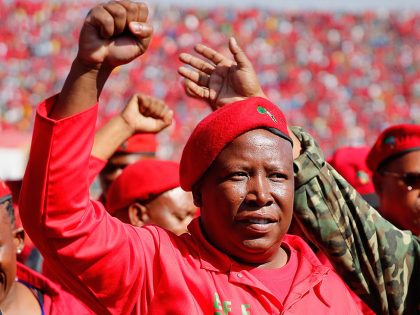
The suspension today of Julius Malema, President of the ANCYL, and his rise and fall, must be read against this backdrop.

[Read more...]

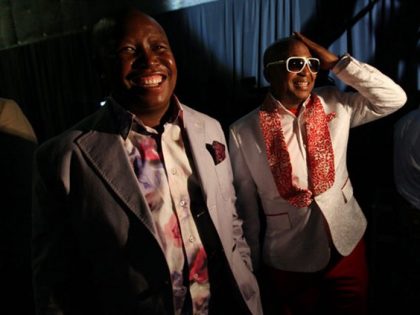
‘Julius Malema sets the cultural agenda’

[Read more...]

The Dutch Disease

What is it with Dutch cultural elites and South Africa?

[Read more...]

‘Nigeria’s own Donald Trump’

MTV Base, the music channel’s African subsidiary carried on satellite TV, have been making these upbeat video features, where a group of upwardly mobile young Africans–most based on the continent–interview leading businesspeople, entertainers and a few public representatives (I spotted Julius Malema and Paul Kagame in the series promo). At the same time the interviewers are also profiled. The videos come in at 20 minutes or so and are sponsored by cell phone company, MTN.

A few are online. The first is an interview with Nigerian business tycoon, Aliko Dangote, who has a reputed net worth of US$13.8 billion and is the 51st richest man in the world. The presenter hypes Dangote as “Nigeria’s own Donald Trump” which is odd since Trump is hardly a successful businessman.

[Read more...]

Pseudo-cosmopolitanism

More from that 2008 Comparative Literature interview with my favorite Communist poet, Jeremy Cronin. Bua Komanisi:

… A sense of audience has always been important for me. When I write a poem, or when I go back to an old poem, I try to listen to it with the ear of someone else, perhaps an audience, real or imagined. One audience whose feedback and engagement I have always appreciated is the relatively small circle of fellow South African poets, critics, and academics teaching poetry. But I have also always wanted to write a poetry that is generally accessible to a wider audience.

In this I have not always succeeded, of course. The failing is not just personal; there are many objective challenges. There are, for instance, eleven official languages in South Africa, and while English is the major lingua franca, writing poetry in English is not necessarily an advantage. Afrikaner nationalism, with all of its reactionary tendencies and faults, was centrally a cultural and language-based movement, and poetry was (and still is) cherished amongst a broader Afrikaans-language public. This has never been the case with the often pseudo-cosmopolitan, white, English-speaking community into which I was born. Major English-language South African writers—like the two Nobel laureates, Nadine Gordimer and John Coetzee—tend to be much better known outside of South Africa and tend to write, one suspects, with a European or North American audience in mind. For me, oral performances, particularly in contexts which are not narrowly poetical (a trade union meeting, or a political conference, for instance), have been a very important means for reaching a wider, more diverse audience.

Source: Comparative Literature.

Putting up with being insulted by Malema

UPDATE: The South African Civil Society Information Service (SACSIS) keeps bringing it. This is not the handwringing of The Daily Maverick passing for insight. Most of the op-eds on the site go over the heads of the people its intended. Others dismiss it as partisan or ideological because they can’t take the truth.  Recently they carried an op-ed by Jane Duncan on the rightwing political ideology of the Democratic Alliance. (I cut and pasted it here.) Now there’s piece about the bargain between the ANC government and whites. It is by Cape Town trade unionist and educator Leonard Gentle:

The ANC’s role in achieving [a] state of existence [where there is a great deal of policy convergence between the ANC and the DA] cannot be underestimated and it has every right to be upset that its credentials to preside over this order – rather than the DA for instance – is so under-recognised by the media and the predominantly white middle classes.

Indeed, how much the ANC has transformed itself in the service of solving the great South African conundrum is remarkably unappreciated.

How is it possible to deliver (largely) white entitlement, wealth and security in a sea of (mostly) black poverty, and still emerge with political credibility and stability?

What commentators in 1994 used to call the South African “miracle” – the peaceful settlement to a seemingly intractable problem – lives on today in the form of apartheid ghettos, 40% unemployment and the extreme wealth and success of corporate South Africa.

In response to this potential powder keg, the ANC has successfully managed to keep the institutions of the current order intact and functional.

How could it do so?

[Read more...]

The Julius Malema Project

Hein Marais assesses last week’s election results in South Africa:

The election outcome presents the ANC with little more than temporary respite. Disgruntlement and community protests will continue, and the party’s authority will be tested, not least by its own supporters.

These are not teething problems. They are anchored in deeper economic and social crises that date back to the 1970s, and which the ANC government has not yet been able to resolve. It has worked to improve the lives of the black majority, yet close to half the population lives in poverty; jobs are scarce, the country is more unequal than ever, and insecurity is rife.

These realities will keep generating insubordination and eventually will spark instability. With the scope for material change seemingly cramped, other ways of bolstering authority and building consent have to be found.

One tried and trusted way of defusing uproar is to affirm and valorise bonds that can muffle discord, or channel it in diversionary, more manageable directions.

Exclusionary interpretations of belonging, entitlement and rights might soon prove to be politically rewarding – even, or perhaps especially, in a society that was split asunder by apartheid.

There is a real danger of a recourse to rousing affirmations of identity and entitlement, and to populist discourses of authenticity – who is a “real” South African, who is a “real” African, who is black, what is a man, and where women fit into all this.

These manoeuvres might be accompanied by ever more “narrow and exacting” interpretations of culture and tradition. Antipathy toward the “alien luxuries” of liberal constitutionalism might gain support; indeed, heartfelt misgivings about “hollow rights” and a “paper constitution” already circulate.

Left unchallenged, this might well develop into a form of populist nationalism. Some in the ANC seem willing to risk such an experiment, in which social conservatism can be combined with licence for acquisitiveness and immoderation, with targeted largesse serving as a lubricant. Some recognise in the Julius Malema spectacle the prototype of such a “project”.

The outcomes are difficult to predict. No doubt such moves will be hotly contested, from both inside and outside the ANC. But it would be foolish to assume a progressive outcome.

Too many coarse tendencies and brazen interests now rub shoulders with power.

Read the rest of the article.

What’s So Funny

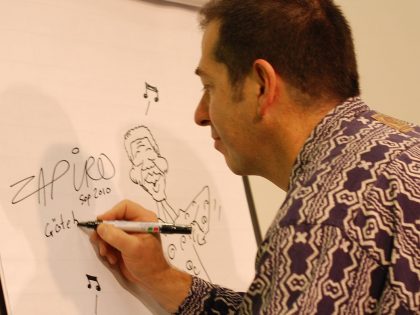
Cartoonist Andy Mason recently published a history of the art form in South Africa. What’s So Funny? Under the skin of South African Cartooning is the only book of its kind that traces the origins and development of cartooning in South Africa, and its political place in the socio-political context. Brett Davidson recently interviewed Mason and put 5 questions to him.

[Read more...]

Follow

Get every new post delivered to your Inbox.

Join 1,917 other followers