In the first sentence of my recent essay in Harvard’s Transition Magazine, I declared that I did not want to write about Nicholas Kristof because his writing was boringly predictable. But I also did not want to write about him because the fundamental problem my essay tries to explore is not really about him. It remains intriguing to me how he became the spokesperson and even poster boy for a certain kind of development and humanitarian intervention. Perhaps it’s even more interesting to ask why he is so resistant to changing the parameters of his thinking in the face of increasing criticisms. Just in the last few months Elliott Prasse-Freeman published a pointed critique in The New Inquiry, pointing out how Kristof’s advocacy is neo-colonial. Anthropologist Laura Agustín, in her blog The Naked Anthropologist and Counter Punch, used her own scholarship on prostitution to show clearly why the specifics and the particular histories and circumstances of the women Kristof claims to be rescuing actually do matter. But his writing certainly did not create the relationship between Americans and Africans that I find so disturbing.
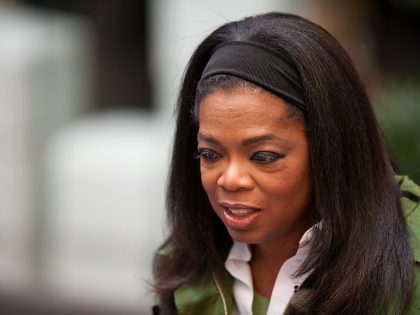
Oprah and Kristof: What don’t they have in common?
Ne-Yo trying to adopt “African children”
In this video, about a week old, American R&B singer Ne-Yo (if you don’t know who he is) tells VLAD-TV (definition: “the TMZ of hip hop”) that his wife is a “bleeding heart.”
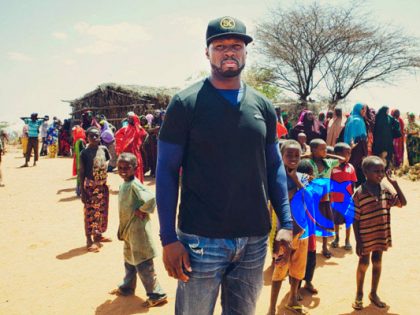
50 Cent goes to Somalia

So rapper 50 Cent (accompanied by American journalists) was in Somalia and Kenya this week to visit people living in refugee camps displaced by the civil war with Islamic militants. Expect lots of ’50 in Somalia’ reports on US television. 50 Cent, who joins a long line of celebrities helping Africans (he is being touted as the 21st century celebrity humanitarian already) handed out food and danced with the children. He also had enough time to pose for what looks like a movie poster shot with children (above) and a soldier (below), and to promote his energy drink Street King. If his Facebook page receives 1 million “likes” by Sunday, 50 will donate an additional one million meals. And he’ll sell more Street King in the process. We’ve also learned something about Somalia in the process.
[Read more...]
Gimme Hope
This is the second in a video campaign to promote the work of American ngo Mama Hope.
They work with local partners in Kenya, Uganda, Tanzania and Uganda to fund the completion of schools, health clinics, children’s centers, clean water systems and food security projects. The idea with this campaign–titled ”Stop the Pity. Unlock the Potential”–is to tell “… the story of connection instead of contrast and potential instead of poverty.” In Mama Hope’s own words: “… People everywhere have talent and capacity, and people everywhere share a desire to be able to use those gifts to improve their lives and the lives of the people they care about.”
Ah. Mirroring. a classic way of encouraging the feeling that the chasm between the smug, satisfied prick of Self and the other is not so vast. Hey, there’s nothing wrong with that.
50 Cent Wants to Help Africa
Remember when rapper 50 Cent announced that he would try to provide 1 billion meals over the next five years to poor Africans? His strategy: make some money while “helping” Africans. Watch the video. With every shot you purchase of his new energy drink, Street King, “a meal is provided for a child in need.”
No comment.
Clooney in Africa
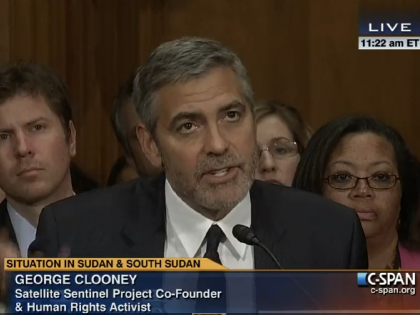
The media buzz (including blogging, tumbling and retweeting, as well as Facebooking) around Newsweek magazine’s ridiculous cover story of film actor George Clooney (title: “On the ground with a new kind of statesman”) highlight the titilating; i.e. Clooney’s sexual conquests of “way too many chicks”). Too bad, since the piece is really about how Clooney has the access and time to jet off to be a presence in nations that may not need him.
In January alone, he’s balanced the rigours surrounding the Academy Awards, hanging out on Mexican beaches with his Italian model/actress-of-the-moment, and giving face-time to South Sudanese. There he is in Sudan (above), method acting Marlow by the river of his destiny.
‘Haiti in Africa’
Sketch by the UK comedy sketch group, “The Unexpected Items,” filmed in front of the School of Oriental and African Studies (yes, that still what it’s called).
H/T: Konwomyn.
Blinded by Red Ribbons
And what has Mr. Bono been doing lately?
Here he is, frolicking with a gala-flawless red satin ribbon. (Caption:”U2 front man, Bono, middle, poses with fellow band member, The Edge, left, Australia’s Prime Minister Julia Gillard, right, and New South Wales state Premier Kristina Keneally at an event to launch World Aids Day in Sydney.”)
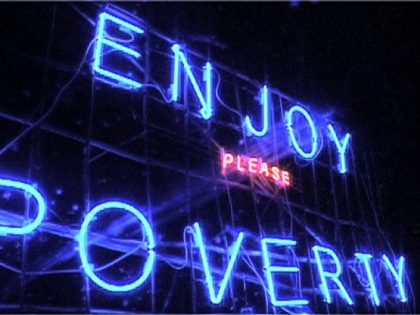
‘Enjoy Poverty’: Interview with Renzo Martens
A still from “Episode 3″ of Martens’ “Enjoy Poverty” Project.
Joe Penney, Guest Blogger
“It is now widely acknowledged that Africa, as an idea, a concept, has historically served, and continues to serve, as a polemical argument for the West’s desperate desire to assert its difference from the rest of the world,” Cameroonian academic Achille Mbembe wrote in 2001.[1]
Nowhere is this more evident than in representations of the Democratic Republic of Congo. A country the size of Western Europe with less paved roads than Ireland, the DRC has been immortalized as the “dark heart” of the “dark continent” since Joseph Conrad’s timeless 1899 novella. Yet contrary to mainstream perceptions, the countless descriptions of Congo emphasizing its obscurity and poverty against the whiteness and wealth of the West drive home a narrative that is more reflective of its proponents than its sub-Saharan subjects.