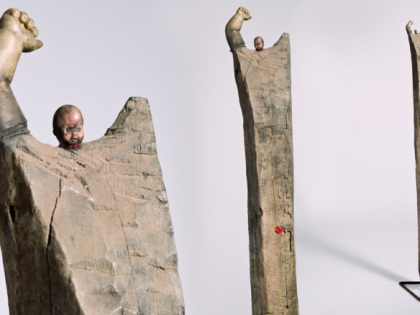
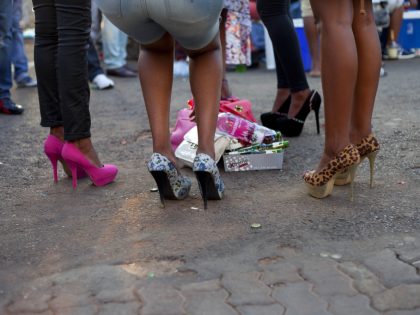
In the introduction to The World According to Bylex Filip De Boeck and Koen Van Synghel describe the Congolese artist Pume Bylex as “not interested in the day-to-day reality of Kinshasa. [He] turns his attention to what lies beyond the horizon of the visible and the tangible (…) a world with perfection and harmony at its centre.” [Read more...]
The World of Congolese artist Pume Bylex
Disco Angola (in New York City)
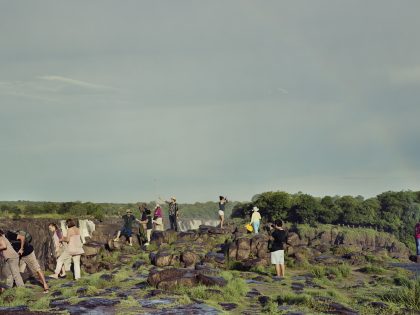
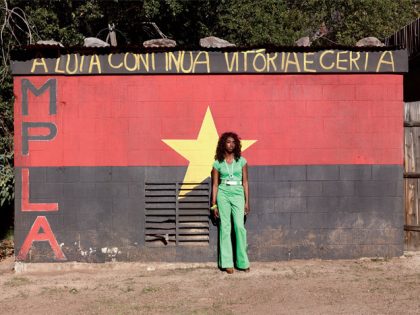
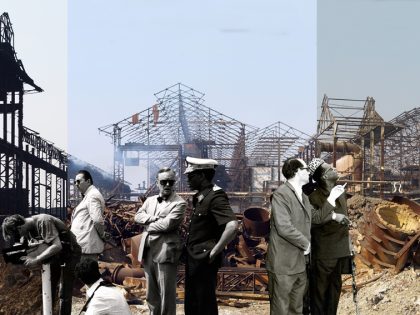
The photographer Stan Douglas’s new project “Disco Angola,” a work in progress, is on display at the David Zwirner Gallery in New York until April 28, 2012. The New Yorker announced the show in Goings on About Town with the image above. What’s amazing is that Douglas has not been to Angola, though from what I read in this interview with Monica Szewczyk he has done a good bit of studying up. [Read more...]
The Branson Biennale for Morocco

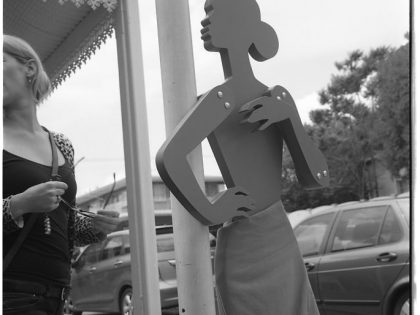
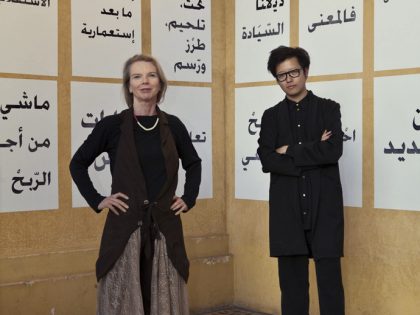
Vanessa Branson stands, hands on hips, her loosely hanging skirt tails give her the figure of a Western women making modest concessions to the predictable inquisitive gaze of an Arabic polis. Her trainers are burnished gold — a playful note — and what you wouldn’t be forgiven for calling “ethnic jewelry” is slung around her neck. She has just organized the 4th Marrakech Biennale and looks proud of this achievement. Next to her, one of the young curators, Carson Chan, is dressed entirely in black, wearing statement glasses, with folded arms submitting mournfully to the publicity shot, any visible reluctance counterbalanced by a quiet confidence. It’s quite clear who has the money, and who already suspects he knows how this image will be read. [Read more...]
OIL
While I was in Toronto with Sean and Tsitsi Jaji for the Canadian Association of African Studies (CAAS) conference, I checked out Edward Burtynsky’s “Oil” at the Royal Ontario Museum Institute for Contemporary Culture (exhibition runs April 9 to July 2, 2011, and getting into the museum is pricy – $25 per person). The three-year touring exhibition is organized by the Corcoran Gallery of Art in Washington, and features Burtynsky’s decade-long exploration of the effluvia of our love-affair with oil—from extraction to production to consumption. Included are images of herds of “nodding donkeys” (the pumpjacks used to extract oil), rows and rows of immaculate, identical automobiles in sales lots, meditations on the beauty of clover-leaved, many stranded expressways of LA and Shanghai, and the beckoning neon fingers of Exxon, Shell, and fast-food drive-throughs in the hinterlands of America. There are also abandoned oil fields owned by the State Oil Company of the Republic of Azerbaijan (SOCAR), mountains of dead tyres, and the Miro-like patterning in the oil sands in Fort McMurray, Alberta. An image of a body of water in Northern Alberta (here and here) which has the second-largest known deposit of oil in the world after Saudi Arabia, contains a mesmerising sky of rolling grey clouds mirrored in what appears to be perfectly still water—but is in actuality a toxic pond. In the large scale of these photographs, we realise how small the presence of humanity is—if it is there at all. In Burtynsky’s images of shipbreaking in Chittagong, Bangladesh (above), clinging to the looming hulls, somewhere in the dirty reds, rust, mud, and chemicals, are the bodies of the men engaged in the process of dismantling these giants: hardly noticeable, but made visible because he has carefully enlarged the image to a scale that removes our unknowing and disinterest.
Burtynsky calls his images “the new reflecting pools” of our times. Next to his, George Osodi’s “Oil Rich Niger Delta,” images are different beasts. The crudeness and cruelty of toxic lives, enmeshed within the grand profiteering and politics of oil extraction in the poorest regions of the world are in the forefront here. Significantly, Osodi is able to avoid pity and guilt. Though his images do not have the finesse of Burtynsky’s, they are more intimate, and more immediately “lively” and living (see them here and here).
–Neelika Jayawardane.
Finland’s Africa
The (Finnish) ARS 11 exhibition investigates Africa in contemporary art. In addition to artists living in Africa, the show also features others who live outside the continent, artists of African descent as well as Western artists who address African issues in their work. The exhibition features some 300 works by a total of 30 artists. The Kiasma Theatre also has a programme of ARS events and performances. The themes of the exhibition, such as migration, environmental problems and urban life are global, issues that affect us all. At best ARS 11 can produce new understanding and also provide background information on the situation in today’s Africa. The exhibition will extend the idea of what Africa, contemporary art and African contemporary art are today.
I don’t want to sound too obsessed about this, but the chosen ‘young’ African artists again really are the same ones you’ll have encountered at any recent major Africa-themed exhibition around the world (I’m thinking for example of those in the U.K., Brazil and Germany). Surely there is more than this pool of, say, ten young artists? Some curators are getting lazy.
Common Language
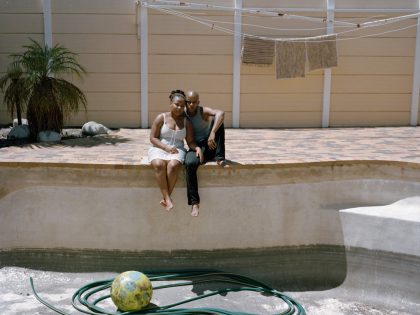
“Idioma Comum” is a new exhibition at the Fundação PLMJ in Lisbon, Portugal. It features some of AIAC favorites such as Kiluanji Kia Henda, Lino Damião, Mário Macilau, Mauro Pinto, Celestino Mudaulane, René Tavares (see video above), Jorge Dias and Yonamine. Also listed are Abraão Vicente, Délio Jasse, Flávio Miranda, Ihosvanny, Pinto and Julia Kater.