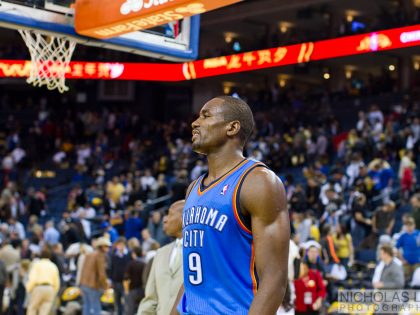
Last year we pointed to the fact that sports commentators, statisticians and journalists can’t distinguish the Democratic Republic of Congo (the DRC) from its neighbor the Republic of Congo every time they talk about NBA basketball player Serge Ibaka. He was born in Brazzaville, in the Republic of Congo, normally referred to as Congo-Brazzaville, not the DRC or what used to be known as Zaire (until 1997) and now commonly referred to by its initials or as Congo-Kinshasa. The only thing the two countries share is a river: the Congo (yeh, that river which Conrad fictionalized). Earlier this week Deadspin, the American sports blog, pointed out that ESPN lists Ibaka’s birthplace as “Brazzaville, Zaire.” At least they know that Zaire still existed when Ibaka was born in 1989. But again it is the wrong country. Today I noticed they just deleted his country and his birthplace is now only listed as “Brazzaville.” So now he has no country.
NBA player Serge Ibaka has no country
Magnificent
Earlier this week ESPN won seven Sports Emmy Awards, including one for music during the 2010 World Cup in South Africa, like the video–played at the start of broadcasts and during breaks from the studio in South Africa–featuring U2 (I prefer Bono when he sings, not when he wants to save Africa) and the Soweto Gospel Choir above and this one, below:
What’s “a native African”
Even if you don’t care about boxing. On sports network ESPN’s their “analysts” Chris Broussard and Skip Bayless discusses comments by former boxer Bernard Hopkins that Manny Pacquiao does not want to fight African American fighters. Broussard then decides to break down “race.” Especially that of the only black fighter ever faced by Pacquiao, the Ghanaian Joshua Clotty. (Pacquiao beat up Clotty.) Watch. Seriously.
Sunday Ephemera No. 4
Sean Jacobs
This is worth remembering. In 2004 the Liberian footballer George Weah was awarded the Arthur Ashe Courage Award at the Espys. (For those who don’t care: that’s sports channel ESPN’s versions of the Oscars.)
This is the man who scored the greatest goal of all time and the only African player to win the World Player of the Year and European Player of the Year. Beat that. (BTW, Weah is contemplating a run in Liberia’s presidential elections next year.)
‘Symbols of Liberia’s Struggle’*
Rapper Nas narrates a short insert on ESPN’s “E:60″ on the Liberian national amputee team made up of men, often former enemies, who lost the use of their legs or arms in Liberia’s very recent civil war. (Above is a kind of mash up from the in-studio introduction that usually precedes an insert as well as an excerpt from Nas’ narration. I am a regular viewer of the show.) You can watch the 10 minute insert here. It includes some incredible goals and celebrations. It is also about the politics of rebuilding societies after wars. Not bad for ESPN.
* That’s a line from the show.
ESPN does the World Cup
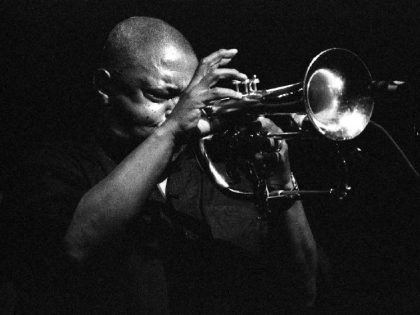
I, too, am in full World Cup frenzy. And while Puma gets Sean’s vote, I think I might have to go with ESPN on this one. Their 2010 World Cup coverage will feature “a 10-part series that offers an introspective look at the country of South Africa through the eyes of one of the host nation’s renowned ambassadors. In Umlando (Zulu for “Through My Father’s Eyes”), jazz music legend and anti-Apartheid activist Hugh Masekela and his American-born son, Salema, an ESPN reporter for the 2010 FIFA World Cup, explore together the people, culture and inspiring landscapes of South Africa, and the nation’s history.” Read more here.
Hugh and Sal recently spoke with Jason Von Berg of Times Live about this project. Listen here. As Sal says, he and his dad are going on a road trip this summer, and they’re inviting us along.
WHEN RUGBY SHOOK THE WORLD
I’ve been meaning to post this for a while. “Foreign Policy,”a magazine whose blog loves lists, recently published one on “The Top Ten Sporting Events That Shook the World.” Included among the list, at number 6, was the South African national rugby team’s 1995 World Cup win: