Do you need another rap film?
Do the foregrounding of celebrities and stories of human tragedy help or hurt two new films about hip hop in Uganda?
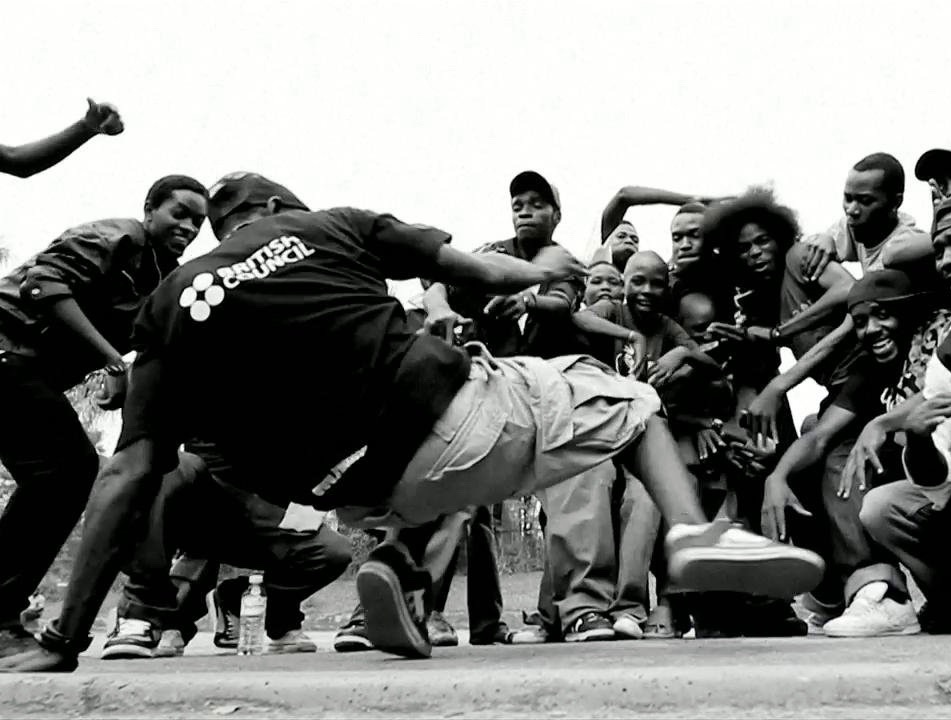
Still from “Bouncing Cats.”
Not, “Do you want another rap?”, but two documentaries on Hip Hop, with a similar focus, set in Uganda. Which for me, makes the differences in their presentation style all the more startling.
This first one “Diamonds in the Rough” (extended trailer here) focuses on the “ . . . Bataka Squad artists, Babaluku and Saba Saba, rise to forge a revolutionary path using music. They are on a mission to empower the forgotten youth of Africa from within, while spreading their message of hope around the globe. Narrated by Spearhead singer Michael Franti, follow the Bataka movement to amplify the spirit of the next generation in this musical journey.” The film is pretty much in the style of the mid-1990’s “underground” Hip Hop documentary, which has it’s own set of conventions but tends to portray fairly straightforward the perspectives of its subjects. I always thought films like this where the director had to engage with the situation in a more immersed experience are a valuable peek into the inner workings of a scene or a culture.
The second one, the Red Bull sponsored “Bouncing Cats” (trailer here) is in a more high budget, made for prime-time television feel good (feel bad?) story, style. “Bouncing Cats” is described on its website as “ . . . the inspiring story of one man’s attempt to create a better life for the children of Uganda using the unlikely tool of hip-hop with a focus on b-boy culture and breakdance.” The lead character, Abraham “Abramz” Tekya, a Ugandan b-boy and A.I.D.S. oprhan created Breakdance Project Uganda (B.P.U.) in 2006. “The dream was to establish a free workshop that would empower, rehabilitate and heal the community by teaching youth about b-boy culture.”
“Bouncing Cats” is meant to spread awareness of a situation the audience might not be familiar with. But, I can’t help but question if the participation of celebrities and the foregrounding of stories of human tragedy diffuses the attempts at trying to make a connection to the lived experience of the subjects. For me it’s a distancing experience that can reinforce a marginalization of the subject culture from both perspectives.
The need to present the story in this way isn’t really the fault of the director. In our HD culture, the general public usually needs to have a little flash and drama to pay attention. Plus you gotta sell DVD’s. So I have to ask, do we really need these things to tell these stories?