Africa Is a Countryhttps://africasacountry.com2026-10-15T16:48:55.487087Zhttps://africasacountry.com/static/img/logo/logo-type.pngNot the continent with 55 countrieshttps://africasacountry.com/2026/10/reading-list-anooradha-iyer-siddiqiReading List: Anooradha Iyer Siddiqi2026-10-15T16:48:55.487087ZAnooradha Iyer Siddiqi
We are taught to think of a refugee camp as an object produced in an instant, only in response to an emergency — one brought on, perhaps, by those seeking refuge. We are taught that refugee environments are provisional and abject, moreover, to be naturalized as such within the African landscape — as the African landscape. We are taught to misread migrant spaces as lacking history or architectural expression. To counter these misdirections, Architecture of Migration: The Dadaab Refugee Camps and Humanitarian Settlement looks closely at the complex settlements, ecologies, domesticities, archives, and material aesthetics. In Ifo, Dagahaley, and Hagadera camps, established in 1991 by the Kenyan government and the United Nations High Commissioner for Refugees at Dadaab, Kenya, in lands shared with Somalia and Ethiopia, the book finds African, Muslim, and Afro-Asian aesthetic worlds and a historical repository of partition, sedentarization, and migration. Dadaab forms a material afterlife of events long unfolding, through colonial and postcolonial time and space, and in multiple registers, aesthetic as well as social.
My book is grounded in 14 years of feminist and critical collective practice and research (see Cohabitations, Dadaab Commons, Feminist Architectural Histories of Migration, Insurgent Domesticities, and Settlement). While researching in dozens of archives and libraries in Africa, Asia, and Europe, and interviewing hundreds of women practicing architecture and art, representing governments, cultural institutions, and nongovernmental agencies, or living life in refugee camps, I read many books! If the anticolonial thought in Frantz Fanon’s Black Skin, White Masks and Walter Rodney’s How Europe Underdeveloped Africa anchored my work, its everyday tugs and buoying came from feminists.
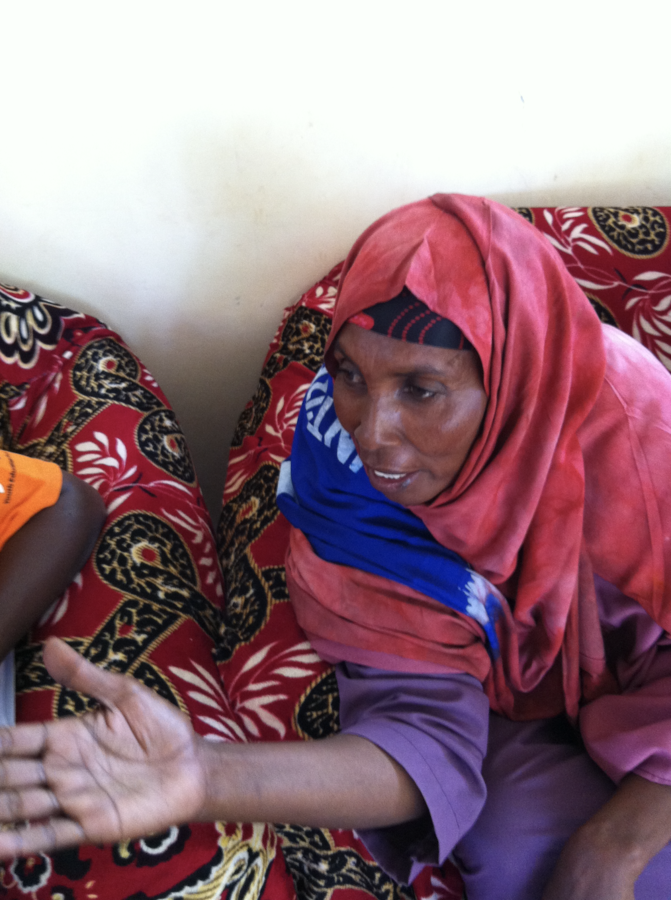
Ifo camp Chairlady Isnina Ali Rage. Photo by author, 2011.
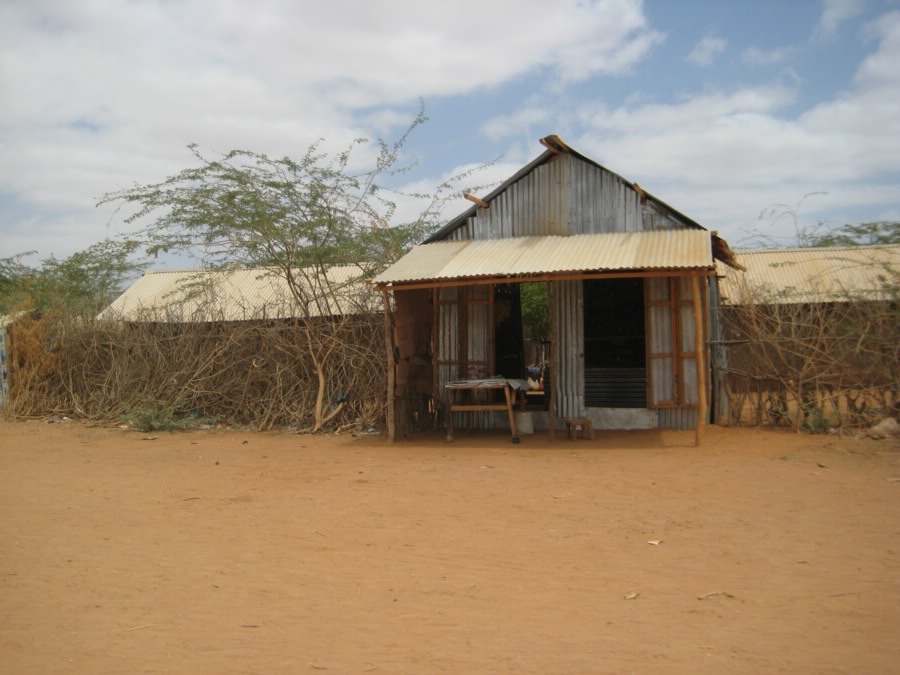
My study of the handcrafted acacia camp environments and interviews with many of their builders — including Ifo Chairlady Isnina Ali Rage and shopowner Shamso Abdullahi Farah, and Dagahaley farmer Maganai Saddiq Hassan — gave shape to a consciousness rooted in the social and ecological worldmaking of African, Muslim, and Global South feminists. Let me begin with three. Sylvia Tamale not only insists on decolonizing master narratives that suppress multiplicity in Decolonization and Afro-Feminism, but through her years of activism in Uganda and beyond, plants the working and thinking of African feminists on the ground, in the natural environment. This perspective is hardly limited to African feminists, as Radha D’Souza demonstrates in the Court for Intergenerational Climate Crimes — based on her book What’s Wrong with Rights?: Social Movements, Law and Liberal Imaginations — which foregrounds the workhorse labor and the place of the indigo plant (Comrade Indigo) within majority-world feminist intellectual commitment; she dispenses with reductive “West versus Rest” critiques through the perspectives of European underground and Third World intellectuals in the co-edited Decolonizing Knowledge: Looking Back, Moving Forward (open access). Further articulating the vitality of social difference to inform constructions of knowledge, Saba Mahmood argues that those constructions must assert against universalizing epistemes, secular as well as religious, in her foundational work on Cairo’s women, Politics of Piety: The Islamic Revival and the Feminist Subject.
Store and shelters designed and built by Shamso Abdullahi Farah, Ifo camp. Photo by author, 2011.
From there, global Black feminisms were my north star. Yvonne Adhiambo Owuor’s Dust dwelt within the landscapes of Kenya’s Northeast, the erstwhile colonial “frontier” constituted of migratory lifeways and marabou storks; her habitations haunt my book’s histories of land, emergency territory, and sedentarized pastoralists. Lose Your Mother: A Journey Along the Atlantic Slave Route, Saidiya Hartman’s attempt to fill in the blank slate of the historical record and her own life, helped me think with the stories of enslaved children freed from Indian Ocean dhows, raised near Bombay, and resettled near Mombasa: the negotiation between rescuer and rescued in the East African abolitionist settlement of Freretown that forms Dadaab’s prehistory. My book stands on the shoulders of Mabel O. Wilson’s work on: (1) spatial agency, as rooted in the bodies of builders and the physical labor of construction, in an essay on the “provisional demos” of the African American protest camp in Design, Displacement, Migration: Spatial and Material Histories, and (2) the inseparability of racial thought from modern subjecthood and the architectural discipline, which grew together out of Enlightenment reason and abstraction, in Negro Building: Black Americans in the World of Fairs and Museums and the co-edited Race and Modern Architecture: A Critical History from the Enlightenment to the Present.
“Frere Town,” courtesy of National Museums of Kenya, Nairobi. Sibbie (née Bazett) Burns Photograph Album, Album II, c. 1892–late 1890s.
My book argues that longstanding refugee settlements — aid environments long utilized to slowly confine migrants and police the border — are not de facto architectures to be understood teleologically, as if brought by people upon themselves, but instead predicated upon foundational partitions. This thinking draws on Vazira Fazila-Yacoobali Zamindar’s positioning of partition not as an event but as a concept, in The Long Partition and the Making of Modern South Asia: Refugees, Boundaries, Histories. In it, the violence of a partition is not a vague consequence of border conflict, but the direct result of bureaucratic shaping, as states attempted to resolve political uncertainty — debunking the myth that India and Pakistan somehow emerged fully formed as partitioned states, but rather, partitioned through a process of urban shaping. This is so with Palestine, Ireland, and Somalia itself. Safia Aidid’s Pan-Somali Dreams: Ethiopia, Greater Somalia, and the Somali Nationalist Imagination shows a political imaginary of possible futures based on territorial unification, conceived in reaction to a colonial present; Greater Somalia was not merely a nationalist movement but, following Raymond Williams, “a structure of feeling.” My book argues in favor of such feeling, which overcomes the partitioning principle, toward a straddling collectivity.
2026-10-15T16:48:55.487087ZWhat if migrant environments, so often cast as scenes of abjection, border transgression, criminality, and placelessness, are instead repositories of knowledge, craft, and refined domesticity?https://africasacountry.com/2026/10/death-as-liberationDeath as liberation2026-10-14T15:38:23.332852ZEliel Peterson
Death as liberation is hardly a comfortable political proposition to digest. In a world where Black death is often the common condition, there is a well-established insistence on our living. So what do we make of two of Africa’s greatest filmmakers, Ousmane Sembène and Souleymane Cissé, whose earliest cinematic visions, expressed through their respective debut features Black Girl (1966) and Den Muso (1975), center on the suffering, alienation, and eventual deaths of Black women?
Sembène’s Black Girl is preoccupied with racial violence and the economic exploitation that continues to structure relations between Senegal and France. The film follows Diouana, a young Senegalese woman who accepts employment with a white French family and travels to Antibes believing she is embarking on a new life. While Cissé’s Den Muso, turns inward, examining interpersonal violence and the ways patriarchal power consumes family life and communities, weakening the broader social fabric of a nation. The film follows Tenin, a mute young woman who becomes pregnant after being raped, exposing the brutal underbelly of the patriarchal violence imposed upon her. Despite the differences in their circumstances, both films position death as a troubling possibility of liberation for their central characters.
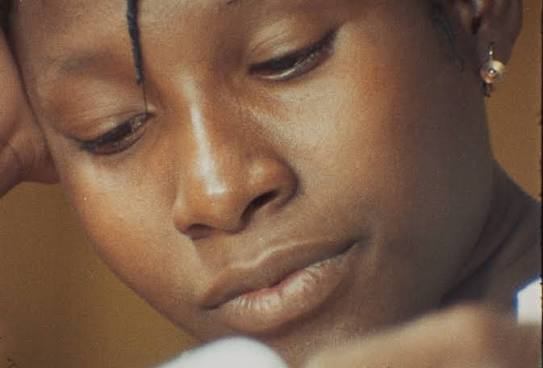
Tenin (Dounamba Dany Coulibaly) in a still from Souleymane Cissé’s Den Muso (1975).
The history of Black resistance has not solely been confined to the preservation of life. From enslaved Africans who leapt from ships during the Middle Passage, to those who faced death in the fight against their oppression, It is true that to rather die than to endure is not a popular or digestible form of liberation. Although these acts are not equivalent, nor do they carry the same weight as the deaths of these fictional characters, Sembène and Cissé, raise an uncomfortable question: what does life mean for a person stripped of agency, recognition, and self-determination?
For Diouana and Tenin, freedom remains out of reach because of the structures governing their everyday lives that continually deny these women full humanity: Tenin’s father and her rapist, Diouana’s white employers. This sustained stripping of humanity produces what I would argue is already a death, albeit a social one, that precedes their physical endings. Sembène and Cissé challenge audiences by asking what is living for the dehumanized. Diouana travels to France only to find her livelihood replaced by isolation and unpaid, alienated labor, while Tenin’s body becomes a site upon which familial and communal shame, punishment, and control are dumped. Death, therefore, is at the core of both films from the outset, existing not only as a shocking culminating event, but as a condition of violence. By the end of each film, Sembène and Cissé are not arguing over whether death is a worthy or noble choice for self-liberation; rather, they position the act of self-annihilation as the only remaining form of control available to their characters, and as an indictment of a society in which death is the only option.
It is understandable to recoil at the self-inflicted violence that ultimately claims both Diouana and Tenin. One might ask why their rage is not directed solely towards those who harmed them. Why does Tenin’s retaliation extend beyond her rapist? Why doesn’t Diouana exact revenge on her employers and flee France? These questions linger because death feels like an unsatisfying conclusion, one that denies us, as audiences, the catharsis of resistance. We want these women to fight back and survive. We want their suffering to lead somewhere other than death. Yet perhaps the more daunting question is not why these women die, but whether we find their deaths more difficult to accept than the suffering that precedes them. What is ultimately more uncomfortable to confront: their deaths, or the conditions that made life itself unbearable?
Neither film offers an uncomplicated answer. To read Diouana’s and Tenin’s deaths as acts of liberation is not to suggest that their deaths resolve the violence they endure, or that self-annihilation is freedom in any complete sense. Their deaths do not dismantle the structures that dehumanized them. What death offers these women, perhaps then, is not freedom but a final assertion of agency within those systems. This is what makes their endings so devastating: the possibility of control emerges only when the possibility of living on their own terms has been all but extinguished.
Decades later, Black Girl and Den Muso remain essential viewing, not only for their place in the landscape of African cinema, but for their boldness in confronting the most uncomfortable, divisive, and difficult questions surrounding post-independent life. Both films position death as a troubling yet legible response to systems that make life itself untenable, refusing a comforting resolution. Sembène and Cissé began their careers with audacious visions and hard questions, a truth that held throughout their working lives.
Long live the giants of African cinema, and may their audacious clarity continue to shape how we see, think, and imagine our world.
2026-10-14T15:38:23.332852ZOusmane Sembène’s and Souleymane Cissé’s debut features end with women who choose death. What is more uncomfortable to confront: their deaths, or the conditions that made life itself unbearable?https://africasacountry.com/2026/10/forward-but-for-whomForward, but for whom?2026-10-13T14:43:58.437281ZAfolabi Adekaiyaoja
I have spent this week reflecting on African football. Qualifiers for the next Africa Cup of Nations (AFCON) have begun, the identity of the reigning champions still awaits a ruling from the Court of Arbitration for Sport, and Nigeria begins its campaign without a federation board, after its president and executive committee resigned in August — a rare case of Nigerian football administrators paying a price for failure, though, as I will argue, not quite the accountability it first appears. None of it can be separated from the politics and money that will shape next year’s FIFA presidential election.
Weeks after the 2026 World Cup in North America, FIFA unveiled a plan to sell a stake in the tournament’s commercial rights to private investors. The proposal would have seen a new entity, FIFA Forward Enterprise (FFE), take over FIFA’s broadcast, sponsorship, ticketing, and licensing operations. FIFA would keep control and sell minority stakes to outside investors, raising up to $4.2 billion against a $20 billion valuation. The lead investor was reportedly Thrive, a firm founded by Joshua Kushner, whose brother Jared is US President Donald Trump’s son-in-law. To win the member associations’ approval, FIFA promised to raise each one’s development allocation for 2027–2030 from about $8 million to $20 million, with an optional further $20 million paid up front. But the backlash, largely led by UEFA, the European confederation, was swift and relentless. Within days, FIFA president Gianni Infantino withdrew the plan and has spent the weeks since trying to salvage his presidency and avert a challenge that previously seemed impossible.
During this period, Africa’s confederation stood firmly with Infantino. Several federation presidents backed him publicly, and Samuel Eto’o, the Cameroonian legend who now runs his country’s federation, went further, arguing that the plan could have done a great deal for smaller federations. FIFA’s crisis meeting was held in Rabat rather than Zurich, and the executive committee of the Confederation of African Football (CAF) later met there and unanimously reaffirmed its support for him. Much of the commentary has cast this as a deferential, even subservient, relationship, with Africa as a continent unable to stand up for “true footballing values” once money is on the table.
But Africa’s relationship with FIFA did not begin in deference. UEFA may have threatened a boycott this summer, but in 1966 it was African federations, led by Ghana’s Ohene Djan and Ethiopia’s Yidnekatchew Tessema, that boycotted World Cup qualifying ahead of England ’66 because they had been made to share a single qualifying place with Asia and Oceania, while Europe had 10 of the 16 spots. The boycott worked: Since the next tournament, in 1970, Africa has had at least one guaranteed place. In 1974, the same bloc helped the Brazilian João Havelange defeat Stanley Rous for the FIFA presidency. Rous had spent years trying to keep apartheid South Africa, already shut out by CAF, inside world football.
However, Havelange’s victory set the terms of the bargain that has governed FIFA-Africa relations since. He campaigned on the promise of expanded tournaments and development for the Global South. He delivered them, but he also brought a culture of patronage that defined his 25 years in power. Sepp Blatter, his long-serving general secretary, inherited the same structure when he succeeded him in 1998, and used it to peel away African federations even though CAF officially backed UEFA’s Lennart Johansson. In 2002, when CAF’s own president, Issa Hayatou, contested the presidency, he was beaten heavily, deserted by members who preferred the patron they had to the African they might have had.
Under Infantino, FIFA has become even more involved in Africa’s management. In 2017, Madagascar’s Ahmad Ahmad unseated Hayatou as CAF president, a result Infantino reportedly supported, and in 2018 Ahmad declared Africa’s support for Infantino’s re-election a year early. In 2021, Infantino cast a long shadow as rivals stood aside and endorsed Patrice Motsepe, the South African mining billionaire, as new CAF president, after FIFA had sent its own secretary-general, Fatma Samoura, to run CAF’s affairs for six months in 2019, and after Ahmad was banned by FIFA’s ethics committee. Motsepe’s tenure has recorded successes, but critics still cast him as Infantino’s puppet in Cairo.
The politics of football on the continent have changed too. Back then, many political leaders saw football as yet another theater of development and anti-imperialist engagement. Now the game has been ceded to career football politicians, who have mostly traded votes for development money and loyalty. That may sound like an indictment, but the trade is also pragmatic: African federations need FIFA’s money more than most, and a grant that more than doubles is a powerful inducement. Spread across the continent, that money can also reorder established hierarchies and make African football more competitive, which is the strongest case for the bargain. The deeper issue is what the game’s surplus is made of. Africa develops talent and exports it, with the value mostly realized in Europe by the clubs that buy and sell it, and the leagues that broadcast it around the world.
The 2026 World Cup puts that case to the test. Nigeria and Cameroon, with eight AFCON titles between them, failed to qualify. This followed repeated challenges within Nigeria’s football management, including three coaches in a single qualifying campaign, several disputes over unpaid wages and bonuses, and a security agency investigation into how a ₦17 billion government fund meant to settle them was spent. That investigation is also why the board’s resignation is not quite the accountability it looks like. Ibrahim Gusau and his colleagues stepped down after weeks of reports that they were being pressured to go, and the National Sports Commission promptly suspended the election to replace them. FIFA treats government interference in federations as grounds for suspension, leaving Nigerian fans caught between administrators no one can remove and a state that removes them through pressure. Eto’o, Cameroon’s federation president, has fought openly with the sports ministry, including over who should coach the national team. Their size, pedigree, and economic weight ought to make them less dependent on FIFA’s money than most, which makes their loyalty harder, not easier, to explain.
Compare them with Comoros, a two-time AFCON qualifier, and Cape Verde, whose debut World Cup run to the round of 32, unbeaten in a group with Spain and Uruguay, won over neutrals everywhere. The president of the Comoros federation has told reporters that his federation has struggled to make ends meet, while FIFA’s own announcement of the plan held up Cape Verde as an example of how a decade of Forward funding enabled the debutants to qualify for the tournament.
Infantino’s strongest ally remains Morocco, whose federation president, Fouzi Lekjaa, was one of the first to pledge his support. Rabat will host the next FIFA presidential election, and Morocco has lobbied hard to stage the final of the 2030 World Cup, which it cohosts with Spain and Portugal. Morocco has gone from missing four straight World Cups to reaching a semifinal in 2022 and a quarterfinal this year. It is also, for now, Africa’s champion, though not because of anything that happened on the pitch. Senegal won the Cup of Nations final in Rabat in January, but CAF’s appeal board later ruled that Senegal had forfeited the match because its players left the field in protest at a late penalty, and recorded a 3–0 win for Morocco. Senegal’s appeal goes before the Court of Arbitration for Sport on October 8, and this contested status does not help change the impression that FIFA’s most important African ally holds the continental title by an off-pitch decision.
These examples seem to make a neat case for either prudent FIFA-backed spending, like Cape Verde’s, or prudent football management, like Morocco’s. But the binary does not hold. Cape Verde may owe some of its success to FIFA funding, which supported pitch infrastructure and coach-training courses, but it also owes much to its strategy of building a national team from its diaspora in Portugal and the Netherlands. Morocco’s state-of-the-art Mohammed VI Football Complex, along with its recruitment from the diaspora, has also enabled it to field competitive teams across genders and age groups, culminating in last year’s men’s U-20 World Cup title. Neither project was authored by FIFA, and FIFA cannot take credit for either.
What African football actually shows is that competence and patronage are not opposites. They can work together. Morocco’s long-term planning has bought it leverage, and this summer it spent that leverage on loyalty. Nigeria and Cameroon, their administrations in disarray, needed the grant too badly to spend their votes on anything else. The strong and the struggling ended up in the same place, and none of them used their position to ask FIFA for anything. Cape Verde and other emerging football nations face a different test: whether they can turn a diaspora-built national team into lasting domestic pipelines. This complicates any simple reading of the $20 million grant as a bribe, and shows how one continent’s support can conceal very different interests and motivations.
None of this makes UEFA football’s moral arbiter. It saw off the Super League in 2021, then catered to the whims of its super clubs by expanding the Champions League to 36 teams. Europe’s biggest clubs, meanwhile, are represented by a body led by Nasser Al-Khelaifi of Paris Saint-Germain and Qatar Sports Investments. Gulf money sat on both sides of this fight. Africa has no more reason to trust European piety than FIFA’s generosity.
The FFE plan was, in effect, a scheme to sell the rights to that flow of value. African federations were right to take its money seriously, and they do not deserve to be tarred as sellouts for doing so. They went wrong by handing over their votes without asking for anything in return.
An Infantino re-election would cement a FIFA politics built on courting Africa’s substantial 54 votes. Leverage of this kind is not a problem in itself: UEFA leverages its markets, Asia leverages its growing investment and viewers, and South America has long utilized its marketable stars. The question is whether Africa uses its own leverage for anything that lasts. Infantino has proposed an independent review of FIFA’s governance, to go before the FIFA Council on October 15, and has assured every association that its treatment will not depend on its position on any proposal. The fact that he felt the need to say so is telling.
Africa’s football leaders could spend this leverage on loyalty or, as they did in 1966, to build something more structural. They could press for more independently audited development funding that avoids pitches built as political enterprises, seek larger shares of transfer fees for academies that produce players, and assert a real voice over a calendar that caters to Europe and is not truly global. None of these would come as a gift from a patron; they would have to be demanded.
Football’s capacity to do good in harsh economic conditions is undeniable. But there is a difference between development that is authored and owned on the continent and development handed down as patronage. The question African fans and the administrators who answer to them should be asking is how to make those administrators start asking for something in return that no one in Zurich can simply give as a gift.
2026-10-13T14:43:58.437281ZAfrica’s football federations stood by Gianni Infantino through FIFA’s sell-off scandal. What would it take for them to spend that leverage on something that lasts?https://africasacountry.com/2026/10/we-are-not-a-noveltyWe are not a novelty2026-10-12T15:56:21.355032ZB Camminga
Trans and gender-diverse people are routinely told that what they are is new — a sudden emergence, a recent contagion. In South Africa, this claim circulates with increasing force: In the surge of Christian fundamentalist organizing against trans rights, in the transphobic slurs directed at a trans contestant on Big Brother Mzansi earlier this year, and in the pronouncements of prominent political figures who have characterized transgender rights as a form of “woke” ideology. The implication is always the same: that we are a novelty. And novelties do not deserve the weight of rights.
The historical record tells a different story.
In 1815, a young British military surgeon arrived at the Cape Colony. James Barry was cantankerous, flamboyant, and conspicuously short. During his time at the Cape, he performed what is believed to be the first cesarean section in southern Africa in which both mother and child survived. The child was named after him: James Barry Munnik, who would grow up to become the grandfather of J. B. M. Hertzog — founder of the National Party in 1914 and one of the principal architects of apartheid.
J. B. M. was also the namesake of the hertzoggie, the apricot-jam-filled tartlet. When he reneged on promises, the Cape Malay community responded with the twee gevreetjie: a coconut-topped protest cookie whose name means, in Afrikaans, “two-faced” or “hypocrite.” On the eve of his death, Barry made one request: that no clothing be removed and that he be buried as is. The request was not honored. It was discovered that Barry was what we might now understand as a man of trans experience. His legacy is deeply ambivalent — he was a colonizer, an agent of empire. But his presence in the historical record asks us to complicate our timelines.
In 1966, Joan Kruger, Edna Hobles, and Sonia Kola were arrested under legislation known as the Disguises Acts — a set of pre-Union laws dating back to 1891 that criminalized “masquerading as women.” The three were well known enough to have been featured in Drum magazine that same year. Joan and Edna were eventually released. Sonia was charged. The distinction was this: Joan and Edna had no prior arrests. Sonia did. And she would not stop wearing dresses. S v. Kola (1966) became the case that set the precedent for what would later be amalgamated into the Prohibition of Disguises Act (1969).
Access to alternatives was starkly racialized. Gender-affirming surgery had been available to white people in South Africa since at least the early 1950s, and by 1974 the state had become directly involved — funding reassignment surgery under the belief that it constituted a cure for homosexuality. For Sonia, as a South African of color convicted in 1966, none of that access was available. She had her dresses.
What the case produced was a legal trace that ran forward through decades of jurisprudence — cited by Edwin Cameron in arguments that extended constitutional protection of sexual orientation, and by Justice Laurie Ackermann in the majority judgment that gave that protection a broad reading. A case about a woman who would not stop wearing dresses became part of the constitutional fabric of the new South Africa.
In 1992, Michelle Emmerich — a trans woman, an ANC member, and a civil servant — faxed a proposed Gender Rights Article to the Convention for a Democratic South Africa (CODESA), hoping it would be included in the Bill of Rights. No one responded. She was told she was too emotional and should tone it down. In her own words: “I for one sticks out like a sore thumb. I have decided to call it a day. Just imagine, being the only [transgender] human rights activist in the ANC.” And so she quit, leaving almost no trail. That unanswered fax, now archived at Constitution Hill in Johannesburg, is a marker in the record, evidence that the argument for an expansive understanding of gender was already being made in 1992, long before it found a hearing.
Before any formal trans organization in South Africa, there was a small group known as the Phoenix Society — founded in the 1980s and composed of white transvestites, crossdressers, transsexuals, and those who called themselves “transgenderists.” They communicated through veiled messages in magazines and their own publication, FanFare. A short documentary about the group was made for the South African Broadcasting Corporation program 50/50 — and never aired. Some members believe this was the result of an intervention by the apartheid security police.
The Phoenix’s membership is largely lost to history. But one name has survived: Charl Marais, who in his own words was “the only female to male person that they knew of and also, in that day and age, I was the only Coloured there.” Charl would go on to become a pioneering writer and editor of Trans: Transgender Life Stories from South Africa — one of the first works to put trans South African lives on the record, in their own words.
These are not the famous names. They are not the landmark cases. They are not even necessarily people with uncomplicated politics. But here is what their stories show: trans and gender-diverse people in South Africa have not merely survived its history — they have shaped it. The claim that trans identity is new is not only historically inaccurate; it erases a history of people doing the quiet, stubborn, necessary work of existing, and who, in doing so, shaped something larger than themselves.
2026-10-12T15:56:21.355032ZTrans and gender diverse people are routinely told that what they are is new. In South Africa, they have not merely survived history, but they have also shaped it.https://africasacountry.com/2026/10/utopia-is-not-a-metaphorUtopia is not a metaphor2026-10-09T19:55:08.482851ZMarta Mboka Tveit
The recent popularity of the term “Afrotopia” inspired me to revisit Thomas More’s original Utopia (1516). Rereading the novel led me to rethink what we mean when we talk about ideology, future-casting, and visioning as praxis.
“Utopia” or “utopic” is today a widely used term across a variety of fields and contexts. People often use the term derogatorily, as a tired metaphor, carrying connotations of naiveté or veiled dystopian impulses. It gestures vaguely toward paradise, toward the promised land, but carries with it a whiff of the opposite. Don’t be naive, the contemporary connotation seems to say; don’t fall for the lies, don’t dream too big. Recently, daring scholarship has given the term a new, promised-land spin: for instance, in Felwine Sarr’s bold essay Afrotopia (2020), a poetic call for an African utopian philosophy of self-reinvention for the 21st century, and, more recently, in Joseph Agbakoba and Marita Rainsborough’s Beyond Decolonial African Philosophy (2025).
But reading Utopia, I was surprised by how concrete and policy-oriented the novel is. Its protagonist, Raphael Hythloday (sort of an early anthropologist), is in a debate with a fictionalized version of More himself and some others, and ends up talking about his visit to an island called Utopia, a visit that has profoundly changed him. Hythloday talks about how they organize life there, and how it’s going really well. In other words, the book is, thin veil of fiction aside, a set of policy recommendations. Utopia is an imagined place that has implemented these recommendations, which, as More understood them, result in a more egalitarian, life-supporting society. That’s all it is — no soaring, elusive nothing.
Thomas More (1478–1535) was a Renaissance man and deeply Catholic. An English lawyer, scholar, statesman, and writer, he entered royal service under King Henry VIII, eventually rising to the high office of Lord Chancellor in 1529. In 1516, when he wrote Utopia, he was living through the transition from the late medieval period to the early Renaissance, when society was rigidly hierarchical, dominated by the monarchy, the nobility, and the powerful Church. Corruption and the abuse of power were widespread among both political and religious leaders. More himself would pay for his convictions: in 1535 he was beheaded for refusing to accept Henry VIII as head of the Church in England.
Utopia, it turns out, was not written as a metaphor for paradise, or some other magical place to house lofty dreams and impossible longings. It was written for those trying to organize. Like “utopia,” “democracy” or “the democratic society” has conventionally become a vague, transcendental thing, an ideal to be striven for but never reached, perhaps even unreachable. Yet early Athenian democracy was grounded in concrete institutional reforms rather than abstract ideals. In the early sixth century BCE, Solon’s reforms, widely understood as a foundational precursor to democracy, addressed both economic and political inequalities through specific measures: the seisachtheia, which canceled debt bondage; the establishment of legal recourse for broader segments of the citizen body; and the organization of political participation according to wealth classes, as Aristotle records in the Constitution of the Athenians.
The Athenians, we are told, would sweep a rope dipped in red dye through the crowds in the marketplace to herd people into the public meetings. That’s not mystic, timpani-and-marble, city-on-the-hill, shining-Athena stuff. That’s sandal prints in mud, overturned fruit stands, snotty crying children, slippery bodies slapped together — overcrowded, stinky, sweaty, loud democracy.
Perhaps there is something useful to be reminded of here in the current moment, which is calling for a radical reimagination of social order. Neither Athenian democracy nor More’s Utopia was originally introduced as an ideal, a shining, vague star in the distance to reach toward. They were policy recommendations for the then and there, for a place and time, suited to fit a certain group. What would the equivalent place-and-time, tailor-fitted African societal epitomes look like?
Resetting the mechanisms of collective visioning requires, first of all, setting aside some of the major constraints of the present. Forget the debt for a minute. Leave the contract negotiation for tomorrow. Put that blaring traffic cone from across the Atlantic on mute. These powerful forces are always at play, always going to be there; it’s always urgent. But to truly re-vision what is wanted and needed from the inside, to build with intention, they must be temporarily suspended.
External power and pressure cannot be the only determining factors for shared vision, nor can “the way things are now” determine collective desires. Or else, what was all that marching and demonstrating and bloodshed for? Pragmatism and realism have their uses, but they can also get in the way of expansive, rooted visioning. They are most useful as tools for moving toward those visions from the distressing present, not for formulating them. So the question becomes: if external pressures and powers were not a factor, what would African societies be like, and, more importantly, what should they be like?
Second, resetting visioning may require new categories and taxonomies, and categories of categories. Kwasi Wiredu, Ngũgĩ wa Thiong’o, and other giants, as well as Sabelo Ndlovu-Gatsheni more recently, have written in depth about the colonization of mindscapes: how historical forces have shaped how people think, express themselves, perceive the world, perceive themselves, and imagine. The long process of resetting may require a further retreat from the schemas of the development industry and the dominant dichotomies one is used to thinking with: citizen/noncitizen, nation-state/statelessness (see Achille Mbembe on a borderless world), precolonial/postcolonial, rural/urban, energy-rich/energy-poor, East/West, socialism/liberalism, global/local — yes, perhaps even Marxism and class struggle. Gender categories may be rethought, along with sociomaterial relations, patronage, even good and evil, and the by-now-exhausted twins “modernity” and “tradition.”
The names and categories should be reimagined from within. As Ndlovu-Gatsheni puts it in Epistemic Freedom in Africa (2018), “seek ye epistemic freedom first.” This may necessitate a rebuilding, exactly, of the infrastructures of receiving and categorizing knowledge: new categories and stories for making worlds, for creating shared horizons and imaginaries, and ultimately, methods for making those visions into realities.
Some key questions rise to the surface. Both the Athenian and Utopian visions go beyond negative utilitarianism, beyond survival and minimizing suffering, striving instead for bespoke systems to suit the population in question in a specific space and time. (Whether the visions came true, whether they really were what they said they were, and whether they worked well for most people in that place and time are valid questions, but separate ones, for tomorrow. There is no monitoring and evaluation in visioning.) Like the Utopians or the Athenians, one might ask: what kind of infrastructures (in a broad sense), systems, and institutions will work to the greatest benefit of all for the particular group in question, in this particular space and time? If external pressures and powers did not exist, what would African societies be like, and what should they be like? What can African philosophy and philosophers contribute to setting the future trajectory of our species and the planet, and how?
Inspiration might be drawn from precolonial cosmologies and the like, but that is only inspiration, for the population in question is not a precolonial one. The answers might not look like Western-style liberal democracy. Neither need they look like a society based (only) on sharia law, kings, dictators, elders, do-gooder regimes, or the various manifestations of puppet regimes or rule-by-consultancy (Sarr writes helpfully on the latter two). Maybe it turns out that the problems that are made into problems are not really problems at all — maybe the real problems are other problems.
Perhaps new visions can be sparked by taking seriously “fringe” degrowth ideas such as basic income, circular economies, energy cooperatives, green currencies, a wealth tax or income caps as proposed by the convivialism movement, four-day weeks, or the promotion of non-wage-labor existences, to name a few. Or perhaps resetting visioning results in ideas that are not currently thinkable, where African societies and African thought light the way in the search for new paradigms of what it means to live well and of ways to organize societies.
The material point is that the present global upheavals represent a moment of possibility to fundamentally rethink sub-Saharan African societies, and the very processes by which they are formed, reaching far beneath surface-level reforms. Such processes might benefit from a “science fictionality” moment, a term associated with Istvan Csicsery-Ronay Jr. (see also the role of science fiction in enhancing critical thinking), given the ideological acrobatics of the present. They might also benefit from a bridge to Africanfuturist thinking, to borrow a term associated with the artist Pamela Phatsimo Sunstrum and popularized by the writer Nnedi Okorafor. Articulated through storytelling, Africanfuturism, as Okorafor defines it, is specifically and directly “rooted in African culture, history, mythology and point-of-view as it then branches into the Black Diaspora, and it does not privilege or center the West.”
In addition to the fate of More and many visionaries like him, the biggest tragedy of articulated visions is something else: that they show us, time and again, how close we are to getting it right, to making better real. Radical reimagining, in art, storytelling, and scholarship, can allow further reflection on the nature of visioning itself, and a rereading of past visions, in whose ruins we are currently residing. There is space now to re-examine history and to make bricolage from past and present ideologies, without being blind to the subtle and treacherous nature of visions and of visioning itself.
2026-10-09T19:55:08.482851ZThomas More’s Utopia was not written as a metaphor for paradise, but for those trying to organize. What would an African equivalent look like?https://africasacountry.com/2026/10/brazils-racket-societyBrazil’s racket society2026-10-08T17:48:13.241794ZBenjamin FogelWilliam Shoki
Brazil’s presidential election is headed for a runoff. In the first round on October 4, far-right Senator Flávio Bolsonaro, the eldest son of former president Jair Bolsonaro, edged out President Luiz Inácio Lula da Silva 47 percent to 45 percent. The right also consolidated its hold on Congress, with Bolsonaro’s Liberal Party now the largest bloc in the Senate. The result came despite Flávio’s thin record, his documented ties to Rio de Janeiro’s militias, and his father’s 27-year sentence for plotting a coup after losing the 2022 election.
As Latin America’s largest economy and its most populous democracy, Brazil has long served as a bellwether for the region, and increasingly for the world. Analysts of neoliberalism have used “Brazilianization” to describe a future of informal work, fortified elites, and hollowed-out states that they see arriving in the global North. The outcome of the runoff will help decide whether Brazil holds out against a regional turn toward Trump-aligned strongmen, a wave that has already swept Argentina, Ecuador, and, most recently, Colombia.
The stakes are high. Lula’s third term delivered growth, rising wages, and record-low unemployment, but it was hemmed in by a hostile Congress, and household debt and the cost of living kept climbing. Meanwhile, the Trump administration has intervened with unusual openness. It has imposed punitive tariffs and sanctioned a Supreme Court justice, and it has designated Brazil’s two largest criminal factions as terrorist organizations. As Benjamin Fogel wrote inJacobin before the vote, “something deeper and more paradigmatic is going on” than ordinary frustration with an incumbent.
In this conversation, editor William Shoki speaks with Fogel, the Deputy Director of the Alameda Institute, a historian of Brazil and contributing editor at Jacobin (as well as an alumnus of Africa Is a Country), to unpack the first-round results, the coalition of interests behind Flávio, and the political economy that makes it cohere. They discuss why Brazilian capital has made its peace with predation, why anti-corruption politics so often breeds cynicism, how “security slop” became the right’s signature policy, and what Brazil and South Africa reveal about everyone else’s future.
William Shoki
For readers who haven’t followed Brazil since Lula came to power for his third term in 2022, what happened on October 4?
Benjamin Fogel
To give a little background: Lula won the election in 2022, but at the same time, what people were calling the most right-wing Congress ever was elected. So if Bolsonaro was defeated at the polls, Bolsonarismo — and we can get into what that is later — was still very much alive.
That election was contested. Apart from all sorts of maneuvers before the vote — trying to discredit it through disinformation channels, trying to buy votes, voter intimidation, and obstruction by the Federal Highway Police on the day — there was an attempted coup, which led into the events of January 8, 2023. That bore some resemblance to January 6, in that you had a bunch of fanatical Bolsonaro supporters storm Congress and trash the place. But Brazil, unlike the United States, has a history of military coups, and it was touch and go whether the military would back it. There were other aspects to this, such as a plot to assassinate Lula, his vice president, and the Supreme Court justice who was overseeing the elections.
So it was defeated, and some people had thought this would discredit the right. It certainly weakened them for a while. But having a right-wing Congress made it really difficult for the Lula government to govern. In terms of the macroeconomic agenda, there were some successes. We’re not talking about anything dramatic, but the economy was growing at three or four percent, and the minimum wage increased. Overall, people were slightly better off than when Lula started, but there wasn’t a massive shift in wealth, and there were other factors we should get into later.
Bolsonarismo persisted. Then last year, Bolsonaro was successfully prosecuted for the failed coup, along with a bunch of his allies — the first time anybody has ever been successfully prosecuted for one. He was in prison and then placed under house arrest for health reasons — as people like to say, he’s permanently ill. What that meant is that the throne of the Brazilian right was up for grabs, and there were a number of pretenders. These included the governor of São Paulo, Tarcísio de Freitas, who’s just been reelected by a huge majority, and even Michelle Bolsonaro, Bolsonaro’s current wife, who is quite a bit younger than him. She has a big following among evangelicals, particularly women, and has just been elected senator for the Federal District, which is Brasília.
There was some dispute within the family. She had beef with the three sons from Bolsonaro’s first marriage, who are all politicians: Flávio, aka Zero Um; Carlos, aka Zero Dois; and Eduardo, aka Zero Três. Those are the nicknames their father gave them. But basically, the father decided — even though he couldn’t communicate with them directly, there were ways of communicating with Flávio — that Flávio was going to be the candidate. Flávio is the oldest, and a longtime senator from Rio. We should get into his background later. But once he announced he was going to be the candidate of the right, all the other people competing for Bolsonaro’s support fell by the wayside.
The other factor here, which we’ll have to expand on, is US support and US intervention in favor of Flávio. So that sets the stage.
For a lot of people, it’s really hard to take Flávio’s candidacy seriously. He doesn’t have any particular personal qualities as a public speaker or charisma. He has a very shady history and links to organized crime. In an article forJacobin, I compared him to Jackie Aprile Jr. from The Sopranos. So he was underestimated, and I think this led to a degree of complacency on the left about his campaign.
At the same time, this is the first election Brazil has had without another center-left candidate outside the Workers’ Party (PT). There were some small radical-left candidates, but all the other candidates were right-wing, some even more right-wing than Flávio, who styled himself as more moderate than his father. In effect, it was just right-wing parties.
So what happened was that Flávio came out two points ahead: 47 to 45 percent over Lula. The polling wasn’t that far off. People have acted like it was a surprise, but I’d been hearing from some of the pollsters and people in the know that this was quite likely, and it was within some of the polls’ margins of error. Lula underperformed in quite a few strategic places. The center-right parties did not get as many votes as some expected. And moreover, there was a bit of a blowout in the Senate. The Liberal Party (PL), Bolsonaro’s party — a sort of machine party that has cannibalized a lot of the old parties — now has the biggest bloc in the Senate. At the same time, it wasn’t a blowout for the left: the number of left-wing deputies in Congress increased by, I think, two or three seats. But the right is now more consolidated, has a big platform, and has the Senate.
William Shoki
If Flávio isn’t a particularly inspiring political figure, and is in fact relatively flat, how did he become the figurehead of the right? There was a competitive field, and all the other contenders stood aside to give him a clear path. Obviously he has the heft of the Bolsonaro name, but as Rodrigo Nunes put it in his recent interview withEquator, Bolsonarismo is increasingly separate from Bolsonaro himself. So what’s the story behind Flávio’s rapid ascent, despite his clear lack of political acumen?
Benjamin Fogel
Rodrigo Nunes’s analysis is incredibly important, and his new book on the global right is an essential read for anyone who wants to get a grip on what’s happening, not only in Brazil but everywhere. When we say Bolsonarismo doesn’t need Bolsonaro, we mean two things. First, it’s a brand — a family brand. Every member of the Bolsonaro family got elected: Bolsonaro’s brother, his wife, his two other sons from his first marriage, and his youngest son from his current marriage. The only one who didn’t is his younger daughter, and she’s too young. So this family clan is really an operation, with the Liberal Party behind it, and that exists because there are a number of convergent social forces behind Bolsonarismo.
But specifically, Flávio is a stand-in for his father. His father is in prison, so he’s unable to run. To the extent there is a policy platform — and there really isn’t much of one — Flávio is running on behalf of his father, to free his father, and because of the brand, that has appeal.
Second, there are the social forces behind Bolsonarismo. I’ll give a brief summary, and then we can get into the specifics. First, the evangelical churches and the so-called Bible lobby. Brazil is set to become an evangelical-majority country in the next 10 years, and the demographics of evangelical Christianity skew quite a bit younger than Catholic voters, for instance. So unlike in a lot of right-wing movements, young people are more likely to vote for it. We’re not talking about a vast majority, but a tendency.
Second, the political common sense in Brazil, to the extent there is one. Miguel Lago, another very interesting scholar of the Brazilian right, has called it a political revolution. You could say, in a Gramscian sense, that common sense is now right-wing, and that has a structural economic basis. What that shift means is that the Bolsonaro brand, with the Liberal Party, has cannibalized the Centrão, the “big center” — the old parties we call fisiológicos, which exist to trade votes for rents. So the center-right has been wiped out, and the physiological parties have been taken over.
Then there are new sectors of capital — particularly agricultural capital, some elements of financial capital, and the online betting lobby. Online betting has been a social cancer in Brazil. Lula banned it before the elections, but there’s a lot of money there. These forces of capital are behind Flávio, as is the United States. There’s also the security lobby, what we call the bullet lobby, which includes members of the security forces and people campaigning against crime — and Flávio himself and his associates have very extensive associations with organized crime, which is another matter we can talk about. And there’s the agricultural lobby, the so-called beef lobby. These forces are behind him, and they’re also where the demographics and the popular culture in Brazil are going.
And then there’s the United States, which has openly intervened. Flávio’s brother Eduardo exiled himself to Texas, was removed from Congress for absence, and has been actively lobbying for sanctions against Brazil. When Bolsonaro was imprisoned, 50 percent tariffs were placed on Brazil. But Brazil doesn’t do a lot of trade with the US and is actually quite resilient in its ability to resist US pressure, so it sort of backfired.
All of these have coalesced. The best description of Flávio — and I’m paraphrasing the Brazilian public intellectual Celso Rocha de Barros — is that he’s a stand-in for other interests: his dad; Marco Rubio and Donald Trump; the Rio mafia; the banking fraudster Daniel Vorcaro, who has been a big, big part of the Bolsonaros’ campaign; the evangelical churches; and things like the gambling lobby.
The best description of this election came from Brian Winter of Americas Quarterly, who’s a kind of business-lobby journalist. He called it “apathetic polarization”: people weren’t particularly mobilized; they were just voting against the other guy. So as the main candidate, Flávio had a chance to get through. People were also voting against the incumbent, blaming them for whatever the problem was. And then there’s what we call antipetismo, the widespread, deep-seated sentiment against the PT that has been part of the conservative revolution that began after the 2013 protests in Brazil.
William Shoki
In some ways, who Flávio is doesn’t really matter, right? Based on your description, he’s an avatar for all these different interests.
Benjamin Fogel
I think it actually does matter. It’s not so much his charisma, though his family name matters. It’s that his particular trajectory, in terms of his associates, is the trajectory of where political power in Brazil is going.
William Shoki
So then, part of why Flávio, and Bolsonarismo more generally, are representative is in how the interests of capital converge with the movement? What is the composition of Brazilian capital at the moment that makes that so? Thinking about patronage populism in South Africa, with radical economic transformation (RET) under Jacob Zuma, and how his family itself became a political brand. Capital opposed it, because RET undermined its ability to accumulate. Organized business responded with a kind of low-intensity investment strike that helped birth the Government of National Unity, effectively a coalition between the center-left African National Congress (ANC) and the center-right Democratic Alliance (DA). So it’s puzzling, as an outsider, why numerous factions of Brazilian capital are siding with a movement that has all these destabilizing, deinstitutionalizing intentions — one that would undermine the formal conditions of capital accumulation in favor of a much more nebulous, mafia-ized political economy, the kind Flávio is very fluent in. Brazil is a large country, one of the most industrialized in Latin America, a regional power. How does that all come together?
Benjamin Fogel
It’s a very large question, and I’m going to give a short and a long answer. But first, on Zuma: RET was an insurgent faction of capital connected to state contracts. That was the whole point of it.
William Shoki
Right, that’s what I’m saying too.
Benjamin Fogel
These were people from outside a certain, more elite wing of the ANC, who had been locked out of the big deals that people like Cyril Ramaphosa had access to. Brazil is very different. And it should be noted that capital was less than enthusiastically behind Flávio. In 2018, capital was very unified against the PT and very strongly behind Bolsonaro. By 2022, after economic chaos under Bolsonaro and the complete catastrophe of the pandemic, it was split. There were divisions between, let’s say, the old financial bourgeoisie, the more export-oriented industrial or manufacturing factions of capital, and the rest. The two sections of Brazilian capital that backed Bolsonaro most strongly in the last election were agribusiness and retail. The reason for retail is that shutting things down during COVID wasn’t good for business — these are big department-store owners.
In this election, there hasn’t been enthusiastic backing from capital for Flávio. In fact, that’s one of the reasons people had assumed Lula had a pretty easy route to victory: it wasn’t as though the main forces of Brazilian capital were actively mobilizing behind Flávio.
But the pithy answer is that the nature of capital accumulation worldwide is predatory, extractive, and rent-seeking. People have used the term “racket society,” which comes from the Frankfurt School. The scam is the norm now. We’re talking about everything from the AI bubble to the openly imperialist way Trump goes to the UN General Assembly: to the victor belong the spoils; we’re taking their oil. The illusions of things like the green transition, or even the Millennium Development Goals — all these convenient fictions — are gone. It’s extractive now.
So in this case, there’s an easy answer. One is that there’s a belief it will be like 2018, when Paulo Guedes was finance minister — Faria Lima’s man, Faria Lima being Brazil’s Wall Street. Guedes was a very antisocial ex–Chicago Boy, in that he was part of the Chicago Boys trying the neoliberal experiment in Pinochet’s Chile, except he was such a prick that he ended up going home. There’s an expectation that they’ll have that again.
There’s another issue I think hasn’t been talked about enough. A lot of the Brazilian elite have significant financial and property assets in the United States, and that’s on their minds when you have a government as hostile to Brazil as Trump’s. It’s not that Brazil does a lot of trade with the US; it’s that the elite park their money there. They have apartments and houses in Miami. They want to keep their money in American banks.
Then there are the extractive elements. Everyone has this fantasy — and I think it is a fantasy — that the hidden wealth of the Amazon just needs to be taken out of the soil. That was something Bolsonaro himself articulated, and he actually had significantly more capacity to articulate a coherent politics than his son, who barely speaks and does aura-farming dances. You have mining interests, and illegal mining is an increasingly big sector. The illegal gold trade is a big way of laundering money, and there’s a lot of that in the Amazon. These are very propulsive interests. You have agribusiness, which wants that land. There was a big transformation in Brazil’s political economy in that agribusiness is such a big sector here, and it’s not just beef — it’s also soy. And where does most of that go? It goes to China. Brazil also has a big petroleum industry, but it’s under national control through Petrobras, the national oil company, which was founded in the 1950s, and I imagine there are some fantasies about privatizing that.
But Brazil has also gone through a big deindustrialization process. In 1980, it was a more industrialized society than South Korea. Manufacturing was almost 50 percent of its exports. That was promoted not only by import-substitution industrialization policies and state intervention in the economy, but by a competitive international arrangement. As Brazil democratized and re-entered the global economy on different terms in the late 1980s and 1990s, it did so under conditions of a debt crisis and hyperinflation, and it resorted to a degree of austerity and neoliberal measures. That had a significant effect in destroying elements of Brazilian industry, particularly in the late 1990s. There was a lot of privatization and a loss of manufacturing’s share of GDP, while agriculture and raw materials grew — the classic way people talk about dependency theory, extracting things from the periphery and taking them to the core. I’m not a subscriber to dependency theory. And Brazil still makes advanced products: it has one of the biggest jet manufacturers in the world, and there are tons of BYD factories here now from Chinese investment.
More recently, under Lula’s second term, and more so under his successor Dilma Rousseff, there was an attempt to use the surplus — Brazil had wiped out its foreign debt and had a lot of dollars — to form a national bourgeoisie again. Many have written about the character of the Brazilian national bourgeoisie: that it’s not loyal to its state, that it views itself as part of Europe or North America as much as part of Brazil. But basically, the Lava Jato (“Car Wash”) corruption investigations — a huge topic — took out the construction industry, which was a really big sector. Odebrecht was operating all over Africa and Latin America, competing with American firms, and remember that the US Department of Justice backed the Lava Jato investigations. That entire sector, which was a pro-Lula sector, was taken out by that investigation, which further shifted power toward these more extractive interests.
Then you have the financialization and “app-ification” of the Brazilian economy. It’s even more app-ified than South Africa. Every time I come back to Brazil, there seem to be twice as many guys waiting around for orders on Brazil’s versions of Uber Eats, Deliveroo, or DoorDash. There’s a huge new fintech sector, which included Banco Master, the biggest banking fraud in Brazilian history, which has been one of the big stories of this election. Then you have online betting, which is ever-present. You have this scam sector. That’s also one of the experiences of living in Brazil, and in South Africa to an extent: someone is trying to scam you every day. We have normalized, as a society, expecting a call to be somebody trying to scam you, getting all these texts, having a loved one’s WhatsApp hacked and suddenly asking for money. This is an everyday experience. These are the operating interests — this new rapacious, unveiled model, uninterested in development, which is a reflection not only of where capital accumulation in the world is going, but is encapsulated in Brazil. And this is a growth sector.
William Shoki
And it’s embodied in Flávio as a political figure, given his ties to the Rio militias, to Banco Master, to the betting lobby, and, as you noted in your recentJacobinarticle, to the case of Marielle Franco, the Rio socialist city councilor murdered in 2018. That raises another puzzle. Corruption has been a long-standing fixation of the right, which reduced the PT to corruption through Lava Jato. And yet the right is so thoroughly implicated in corruption, and it doesn’t seem politically costly for them. Why?
Benjamin Fogel
I would push back on that. It was costly for the center-right, which got absolutely annihilated by the corruption scandals, more so than the PT in the mid-2010s. It’s the same way the center-right has been discredited by the rise of the new right, or the far right, all over the world.
I’m a scholar of corruption — I wrote a dissertation on the history of anti-corruption politics in Brazil. There’s always a hypocrisy about corruption, and there are different forms of it. In my view, the characteristic Brazilian form of patronage corruption is rouba mas faz: he robs, but he gets things done. Corruption is tolerated provided things are delivered. In South Africa, we have a form of corruption — I think the biggest example is Johannesburg — that’s parasitic and doesn’t even try to fix things. It just picks the bones of what’s there.
That aside, anti-corruption politics tends to take a moralizing form, where corruption stands in for everything you don’t like. If you don’t earn enough money, if you’re jealous of somebody on Instagram who’s going to Miami, if you wish you had a better body, if you’re in a bad relationship, if you don’t like the traffic, if your apartment’s too small — all of these things get projected onto the figure of corruption, personified, in Brazil’s case, in the PT. So at one level, anti-corruption politics serves as a metanarrative. It’s an acceptable way of saying things, including outright racism — people being upset that there are more black people at the airports is a famous example. It’s an acceptable way of saying this is what’s wrong, this is unfair. When you say corruption, you’re saying the world as it should be is unfair because sinister forces are manipulating society. In that sense, it’s a metanarrative.
The other point is about the force that has historically mobilized on the streets around anti-corruption in Brazil, which has generally not been the left, and which is also the most solidified base of Bolsonarismo: let’s call it the lower-upper-middle class. These are people who have education — private education — and some money, but who are not truly wealthy. They’re not truly part of the old elite. They lack the cultural and social capital of the elite, or even of a more sophisticated progressive middle class. They’re not poor, but they have a deep fear of moving down in society. Under developmentalist programs, like those of the 1950s in Brazil, or Lula’s redistributive programs, what we saw was a closing of the gap between them and the working and lower classes in access to consumption and consumer goods — things like holidays, travel, and TVs, which were markers of status. And that status anxiety is a mobilizing force. At the same time, the rich got richer, as they tend to do. And there’s an aspiration: we are the frustrated rich; we want to be the entrepreneur. That logic is also part of the individualized, precarious society that app-ification and the gig economy have created.
So corruption specifically wasn’t what mobilized people. Even if there were real corruption scandals, it was a stand-in for a lot of other issues, and they were projected onto the PT. This has been a historic pattern: you can see it in the failed coup against Getúlio Vargas in 1954, in Jânio Quadros’s candidacy for president in 1960, and in the anti-corruption protests that preceded the 1964 military coup.
Moreover, the left is particularly vulnerable on corruption. First, you have to get your hands dirty in power, especially in a society deliberately structured the way Brazil was in its transition. You have to deal with rent-seeking interests to get things passed. Second, the left has sold you something: a better, more just future that it’s going to bring you. So there’s an element of disappointment. The right is saying we live in a Hobbesian war of all against all — which is really what the new right is saying about society — so it doesn’t have to meet the same moral standards.
There was an interesting article in The Conversation by an ethnographer about how people described the PT, often as a cheating husband. This is a classic anthropological and social-theory trope, and it’s personified by Daniel Vorcaro more than anyone else, the banker responsible for this big fraud. He was hosting orgies with hundreds of women, seemingly setting up the whole Brazilian elite with the pleasurable company of young women of various persuasions, holding private parties featuring the likes of Swedish House Mafia and Flo Rida in an underground club in São Paulo, and chatting across the world. He somehow answered every single message on WhatsApp, which is really a superpower, especially in Brazil, which is even more WhatsApp-driven than South Africa. Basically: if you’re the elite, we’re jealous of your sexual success. You’re the boss; you can cheat outside your marriage; you’ve earned it. But if we expect a more moral, humble subject, we feel betrayed.
So it also produces a politics of declining expectations as things go wrong. There’s real scandal fatigue. We have this in South Africa. Every day you read about a new municipal water-truck mafia scam. You get an update from the Madlanga Commission, the inquiry into criminality and political interference in the criminal justice system, about some cop or politician moving drugs or calling in hits. There’s only so much you can take before you say, “Fuck it. There’s no social contract here. Everyone’s out for themselves. I’m going to turn to my own private interest and what I think is good for me.” So a society of declining expectations and defensive postures is what anti-corruption politics and continuous corruption scandals produce.
At times, it can be a mobilizing force that progressive forces can use. I would argue that some on the left were completely wrong to characterize the Zuma Must Fall moment as just being about capital. Remember, that’s probably the last time we saw the unions mobilize en masse. They came out in the streets, and there was a genuine popular element to it. And then we had the disappointments of Cyril Ramaphosa and declining expectations, and that leads elsewhere.
So that, in short, is the pitfall of anti-corruption. That doesn’t mean progressives or the left should abandon anti-corruption. Corruption has been a political mobilizer and issue since people started writing political theory — go back to Aristotle, go back to Machiavelli. But it means that without a program of redistribution, anti-corruption politics leads to the pitfalls of declining expectations.
Part of what’s happened is the disappointment people have felt with Lula’s third government. Sometimes it’s due to external shocks. There’s a Biden element: things are more expensive in the stores, and you’re being told the macroeconomic indicators are fine. And then you have these constant scandals involving the Supreme Court and virtually the whole political class. It doesn’t matter if they’re mostly right-wing, or that there’s been deliberate framing by bad-faith actors, including American-backed social media and US-allied actors, to make it a left-wing issue. What you end up with is an election fought on the terms that the PT is also the establishment, that there isn’t much difference between them and the other guys. What they’re saying is, “We’re less corrupt than the right, even if we’re a little bit corrupt.” That’s not really what you want to be conducting an electoral campaign on. And unfortunately, even if the campaign was doing more than that, this has been the perception among some voters.
William Shoki
Expanding on that perception: one of the major preoccupations of voters in Brazil, and arguably everywhere in the global South, including South Africa, is security and the rise of organized crime — and not just organized crime, but the emergence of this racket society you’ve been describing, in which every aspect of the social fabric has been penetrated by criminal interests and every social relation has been transformed into some kind of extortion. Elsewhere in Latin America, tough-on-crime rhetoric has catapulted strongmen to victory. El Salvador and Bukele are the paradigmatic case, but there’s also Ecuador, Peru and Colombia. What’s surprising is that Flávio is also propagating tough-on-crime rhetoric, and yet he has ties to the mafia, to organized crime, to banking fraudsters. And in this conversation, the left is largely absent. Can you help us make sense of that?
Benjamin Fogel
Let’s start with the reality: security and crime are a big issue. And let’s start with the basic premise that the average victim of crime is a worker on their way to work, or, increasingly, someone being scammed through their cell phone. Organized crime is a huge factor. In South Africa, we’re only now revealing the deep penetration and interlocking interests of all these forms of crime, from drug trafficking to cash-in-transit heists to tender fraud.
But in Brazil, there’s always been a “the only good bandit is a dead bandit” type of politics. This is an old thing. You can trace it back to slavery, to the fear of the enslaved, and then to the criminalization and repression of the popular classes. And remember, racialization in Brazil is very different from the American or even the South African style. There are degrees of racialization; it doesn’t mean you’re black — you could be brown as well. There’s a much bigger diversity. But racialization means the idea of the criminal is not the white Rio mafia politician who’s got shooters on call, has millions of dollars, and is involved in all sorts of rackets that plunder society and lead to its degeneration. It’s a black kid in his teens holding an assault rifle in a favela somewhere on the periphery of Rio or another Brazilian city. That’s the perception of the criminal.
Then there are the big criminal organizations, the two criminal factions. This links to the broader geopolitics of the “Donroe Doctrine,” Trump’s version of the Monroe Doctrine — the idea of using the war on drugs, which has been used repeatedly. This is cyclical; none of it is new. They’ve been declared narcoterrorists, which is a way to destabilize Brazil. These two big factions are the Comando Vermelho, the Red Command, which is based in Rio but has interests across the country, and the Primeiro Comando da Capital (PCC), which is from São Paulo but also operates across the country and in neighboring states, and even has significant trafficking operations through South Africa, particularly the port of Durban, and through Mozambique. But they’re not active in the US. Those aren’t their routes.
While violent crime is down in Brazil, it’s partly because of the consolidation of these organizations. Unlike South Africa, where probably most murders are not linked to organized crime, in Brazil, probably most murders are. There was a battle between these two organizations, which had previously had a truce, over new routes in the north and northeast, and in 2017, just before Bolsonaro, that led to a big increase in the murder rate. One of Bolsonaro’s big promises was that human rights, these NGOs, these lawyers, are an impediment to the security of the good citizen — the cidadão de bem, as they say in Brazil. And even people in the periphery who are black, and who look like the imagined bad citizen, imagine themselves as the good citizen: a white, respectable, educated Brazilian. That’s the imagination. That was a big association in 2018.
There’s also been a constant narrative, pushed from the beginning, that the left is in league with organized crime. Lula has been accused of being linked to the PCC, despite the PCC having significant links to people on the right in São Paulo. They run a lot of São Paulo, which has been governed by the right forever now. They have an accord, and they run half the transport system in São Paulo.
In Rio, the Comando Vermelho has professionalized, and there are people with drug-trafficking links around Flávio. Then you have the militias, which are paramilitary extortion forces embedded in politics — off-duty or ex-cops and firemen, again “respectable,” who said, “We’re going to provide security to keep out the bandits, the bad black youths in their sandals.” But then they got into extortion rackets and all sorts of mafia activities, and now there’s even more of a confluence between them and drug trafficking.
So this is real, and the concerns about organized crime are real. The dynamic of declaring war on organized crime has been raging in Brazil forever. This is the country where the police kill the most people on the books. In Rio alone, they kill over 1,000 people a year on the books, sometimes over 2,000, and God knows what’s off the books, because bodies disappear in those swamps out there or get dropped in the ocean. And the police often act as criminal rackets too.
Then there’s Bukele and his supposed success in El Salvador, which is a tiny country. It wasn’t so much the megaprison and the declaration of a state of emergency; it was also having a behind-the-scenes pact with the criminal gangs there, which are completely different from the Brazilian factions in their history and how they work. So I’ve called this “security slop.” It’s performative — the most asinine, empty type of stuff, the strongman saying we just need to be hard in the war on drugs. We’re in the third generation of politicians who have done versions of this. In the 1970s, there was Nixon’s war on drugs. Then in the 1980s, the cocaine trade takes off. In the 1990s and 2000s, there was the Mérida Initiative and Mexico’s war on drugs. This has been tried, tried, and failed.
So the security slop is megaprisons. Megaprisons have been one of the few policies Flávio is committed to — he’s promised to build five. Abelardo de la Espriella, “El Tigre,” the new president of Colombia, is a lawyer who used to defend narco-paramilitaries for money, in Miami. He promised to build 10. Colombia has, what, 45 or 50 million people; Brazil has nearly 220 million. So, ambitious. They’ve also promised Milei-style massive cuts to the state sector, which I don’t think is happening in Brazil.
There’s also the element that this is how the United States is justifying its interventions in Latin America. And at the same time, take Juan Orlando Hernández, the ex-president of Honduras, who was convicted for, I think, moving 450 tons of cocaine with El Chapo. He had this great line about stuffing the cocaine up the gringos’ noses. He was convicted in an American court and then pardoned through a backroom deal with Trump, and he’s back in Honduras. Daniel Noboa, the president of Ecuador, is from the richest family in Ecuador. His family owns the biggest banana-shipping company in the world, and that’s how the cocaine gets to Europe — in the bananas. There are Balkan mafia guys on the record talking about having the cocaine in those shipments. And as I mentioned, El Tigre comes from a long association with narco-paramilitaries. His next-door neighbor was Salvatore Mancuso, the head of the United Self-Defense Forces of Colombia (AUC), a big paramilitary organization of death squads that was big in the drug trade in the 1990s and 2000s. Mancuso was convicted of drug trafficking, along with a few thousand killings. And El Tigre has a rum brand called Ron Defensor, whose biggest investors are the family of an AUC commander called “Comandante Barbie” — not to be confused with “La Barbie,” the infamous American-born Mexican narco.
So this is hardly unprecedented. But I want you to understand that it’s a slop policy. It’s “if we just kill enough people, it’ll be all right.” It’s not serious: we’ll build megaprisons. And frankly, in this age of AI-generated slop and influencers, that’s enough. Another policy: Flávio wants to chemically castrate rapists, and his running mate was under investigation for raping a 13-year-old girl until the case was shelved by a Supreme Court justice.
But as I was saying about corruption, shouting about the right’s hypocrisy and pointing it out is not an effective response. It’s an impotent response. Moreover, the left has struggled here. It has often made compromises with the police or with hardline candidates on this, or been seen as really soft. I won’t be able to articulate solutions. But the point is that there’s a structural way in which the drug trade has been used not only by the United States to take out its enemies, but also to fund and consolidate right-wing causes. At the end of the day, the origins of the mafia are in a parastate force meant to discipline people who get out of line.
William Shoki
Turning to slop politics as a new political style or genre — all the dynamics you’re describing: the hyper-individualization of political participation, the outsized influence of the online, the gamification of ordinary life. Is what we’re really grappling with a new political subjectivity? One could say the old ways of politics, which largely envisioned offline participation, just don’t work. Politics now moves through digital channels and spreads through networked nodes rather than vertical structures. The beneficiaries are, of course, the right, because they’re not trying to implement a transformative program or abide by any political or moral standards, so a field marked by entrepreneurialism and grifting benefits them disproportionately. The left is completely lost in this terrain, because so much of it is antithetical to what it wants to achieve.
Benjamin Fogel
There are various dimensions. One is that online activity is not unmediated. As we’ve discussed — with the political-economy shifts, the move toward the gig economy, and the constant corruption scandals that discredit the mainstream media — there’s an illusion that you’re speaking directly, that you have direct access to somebody. But that’s mediated through the algorithm, and we know the fingers are on the scale. One of the many American interventions in this election was Meta down-boosting, shadow-banning, and even banning PT accounts during the election while promoting right-wing content. And of course we know what Elon’s X has done.
The influencer economy is part of the gig economy. Ask young people what they want to be — and this is hardly confined to the global South — and lots of them will say, “I want to be an influencer.” What is an influencer? It’s showing that I’m authentic, that I have direct access to you, that I’m going to show you some product, or this special health supplement that’s going to get you super jacked. There’s no place more online, and no place where the influencer economy is more competitive, than Brazil. And it’s also a good way to get elected. Where the old corrupt political machine used to be the mediating factor, because that’s how you got people out to vote, now you can get elected as an influencer.
Let me give you a profile of the average influencer who gets elected in Brazil. This type has been around since the YouTube days, before TikTok and Instagram got big: basically a cop who killed a bunch of people and then blogged about it. “I’m Deputado Corporal Whoever, or Sergeant Whoever. I kill people, vote for me. I’m tough on crime.” That’s now an average type of person who gets elected, and there are all sorts of examples. Then there are the more political entrepreneurs, who are trying to make money. In this new right, there’s no contradiction between grifting, hustling, and the grindset mentality — taking advantage of what they call coaching culture, teaching people how to make money, which is already scamming them — and being a right-wing ideologue.
I think the most-voted federal deputy in São Paulo ran a candidacy mostly about trans people and bathrooms. Funnily enough, one of the new-right figures, Renan Santos, who was part of the Movimento Brasil Livre (MBL) — one of the very far-right, libertarian-backed movements that were part of the 2015 moment — is also one of the best critics of this right now. His big slogan on crime is “capture, kill.” But he understands. His line is basically: whatever you think about trans people and bathrooms, this isn’t even 0.1 percent of Brazil’s problems. This is slop. Nobody can tell me what Flávio actually stands for, and you’re voting for him.
The influencer economy favors the right, but that doesn’t mean the left can’t use it. In fact, some of the candidates who emerged in this election on the left have been effective communicators on the new platforms. Jones Manoel, for instance, who is very proudly an old-school communist, is one of the most-voted federal deputies in the Northeast. Then there’s Elias Jabbour, a developmentalist economist, who got elected in Rio, which is a pretty right-wing place.
And then there’s this other factor that has to be stated again. The United States may not have directly manipulated the election, in the sense of hacking the results, and in cases of American intervention it’s hard to know what is effective and what isn’t, because it’s covert — that’s the nature of covert ops. But at the very least, there’s what I’ve called, drawing on Rodrigo Nunes, the investment in social disintegration: these technologies of social media, fintech, online gambling, all this stuff that’s really destructive for society, which then finds expression in things like the prosperity gospel in mobilizing people. At the very least, that’s a form of intervention mediated through the United States’ technological and cultural power, and it has shaped the environment here and elsewhere.
William Shoki
The US influence complicates my final question, but let me ask it anyway. There’s renewed theoretical interest in discourses of peripheralization — in crude summary, the idea that the core of the capitalist world system increasingly takes on features of the periphery: informalization, public insecurity, rampant inequality, elite fortification. Over the last five years especially, the two classical cases have been Brazilianization and South Africanization. They have theoretical uses, and rhetorical ones — especially South Africanization, which circulates among right-wing ideologues that present South Africa as a cautionary tale of what happens when power transfers from white settlers to a black majority. You’re a South African Brazilianist who has spent a lot of time in both countries. There’s that line, misattributed to J. G. Ballard, I think, about the periphery being where the future reveals itself. Do Brazil and South Africa reveal something about the future of the world? And, more immediately, what do you think will happen in the second round on October 25?
Benjamin Fogel
I’m going to very unsubtly not give predictions. Eighteen days is an eternity in Brazilian politics. But Lula will have to mobilize to win, because Flávio’s structural advantage is that the other parties that ran were right-wing, and quite clearly can’t stand the Workers’ Party. So Lula is going to have to get non-voters and those who voted null. Brazil has compulsory voting, but this election saw record abstention, the highest since 1998. So there’s space to move that, but it’s going to take a different type of campaign.
Now, the first question, and then I’ll get to something more practical. I’ve written an article in theNew Statesman, for instance, about how, in the right-wing imaginary, the idea of white genocide in Rhodesia and especially South Africa — this absolute nonsense — serves as the dystopian example of where multiculturalism and liberalism lead. So it serves that rhetorical imaginary.
In Brazil, the Brazilianization thesis comes from critical theory. It started off as talk about precarity and development economics, but Paulo Arantes — who is untranslated; at our organization, Alameda, we’re working on theorizing peripheralization — offered a peripheralization thesis based on Brazil’s contradiction: it’s both highly modern and highly industrialized, and a peripheral place shaped by slavery and the production of surplus peoples. You see that in gated communities versus slums.
And look at this elite that’s given up on a developmental project, because I think that’s the crucial thing. Flávio does not have a developmental project. Trump does not have a developmental project. It’s self-enrichment: everyone’s going to be an entrepreneur. And part of the problem on the left is: where is the developmental project? You can talk about nationalization and all of this, but it sounds hollow, because you have to build structural power for that. You have to offer a developmental project, and you have to do more than say we’ve got to do some good social policies and redistribution.
If we think of the social fragmentation that the climate crisis, war, and all these technologies are producing, it’s producing insecurity. You have to speak to security and offer more than the right is offering, which has some grounding in lived experience: all you can do is protect people like you and your own, look after your own interests, and fuck over people you don’t like. You have to work there. That means, in South Africa, in Brazil, and elsewhere, we need to talk about how to deal with organized crime in working-class communities. You can’t just say the police are evil, murder people, and are also crooks. It doesn’t work. It doesn’t stop you from being extorted by some local gang while you’re sitting in Khayelitsha. It doesn’t stop these big criminal syndicates from making big, big money. In South Africa, more so than Brazil, the biggest growth sector has got to be organized crime. I think the Madlanga Commission is revealing it: the same people trafficking drugs are running massive extortion schemes and getting tenders. So first, security, and talking about restoring state capacity to solve people’s problems.
Obviously, I’m just an analyst; I can’t provide the real politics behind it. And I’m even speaking in an individualized way, because you don’t have a collective. I’m not a member of a party. What’s the party for me to join? I don’t know. I can’t vote in the Brazilian elections. But collectively, getting outside the comfort zone has to mean fighting on people’s concerns, not just dismissing them.
And this is going to be my parting words: perhaps we can take some joy in the downfall of Andrew Tate, who looks like he’s completely done for, facing charges in the UK. He was one of the big proponents of the hustle and the grindset. What the right, the influencers, and all these guys are saying is that the system — the Matrix, as he called it — is weighted against you. But instead of saying, “I’m going to destroy the Matrix,” they say, “I’m going to show you how to take advantage of it. I’m going to make you part of the scam.” That’s really the vision the right is selling: yes, everything is a scam, but you can get in on Trump coin and make yourself rich too; you can sell those dietary supplements. But you always end up holding the bag, with your bank account emptied. That’s where the sports betting came in, which is why Lula’s ban on it was a very good policy: people end up broke and taken advantage of.
So think about that, and get outside the comfort zones. That’s what the peripheralization thing means: if it comes up north, you’re going to be in zones of discomfort and insecurity, not just islands of wealth.
2026-10-08T14:16:47.523ZAs Bolsonarismo outlives Bolsonaro, what does Brazil reveal about where politics everywhere is heading?https://africasacountry.com/2026/10/old-nollywood-2-0Old Nollywood 2.02026-10-08T02:58:04.791605ZFolakemi OgungbeSteven W. ThomasFolashade Roberts
Scroll to the comments under the movie Love in Every Word on YouTube, and you will find viewers from Lagos to London, Accra, Houston, and beyond, tagging sisters to “come and watch this.” Even though the movie had no cinema release and no streaming deal, it reached 15 million views within a week of its release in March 2025 on the YouTube channel Omoni Oboli TV. It reached roughly 30 million by year’s end. Omoni Oboli TV was launched by actress and filmmaker Omoni Oboli and her business partner Tomi Adeoye in December 2023. Since then, the channel has gained more than two million subscribers. The success of Love in Every Word and its sequel pushed their YouTube television channel past 182 million total views of 550 videos, and it was named YouTube Nigeria’s Top Creator Channel of 2025.
The story and style of Love in Every Word is somewhat typical of Nollywood cinema, but there is something about the success of its format that raises questions. Is it an example of a new paradigm for how we understand the present-day movie industry in Nigeria? Or is it marking a return to the spirit of the original Nollywood? Does this format’s mix of “New Nollywood” and “Old Nollywood” betoken a new concept? Perhaps we could call it “Old Nollywood 2.0.”
“Old Nollywood 2.0” can be best described as a paradox. It is not a clean break from Old Nollywood nor a break from New Nollywood. It is not even entirely new in its formulation. Sometimes journalists and scholars like to divide film history into neat periods of succession. But looking at the history of Nollywood cinema, the reality is that there have been overlapping industrial formations.
For the past three decades, the Nollywood phenomenon and its global impact has been described, analyzed, and debated by many journalists and film scholars, and the basic plot of its story goes something like this. Once upon a time, in the late ’80s, in the street markets of Onitsha and Lagos, movie theaters were declining because the cost of production and distribution of celluloid films was prohibitive. Independent producers were shooting television drama on video, working with Nigerian television networks, while the Yoruba traveling theater troupes were experimenting with video. Alongside this development, traders and marketers, who were already distributing imported and pirated Hollywood and Bollywood films, began to make and market their own cheaply produced melodrama on VHS.
Before Nollywood, there was a politically Pan-Africanist movie industry across Africa into which the recently liberated postcolonial nation-states enthusiastically invested. In the 1970s, the Nigerian government expanded its involvement in film and cultural production when it hosted FESTAC ’77 and repositioned the existing Nigerian Film Unit (formerly Colonial Film Unit) into the Nigerian Film Corporation, with a mandate to broaden its responsibilities and foster development of the national film industry. Filmmakers such as Ola Balogun and Adamu Halilu made artistically stunning films, sometimes collaborating with Black artists from across the world.
But with the structural adjustment policies that were imposed by the International Monetary Fund (IMF), alongside the devastation of civil wars and repressive regimes, the state’s investment in a liberated media crumbled. What some consider the “golden age” of artistically brilliant, politically progressive Nigerian cinema had diminished. Into the void stepped entrepreneurial, commercially minded filmmakers who took advantage of the straight-to-video format and what economists call the “informal market” of the street. The new “video-films” (first made on VHS and then on VCD and DVD) were quite popular for genres such as crime (e.g., Issakaba, 2001), domestic melodrama (e.g., Violated, 1996), family drama (e.g., Rattlesnake, 1995), religion (e.g., Agony of a Mother, 2002), romance (e.g., Keeping Faith: Is That Love?, 2002), slapstick comedy (e.g., Osuofia in London, 2003), social mobility (e.g., Glamour Girls, 1994), urban aspiration (e.g., Domitilla, 1996), and occult and supernatural narratives (e.g., Living in Bondage, 1992, and Nneka the Pretty Serpent, 1994). The rapid success of these movies far exceeded expectations.
Ironically, Nollywood’s success changed it. Its enormous local and global popularity attracted new investors and renewed interest in theatrical exhibition. The opening of new multiplexes from 2004 created another route to audiences and encouraged a strand of filmmaking characterized by larger budgets, improved production values, and theatrical premieres. The transformation did not stop at the cinema. The South African company MultiChoice/Africa Magic expanded its investment in Nigerian content, while digital distribution and, later, global streaming platforms created still more routes to audiences. Netflix became available in Nigeria in 2016, followed later by Amazon Prime Video’s more substantial engagement with the Nigerian market.
Journalists branded the movies and business that came from this “New Nollywood.” Champions of New Nollywood included filmmaker Kunle Afolayan with The Figurine (2009), Phone Swap (2012), and October 1 (2014). Others include Chineze Anyaene with Ije: The Journey (2010); Obi Emelonye, who went transnational with Mirror Boy (2011) and also made Last Flight to Abuja (2012); Biyi Bandele, who adapted Chimamanda Ngozi Adichie’s novel Half of a Yellow Sun in 2013; Stephanie Linus, who made Dry in 2014; and Kemi Adetiba, who made The Wedding Party in 2016 for EbonyLife Productions, owned by Mo Abudu. Many of these films started with cinema runs and then transitioned to DVDs before streamers came around to lease them for internet consumption.
Soon, everyone was talking about the difference between “Old Nollywood” and “New Nollywood,” whether one was a professor of literature at the University of Ibadan or a taxi driver in Lagos. The salient features of the old Nollywood in the 1990s were low-budget and fast film production, direct distribution through the Alaba Market and Onitsha Market, moral and lesson-driven storytelling, familiar character types and stereotypes, family stories, and religious themes. Often, dancing and other public performances were used as marketing tools. More often than not, what sold the movie was the image and the name recognition of the actors and actresses. We see those features in the classic movies such as Living in Bondage, Nneka the Pretty Serpent, Domitilla, and Glamour Girls.
A good example of Old Nollywood is when filmmaker Amaka Igwe famously boasted back in 1995 that she made her movie Rattlesnake in just two weeks. Rattlesnake is a crime drama about the double life of its main character. It is typical of “Old Nollywood” movies in the way it interrogates the corruption behind wealth through the formal genre conventions of exaggerated melodrama. In contrast, what was called New Nollywood had much larger budgets and production quality good enough for premiering with the public pomp and fanfare of red carpets and large-screen theaters and got recognition at both local (the Africa Movie Academy Awards, or AMAA) and international film festivals (the New York African Film Festival and FESPACO, the Pan-African Film and Television Festival of Ouagadougou). For example, one of the films that ushered in New Nollywood is The Figurine by Kunle Afolayan, which brought the public back into the cinema halls. Because it matched international standards for cinematography and sound design, and because it offered audiences a morally ambiguous, complex plot and realistic acting, it premiered at prestigious international film festivals, thus marking a shift away from Old Nollywood’s grassroots style.
Love in Every Word is an example of what we are calling “Old Nollywood 2.0” to describe the recent transformation of African cinema. Beyond its impressive viewing numbers, it quickly became a social event. Viewers shared clips on WhatsApp, created memes on TikTok and Instagram, and tagged friends and family across Nigeria, Ghana, and the African diaspora, extending the film’s reach beyond YouTube itself. The movie is about the romance between Chioma and Odogwu, played by the former Big Brother star Bamike Olawunmi-Adenibuyan and Uzor Arukwe. As the plot unfolds, the relationship between the two protagonists is affected by familiar Nollywood topics, such as career pressure and family matchmaking, but Chioma also has a troubled past that makes her guarded against men who in any way resemble her wealthy, distant father, whose rejection scarred her as a child.
This story became a broad pop culture phenomenon when phrases and character types from the movie became memes across social media. For example, the phrases Odogwu paranran (a rich provider “Igbo” man who loves loudly) and Achalugo (a beautiful girl who lives softly and receives the love graciously from her Odogwu) adapt the nicknames of the characters to describe real relationships that fans of the movie might have (or fantasize about having). Some fans even made their own videos with voiceovers from the movie, where girls might recreate the story, manifesting the Odogwu paranran soft life for themselves.
The success of the movie is just one example of how filmmakers and film audiences are finding new ways to produce, distribute, promote, and consume motion picture entertainment. Other examples include Head of House (directed by Ruth Kadiri in 2024), My Crazy Rich Girlfriend (directed by Ben Cassie, 2024, for Uchenna Mbunabo TV), and Momiwa (directed by Biodun Stephen in 2025). Interestingly, although the YouTube channel owners are well-established filmmakers, they often hire directors and talented professionals to produce movies for their channels. The statistics are remarkable: Head of House reached more than 6.3 million views, My Crazy Rich Girlfriend reached more than 19 million, and the recent film, Momiwa, had reached 1.3 million when we last checked. In the past, journalists and scholars had to beg theaters, producers, and streaming services for statistics about sales in order to gauge a movie’s popularity and worried that the statistics were inaccurate. But YouTube does that for us.
The apparent dominance of YouTube productions on the Nigerian market comes at an interesting moment, historically, for African cinema. Around November 2024, there were rumors that Netflix was pulling out of the Nigerian market. Netflix denied this vehemently, but there have been fewer “Netflix originals” and fewer acquisitions from Nigeria on Netflix since then. Netflix, which came into the Nigerian film industry in 2016 and produced the first Nigerian original, Genevieve Nnaji’s Lionheart in 2018, went ahead to partner with many Nigerian filmmakers including Kunle Afolayan, Kemi Adetiba, Mo Abudu, and Bolanle Austen-Peter for originals while also leasing several titles. The rumor of Netflix’s departure from Nigeria came as a shock to the industry. Amazon Prime and Showmax have since followed suit.
For the past eight years, African filmmakers and film scholars across the continent had been debating whether the involvement of Netflix, Amazon Prime, DStv, Canal+, and other multinational corporations in African film industries would positively upgrade production quality and opportunities for local talent or would negatively undermine authentic African storytelling. But arguably, by the year 2025, the market of production and consumption had already shifted from Netflix and DStv to YouTube — so much so that what we are calling Old Nollywood 2.0 seems to have responded to the departures of global investors such as Netflix with a shrug of indifference, as its star filmmakers, such as Omoni Oboli, Ruth Kadiri, Uchenna Mbunabo, Biodun Stephen, and a host of others have already moved on to YouTube, blazing a trail and giving a new formulation for sustainable production under new terms and conditions.
Does the success of these filmmakers on YouTube and the new ways of engaging with audiences suggest a paradigm shift in Africa’s movie industry? That is the argument of a new book about African cinema, Contemporary African Screen Worlds (2025), edited by Lindiwe Dovey, Añulika Agina, and Michael W. Thomas, which celebrates what they see as a grassroots, authentic relationship between artists and audiences. These scholars challenge the gatekeeping function of cineplexes, television stations, journalists, academics, and anyone who aims to be the curator of what is and what isn’t worthy of public consumption. The authors gush about the techno-utopian promise of YouTube, TikTok, WhatsApp, and other social media to bypass the film critics and enable those who felt left out of the conversation to have a more active voice. Their argument is compelling, even though one might wonder if it’s mostly those with access to wealth and power that are able to bypass the critics.
We agree that social media has transformed how we watch and relate to cinema, but we want to suggest a different way of looking at it. Many of the qualities of YouTube Nollywood remind us of the “Old Nollywood” of the 1990s, and not in a bad way. The migration of Nollywood films to YouTube has created new possibilities for filmmakers, but it has not necessarily produced an entirely new cinema. In many ways, what emerges is recognizably Nollywood: familiar stories, stars, production methods, and narrative conventions, now operating within a different distribution and consumption environment. Nigerian films released on YouTube have attracted substantial audiences, but they also retain elements of the older Nollywood tradition.
The numbers also demonstrate the considerable audience available to YouTube Nollywood. Unlike Old Nollywood’s VHS and VCD circulation, however, the YouTube audience is now publicly measurable. Views and comments leave visible traces of consumption, while the channel allows filmmakers to gather audiences repeatedly around subsequent releases. In this sense, Old Nollywood 2.0 is not simply the old industry transferred online. Rather, YouTube changes the relationship between filmmaker, distributor, and audience even when some of the storytelling remains familiar. Arguably, if African cinema across the continent is entering a new era in which YouTube is the dominant form of media, then when journalists and scholars talk about cinema, they must pay attention to what is unique about YouTube — namely, its computer algorithms, its monetization structures and mechanisms for copyright control, the possibility for quick and easy cross-platform distribution and advertising from YouTube to TikTok to WhatsApp, and most importantly, the virtual spaces for audience participation.
The film Momiwa is an example. As with the majority of Biodun Stephen’s work, this movie bypassed theaters and streaming companies such as Netflix and was uploaded directly to Biodun Stephen TV on YouTube in early 2025. By August 2026, it had recorded approximately 1.3 million views. Biodun Stephen is known for writing strong and relatable female characters and is frequently credited as writer, director, and producer of her films. Momiwa bears some of the production characteristics of Old Nollywood. Like the Old Nollywood, much of the action takes place indoors, with outdoor scenes largely contained within the compound and around the gate. The emphasis is therefore on story, character, and domestic conflict rather than spectacle. The actions of the selfish, absent mother are performed with exaggerated melodramatic flair by actress Iyabo Ojo, in stark contrast to the angelic, Christ-like performance of Blessing Obasi’s character Momiwa. Even the awkward gateman recalls the comic stock characters of older Nollywood, particularly Yoruba-language films where performers such as Baba Suwe often appeared across films in recognizable comic personas. The difference between movies such as Momiwa and “Old Nollywood” is partly technological: the images are cleaner and the production quality higher, even if still modest compared with Nollywood films commissioned for Netflix or Amazon Prime. It’s also a matter of distribution and the relationship to the audience, as the actors and producers are also social media personalities who reach out to audiences online.
In conclusion, we offer “Old Nollywood 2.0” as a paradox intended to provoke more questions than answers. What is old about the new? Quite a lot. The relatively low-cost and prolific production, popular and melodramatic storytelling, recognizable stars, direct-to-home distribution, and entrepreneurial drive of YouTube Nollywood recall many of the industrial practices that made the video-film era successful. But, this is not just the transfer of Old Nollywood online. The new format allows for audiences to be measured in real time and for viewers to give immediate responses through views, likes, comments, and shares, which also helps in promotion.
However, the gatekeepers have not left: they have just been transferred from the indigenous marketers of Alaba, Idumota, and Onitsha to YouTube algorithms and policies. YouTube appears to offer filmmakers greater autonomy: they can own their channels, choose their stories, determine their release schedules, and communicate directly with their audiences. But they do not own YouTube. Their visibility and earnings remain subject to the platform’s policies, monetization structures, and algorithms. Nollywood has moved from a marketer-driven distribution system to an algorithmically governed one.
Neither does the rise of YouTube mean that cinema or global streaming has disappeared. Nigerian films continue to circulate through multiple routes, sometimes moving from cinemas to streaming platforms while other films go directly to YouTube. These forms coexist and overlap rather than neatly replacing one another. Perhaps, then, Nollywood has never developed through the tidy periods that we sometimes impose on its history. Old forms persist, newer ones emerge, and practices thought to have disappeared sometimes return in altered forms. “Old Nollywood 2.0” is not an attempt to announce yet another neatly defined and chronologically bound era of Nigerian cinema. It is a way of naming this particular moment of return and reinvention, and of asking whether what appears strikingly new about Nollywood today may also be remarkably old.
2026-10-06T13:21:17.623ZSome of Nigeria’s biggest filmmakers now look to YouTube for opportunity instead of cinemas and streamers. But is what looks like a new era really a return to an old one?https://africasacountry.com/2026/10/what-replaced-the-slave-tradeWhat replaced the slave trade?2026-10-07T18:23:07.104903ZJoshua W.J. Brown
The first thought came out ugly because the event itself was ugly: tens of thousands of people moving at once toward Ceuta, a Spanish city in North Africa, beaches and roads filling, people dying, police lines folding, rumors moving faster than governments. I looked at Morocco on one side, Spain and the European Union on the other, and thought: What exactly is being traded here?
I don’t mean that migrants are slaves. They aren’t. That isn’t the argument, and collapsing the two would make the argument stupid. Slavery means ownership: a human being captured, bought, sold, inherited, coerced, and legally treated as property. A migrant is not somebody else’s property simply because a state wants to stop him, move her, return them, admit them, or keep them out.
What I’m asking is what came after. What happens to economies and states that once participated in systems where human movement itself generated external value? Does abolition erase that logic, or does value move somewhere else?
Ceuta is where the question became impossible for me to ignore. On July 30, more than 70,000 people crossed or attempted to cross from Morocco into the Spanish enclave in the largest such surge the border has seen. Current reporting doesn’t support the easy conspiracy version. Economic frustration mattered. False claims spread online that the border was open. Smugglers and informal networks mattered. Moroccan security forces were overwhelmed, and Morocco later reinforced the frontier and prosecuted people accused of facilitating the crossing. If I have to invent a secret order from Rabat to make my argument work, then I don’t have an argument.
But I don’t need one. Europe already pays for migration control in public.
In 2023, the European Union announced a €152 million migration program for Morocco covering border management, anti-smuggling work, migration and asylum policy, voluntary returns, and reintegration. The EU describes cooperation with countries of origin and transit as a core part of its migration system. In July 2026, on the very day the Ceuta crisis exploded, the European Commission announced new funding calls for migration partnerships, border management, and internal security with partner countries.
That isn’t a scandal by itself. Borders cost money. Refugees need housing. Smuggling networks need to be investigated. Returns require cooperation between governments. A state beside a major migration route will obviously spend resources managing it, and there is nothing inherently corrupt about Europe sharing that cost.
The problem appears when I follow the incentive one step farther.
If Europe places a high political value on keeping irregular migration outside Europe, then the government that is capable of helping to accomplish this goal possesses something Europe wants. Geography becomes valuable. Police cooperation becomes valuable. Readmission becomes valuable. Hosting becomes valuable. The ability to make movement harder becomes valuable. And, in the darker version, the possibility that cooperation might disappear becomes valuable too.
Nobody has to sell the migrant. The migrant can still generate leverage simply by being movable.
That’s the distinction I keep coming back to. Under slavery, the person was the commodity. In the modern system, control around the person can become the asset.
The literature already has pieces of this. Scholars write about migration diplomacy, refugee rentier states, remittance dependence, border externalization, and coercive migration. I’m not trying to rename their work. I’m trying to put those pieces beside the historical question that bothered me in the first place: After an economy loses the legal right to trade people, what actually replaces the external income and political structures that trade supported?
But that correction doesn’t kill the question. It makes it better.
A country can build a modern productive economy and still benefit from human mobility in several directions at once. Moroccans working abroad send money home; those remittances are an important source of foreign currency. Morocco is also a country of origin, destination, and transit. Europe pays for cooperation because Morocco sits where it sits. That combination means migration is not merely a humanitarian problem passing through the country. It is part of the country’s economic and diplomatic relationship with Europe.
The same logic appears in different forms elsewhere. A country that hosts a large refugee population can receive international aid partly because richer countries have an interest in those refugees remaining where they are. A labor-exporting country can receive remittances from citizens whose productive work happens abroad. A transit state can receive financing, equipment, or diplomatic attention because it can influence a route. None of these arrangements are automatically abusive. What matters is whether the state begins depending on the rent produced by movement, or by preventing movement, strongly enough that solving the underlying problem becomes less attractive than managing it forever.
Europe is not an innocent customer standing outside this system. It helps create the price.
The more European governments promise their voters that irregular migration will be stopped before it reaches European territory, the more valuable neighboring enforcement becomes. Every agreement that pushes the border outward makes the partner on the other side of that outsourced border more important. Europe can call this cooperation, and often it is cooperation. But dependency changes the bargaining relationship. If Spain cannot manage Ceuta without Morocco, Morocco knows it. If the EU cannot return people without agreements from countries of origin, those governments know it. If European elections can be destabilized by the sight of uncontrolled arrivals, everybody watching Europe knows that too.
This is why I don’t think the useful question is whether Morocco “weaponized” every crossing. That word can become an excuse to stop thinking. Sometimes a migration crisis really is deliberately engineered. Sometimes a state simply stops doing as much as it used to. Sometimes the state loses control. Sometimes people move because they have their own reasons and governments are scrambling behind them. Those things need to be separated.
The harder question is why the capacity to stop movement carries so much value in the first place.
I also don’t want to turn Africa into one economy with one history. The trans-Saharan and Atlantic slave trades were different systems. North African states had different relationships to them. Colonial labor regimes were different again. Algeria is not Morocco; Morocco is not Senegal; Libya is not Ghana. If there is a historical line here, it has to be proven country by country and institution by institution. Otherwise “Africa” becomes a story Europeans tell themselves instead of a continent full of actual economies.
But there is still a structure worth investigating. Abolition ended legal property in human beings. It did not make human movement economically irrelevant. Colonial systems reorganized labor. Postwar Europe recruited workers from North Africa. Permanent diasporas formed. Remittances grew. Refugee systems created international hosting arrangements. European border policy moved more enforcement into countries outside the EU. At every stage, the legal form changed. At every stage, somebody still had an economic interest in where people could and could not go.
That isn’t slavery returning. It is exactly why I keep saying replacement rather than equivalence.
I don’t want to flatten the moral distance between a chained captive on a slave ship and a Moroccan graduate deciding, however desperately, to cross toward Spain. The graduate has agency. He may be lied to, impoverished, exploited by a smuggler, constrained by a passport, and surrounded by governments making decisions about him, but he is still a person making a choice. The enslaved captive was denied even that legal personhood.
The continuity I’m interested in is not ownership. It is extraction around movement.
If that distinction holds, then the political question changes too. Europe does not need to reconquer anybody, and it certainly does not need some fantasy of a new colonial war. It needs to stop building migration policy around dependencies it later experiences as blackmail. That means being capable of controlling its own borders lawfully, deciding asylum claims quickly, returning people who have no legal right to remain, opening legal routes where labor is actually needed, and paying partner countries for real costs without making any single government indispensable.
For countries of origin and transit, the development question is just as uncomfortable. Remittances can keep households alive and finance education and businesses. Migration can spread skills and create networks. Border cooperation can pay for legitimate public capacity. None of that should be dismissed. But an economy eventually has to answer a more demanding question: Are these flows helping build a country people can prosper in without leaving, or are they becoming permanent substitutes for doing so?
It wasn’t that I looked at Ceuta and saw slaves. I looked at a continent and a sea with a very long history of putting prices on human movement, and wondered where the price had gone.
2026-10-05T14:13:50.79ZWhat happens after abolition, when control over human movement still has a price?https://africasacountry.com/2026/10/the-north-african-family-french-critics-couldnt-seeThe North African family French critics couldn’t see2026-10-02T18:28:19.995067ZKévin Drif
Since her 2016 debut feature Raw, the French auteur Julia Ducournau’s films have been a staple of the body horror genre. Her movies reflect an unapologetic approach to exploring physical transformation and the “monstrous feminine,” an idea coined by feminist film scholar Barbara Creed to underscore the significance of gender and sexuality in the construction of monstrosity. In Ducournau’s films, female characters strive for emancipation from social and familial norms through cannibalism or transhumanism. Yet while Raw and her sophomore feature Titane (2021) center white protagonists, Alpha (2025), her third film, foregrounds the complex dynamic of a family of North African descent, marking a significant departure for the auteur. Curiously, this demographic difference has been almost entirely absent from discussions of the film.
Set between the 1980s and 1990s, Alpha follows its 13-year-old eponymous character; her mother, who is a doctor; and her uncle Amin as they confront a mysterious virus that transforms bodies into blue-veined marmoreal statues that eventually turn to dust. Critics have understandably focused on the epidemic narrative, the stigma attached to the infected, and its evocation of the AIDS crisis, but in doing so, they have overlooked another dimension of the story: Alpha is one of the few contemporary French films to place a family of North African origin at the center of a national trauma.
Ducournau hardly conceals the central family’s roots. She casts actors of Algerian, Moroccan, and Iranian descent and the characters move between French and dialectal Arabic. In one scene that features the most cinematic French postcolonial locality — the banlieue — Alpha joins her extended family to share a couscous meal for an Eid celebration. The problem here is not simply that reviewers omitted demographic details but that their silence in effect reproduces a broader tendency and difficulty within French cultural discourse to see race, acknowledge colonial history, and address postcolonial belonging even when it permeates the screen.
Approaching Alpha through a postcolonial lens opens more interpretative possibilities. Consider the body itself, a central concern of Ducournau’s cinema: Alpha’s makeshift tattoo, which symbolically binds her to Amin, evokes traditions of Amazigh inking while also drawing attention to the postcolonial body as a site of inscription, memory, and belonging. The gesture turns the body into a site where cultural memory can persist without being explicitly articulated; Alpha’s body becomes a postcolonial archive — a place where histories and affiliations that remain largely unspoken can nonetheless be inscribed, carried, and transmitted. Furthermore, the film’s concern with body regulation recalls the colonial politics of visibility explored by Frantz Fanon in his writings on French Algeria, where the control of bodies, especially female bodies through the practice of unveiling, functioned as a mechanism of domination.
Alpha’s epidemic narrative also takes on new meanings when viewed through the history of North African migration. The AIDS crisis in France disproportionally affected marginalized communities. According to a 1999 study led by the French Institut de veille sanitaire, or Institute of Health Surveillance, between 1978 and 1998, immigrant populations accounted for 14 percent of AIDS cases in France, when they only represented 6 percent of the adult population at the time. Drug users of North African origin infected through contaminated needles, much like Amin, represented the main mode of contamination for heterosexual men and accounted for 45 percent of North African immigrant cases. Still, they remain largely absent from narratives of the epidemic. This omission and silence of the infected is the result of the religious taboo attached to the disease and the larger structural disinterest in these populations. Ducournau’s attention to Amin gestures towards histories that have largely escaped commemoration.
Alpha’s imagery of suffocation, disease, and social abandonment invites reflection of the lives and afterlives of colonial violence beyond France. The calcification of infected bodies recalls forms of historical petrification through which colonial atrocities are rendered distant, abstract, and invisible within French national memory. The structural and social segregation imposed on the sick in the film, illustrated in the hospital where they are contained in an isolated wing and through Alpha’s school bullying for fear of contamination, echoes this historical marginalization of colonial subjects whose sufferings and deaths have frequently been excluded from national narratives — the 1945 Sétif, Guelma, and Kherrata massacres and the October 1961 Paris massacre are germane examples of this. These historical exclusions can be traced back to the onset of colonial rule where the fact that the infected struggle and eventually can’t breathe recalls the asphyxiating enfumades practices the French army used in Algeria between 1844 and 1845. These are not direct allegories but rather resonances that emerge once the film is situated within the longer history of imperial France and its aftermath.
French film criticism has historically shown no hesitation in identifying and naming postcolonial cinemas. Films centered on racialized subjects are often read through the lens of immigration, integration, exclusion, or identity, so it is reasonable to ask why said frameworks disappear when confronted with a film by Ducournau. It seems that postcoloniality remains visible only when it is offered under the proper label of social issue. In that silence, French Algerian sociologist Abdelmalek Sayad’s observations about immigrants remain relevant: The immigrant is everywhere in the conversation, yet somehow still absent from it. Alpha’s monsters, its diseased bodies, and its haunting marble figures speak not only of illness and stigma but most importantly to the unresolved histories that continue to shape contemporary France and the ghosts of empire that remain lodged within the national body.
As the writer of Algerian heritage Louisa Yousfi reminds us in her essay Rester barbare (2022): “Our monsters are not born out of a lack of you; they are born out of too much of you — too much France, too much Empire.” Alpha’s monsters emerge from that same excess. To overlook the film’s North African dimension means missing one of its most provocative and generative possibilities: the true horror haunting Ducournau’s France may in the end not be the disease itself, but the histories the nation continues to struggle to see.
2026-10-02T18:28:19.995067ZJulia Ducournau’s third film places a North African family at the center of a national trauma, but French critics largely missed what that choice makes visible.https://africasacountry.com/2026/10/where-the-mouse-eats-the-catWhere the mouse eats the cat2026-10-01T13:21:20.531569ZDione RoachSteve HappiFeven Merid
“Welcome to the Central Prison of Douala,” La PJ, an inmate and a star of the documentary Jail Time Records, says in an opening scene of the film. “The place where the mouse eats the cat.” Dione Roach, one of the film’s directors, offered me an interpretation: “The world is upside down in prison; the mouse can be more shrewd,” she said. The intimate glimpse into the Central Prison of Douala, also known as New Bell Prison, does indeed reveal an upside-down world. Like many prisons, its inmates recreate the contours of outside life on the inside, but in New Bell it’s taken to another level. There are actual neighborhoods like the Latin Quarter, home to the Emperor and his gang known as the Latinos, and the Base, where the prisoners who make up the quasi police squad reside. There’s a marketplace for people to sell fried foods and taxis, except these taxis are inmates who swiftly run through the congested prison to hand-deliver messages. They even have a “homeless” population, those who must sleep outside in the courtyard because there aren’t enough beds. Their neighborhood is dubbed House of the Penguins.
This all comes into focus when you learn New Bell is notoriously overcrowded — it was built for 800 people but currently holds almost 6,000. Thus, the prison has been transformed into a mini city, colloquially referred to by inmates as the 11th province of Cameroon (there are officially 10). La PJ, a lanky and charismatic man dressed in his uniform of a conductor’s hat, blazer, and tie, steps in as mayor to give us the lay of the land. “Our jewel of jewels,” he says, as he approaches his final stop on this tour — a recording studio. Specifically, it’s the Jail Time Records studio, for which the film is named and the reason for its making.
Jail Time Records, the recording studio, is the first to be put in an African prison, according to the film’s directors and the studio’s founders Dione Roach and Steve Happi. The two run it as a nonprofit music label for inmates and those who are readjusting to life outside of prison. From its start in 2018, the duo has been documenting the studio’s impact; first, inadvertently, through shooting music videos and then with the intention to make a documentary. Roach, who is from Italy and has been based in Cameroon since 2017, has served as the studio’s artistic director, and Happi, who is from Cameroon, as its lead producer (Happi was incarcerated at New Bell for two years, during which time he met Roach and helped get the studio up and running). Shot over six years, they’ve created a film that captures the curiosities of New Bell remarkably well (Jail Time Records won top prizes at Tribeca Film Festival in New York). A few weeks ago, I spoke to the two directors over Zoom about what it’s like documenting New Bell, the music of their main characters, and how the film let them show a fuller picture of life in prison. This interview has been edited for clarity and length.
Feven Merid
How did you start Jail Time Records and when did you realize you wanted to make a film about it?
Dione Roach
I was volunteering, doing art courses, and I came across a group of really talented musicians. They were incarcerated, and I just had the idea to do an album with them. And then I was even like, why just an album? Why don’t we actually build something that can stay and be used by many people? And so I proposed the recording studio to the prison, and they accepted, and we got it built. And then that’s when I met Steve, who was incarcerated at the time, and he was already a music producer and sound engineer. Someone introduced us, and I was finished volunteering, so I left him the keys of the studio. I came back a few months after, and they’d been doing like so much work and recording, and it had really become this like place of like extreme creativity and outlet.
Steve Happi
Before even starting the movie, I was already doing music videos and having access with the camera inside prison when I was still incarcerated. So as she said, it was just a natural process, and having access with the camera and such intimate moments of our life and our journey, we started recording everything.
Feven Merid
What was it like to film inside such a crowded place?
Dione Roach
At the start, we went with a friend who had like a gigantic camera, and he didn’t already work in prison as well, like so they didn’t know him, and so it just wasn’t really the right setup, you know, for that kind of space and situation. You need something very discreet, and it’s better the closer you are to the people, the more they know you, the more you know them, the better it is, obviously. So then we just shot with a very small little camera, a handheld camera. It’s a very hot place, and yeah, I mean it’s overcrowded; it’s hard. Like, you really have to think if you want to have deeper, more confessional moments with the guys. You really have to think around sound, noise and like where you’re gonna go to shoot and for the place to be quiet for the parts that were kind of more directed. A lot of what we did was just spontaneous and following life, and we’re in prison a lot just doing the work for Jail Time Records, so beyond the film, so we just always had the camera with us.
Feven Merid
Steve, you were in Douala for two years, and now you continue to do work with the prison through Jail Time Records and the film that requires you to return often. What’s that experience like?
Steve Happi
As soon as I went out, like the day after, I was already back there, in the studio as a free man. But I went back there straight to record with the guys and continue projects. So I’m just feeling like it’s part of the journey, and you know we are trying to pull out the best part of each other and see how we can lift our project, how we can push it to the max.
I don’t think of myself as a film director. Naturally, I started being involved in filming, in sharing ideas with Dione, brainstorming, like pushing the narrative where the film’s going to go, so that’s how I end up being a director. But it wasn’t intentional; I just want to be the director of doing music. As she said, it’s really a collaborative project, and that’s even with the guys inside; we taught them how to record with the [sound] boom. So it’s really participative; it’s like a family business.
Even recently, going to Tribeca, we were just there to share the movie with people, and we ended up winning trophies, and from my point of view, it wasn’t really intentional. Like, we started this journey little by little, and we were discovering ourselves. I’m discovering myself.
Feven Merid
In addition to La PJ, there are three main characters you follow in the film: Transporter, Emperor, and Stone. What stood out to me was that they made three distinct-sounding types of music; Stone was reflective and serious, Transporter was more electronic-dance, and Emperor’s sound was very hard. How did they come to be the main three?
La PJ, the charismatic guide to New Bell Prison in Jail Time Records, surrounded by fellow inmates. Photo: Jail Time Records/Dione Roach.
Dione Roach
I think the three of them, it was always clear that they would be like the main characters, but there were other ones that we would have loved to show more of, but it just had to be reduced. As you said, they just have three different energies. They represent three different parts of masculinity, of humanity, of reasons for being in prison, of different ethnic groups in Cameroon, different music. It just made sense. Stone is this rock and is the person that’s, I think, for a normal person or the public, more easy to identify with. He’s got a daughter outside. Transporter is just this kind of incredible Trickster character, and Emperor is like a force of nature, and they’re also the guys that often we were closer to for many periods.
Steve Happi
Emperor was my best friend in prison. My cell and his cell were neighbors, as you say. A character like Transporter, he really wanted to be in the movie. At the beginning, he wasn’t too interested about the music, but he was really interested in the movie. He was always around and made sure to be in every frame, and he started revealing himself.
Feven Merid
How did everybody else around them feel about being filmed? Because you see people like Transporter, La PJ, who were very comfortable on camera and had a lot of energy, but then you see other people, and you’re reminded that this is a hard place to be and this is a low point for people. So how did other people feel about being on camera?
Steve Happi
Generally speaking, they loved it. We’ve been working there for so many years. They are used to the camera already. That’s why you have people doing their normal life, their daily routine. You might see some of them maybe hiding themselves, but people really love to be part of the project, and they love being filmed. This attention that is mostly coming from outside, the energy from the outside, and being seen like in music videos or the film- they don’t know where the project is going to land, but from my observation, they’re always ready for the camera to be there. Most of the time, people are people surrounding us.
Feven Merid
The film won several awards at Tribeca this year, including Best Documentary Feature. How did everyone feel about the film’s success?
Dione Roach
We rang them immediately, Stone and Transporter, and they were super happy, but then the best moment for them was a few weeks ago. It took a bit of time, but it became viral in Cameroon because the BBC did an article, and then all the Cameroonian media started doing articles, and they were like, “we won the Oscar!”
Transporter, one of the three incarcerated artists at the center of Jail Time Records, inside New Bell Prison in Douala. Photo: Jail Time Records/Dione Roach.
Steve Happi
That’s how we call everything related to films. We call it “Oscar”. We called all the guys, and they were screaming, “We won the Oscar!”
Feven Merid
Why do you think rap is the sound, the musical form that people gravitate to the most inside?
Steve Happi
Right now in Africa, to be honest, we don’t listen that much to hip hop anymore. It’s more about Afrobeat, Afro rhythm. So what is really more popular right now is Mbolé and Coupé-Décalé, like what Transporter is doing in some of his songs: fast-paced rhythm beats, rapping fast on top of that. People are listening to hip hop less and less, maybe more melodic and auto-tune type of hip hop, but less and less. With Emperor, we created this new breed [of music]. I have many tracks we didn’t release, but he really represents the sounds of Jail Time.
Feven Merid
Dione, what was your experience like as a woman filming in a crowded, all-men prison?
A scene from Jail Time Records, filmed over six years inside New Bell Prison in Douala. Photo: Jail Time Records/Dione Roach.
Dione Roach
I think because usually it’s always like men filming men and men getting perspectives on men, or like women talking about women, I think there’s very little of women talking about men, and especially prison, it’s such a male world. So I think the fact that I was a woman did help with the guys opening up. Most of the confessions they told me before [filming], even. And then I would ask them how they felt while on camera, and I think because I was a woman, it allowed them to feel they could be more vulnerable.
I never really had issues. I’m quite tough in there as well, quite a tomboy. When you work in the prison, you have to be very ironical, and in Cameroon in general, when someone speaks to you, you have to answer in like a funny and shrewd way, and they like it, and so once you get the hang of that, they really respect you and you’re joking with them, and it kind of brings down barriers.
There are things they might have done that are really difficult to hear because you know these people and you’re friends, you love them, you’ve been together for years with them. When you’re working in prison, it’s expected that a lot of people are there because they have committed acts, but you get to see all sides of people that, if you only read in the news about them, you’d be judging them really negatively. Here you get to see the 360, and that’s the beauty. That’s humanity because I think we are all such a mixture of good and bad and of circumstances, so you definitely become less judgmental.
2026-10-01T13:21:20.531569ZInside Cameroon’s most overcrowded prison, a recording studio turned incarcerated men into artists. Its founders spent six years filming what it became.https://africasacountry.com/2026/09/the-war-abu-dhabi-didnt-need-to-fightThe war Abu Dhabi didn’t need to fight2026-09-29T19:14:44.131615ZHusam Mahjoub
Several outside actors have stoked the flames of war in Sudan, but none has had as great an impact as the United Arab Emirates. The evidence of its destructive role is overwhelming, but the Gulf kingdom’s Western allies have turned a blind eye to it.
At one time or another, Sudanese governments have hosted, armed, or tolerated rebels and opposition groups from all of the country’s neighbors, from Egypt and Libya to Uganda and Ethiopia. Sudan’s neighbors have repaid the favor, and a range of outside actors are now involved in the Sudanese civil war.
Key supporters of the Rapid Support Forces (RSF) include Chad, Ethiopia, Uganda, Kenya, and South Sudan. Egypt, Saudi Arabia, and Eritrea support the Sudanese Armed Forces (SAF) and the de facto government. Among all the external actors, the United Arab Emirates (UAE) is the most consequential, even though it has the least reason to be involved.
Every other external actor has a stake in Sudan that derives from geography, security exposure, or the influx of Sudanese refugees. Even Saudi Arabia, while not a land neighbor, shares the Red Sea coastline with Sudan and has a direct interest in stabilizing its western maritime frontier.
The UAE has no security interest, no shared border or river, and no reason to be concerned about refugees reaching Emirati territory. We can only understand its role in Sudan as part of a broader subimperial project that rests on four connected strategic pillars.
The first pillar is economic hegemony. RSF-controlled mines in Darfur feed gold smuggled to Dubai, often routed through South Sudan, Egypt, Chad, or the Central African Republic. This gold can be monetized into hard currency that sustains the war while giving the UAE leverage over Sudan’s economic and political trajectory.
Beyond gold, Sudan is also a critical node in the UAE’s continent-wide strategy of port and logistics dominance, part of an investment program now worth more than $110 billion across the continent, with dozens of port concessions, dry ports, and logistics hubs. Controlling Sudan’s ports, land, and mineral wealth is one of the reasons the war serves Abu Dhabi’s interests.
The second pillar is political expansion. Sudan is a strategic frontier in the UAE’s broader effort to project political influence across Africa without incurring the costs of formal empire. A subimperial power is not a global imperial force; rather, it acts as an imperial actor within its own regional sphere while aligning its actions with the overarching interests of a global power like the United States. Sudan’s gold, its fertile agricultural land, its Red Sea coastline, and its sheer size make it a central testing ground for that project.
The third pillar is the UAE’s desire to counter Islamist political movements and the influence of Iran. Abu Dhabi has been willing to cooperate with Islamist governments, including Omar al-Bashir’s regime in Sudan, whenever doing so served its interests, just as it has long functioned as a conduit for Iran to evade international sanctions. What its leaders actually oppose is not political Islam or Iran as such, but any political force, whether Islamist, secular, socialist, or democratic, that threatens their preferred regional order.
The final pillar is a concern with regime survival and fear of democratic contagion. The roots of this concern go back to 2011, when the Arab uprisings confronted the UAE with an existential threat to its own model of governance. It responded by becoming an organized counterrevolutionary force across the region, intervening by different means in different countries.
Such interventions included bankrolling the coup that brought Abdel Fattah El-Sisi to power in Egypt and backing the militia of Khalifa Haftar in Libya. In each case, a popular or revolutionary movement threatened a regional order Abu Dhabi wanted to preserve, and Abu Dhabi acted to reverse it.
Sudan’s December 2018 revolution set off the same reflex. This was not because Sudan threatened the UAE materially, but rather because a successful democratic transition next door to the Gulf, achieved by ordinary people rather than by elites, might offer a dangerous model to its own population and to the wider region it is working to shape.
Those four pillars don’t operate through the UAE alone. Most of the states that serve as the RSF’s enablers are not acting solely out of an independent interest in what happens to Sudan. They are acting, to varying degrees, on the UAE’s behalf, as part of a network that also extends to actors like Rwanda and the Somali semi-autonomous state, Puntland.
Over more than a decade, the UAE has built deep financial and diplomatic relationships with the leaderships of these states. Those relationships are based on investment, infrastructure financing, security cooperation, and (in some documented cases) direct influence over individual government officials.
The specifics vary from one country to the next. In Libya, the UAE draws on the territory, airspace, and military bases of Khalifa Haftar’s militia to move weapons and fighters into Sudan. In Ethiopia, Reuters has identified a secret UAE-financed camp near the Sudanese border built to train RSF fighters. Reporting has traced further UAE-linked supply routes for the RSF through Rwanda, Uganda, Kenya, the Central African Republic, and beyond, as well as facilities established in Chad and South Sudan under humanitarian or medical cover that in practice support weapons transfers and the treatment of wounded RSF fighters.
A few other external actors deserve a place in this picture, even if they carry less weight than the UAE. Qatar has historically supported the former Islamist regime and by extension the SAF, but there is no evidence it plays an active role today.
Iran and Turkey have positioned themselves as suppliers and facilitators for the SAF, since there is no global arms embargo on Sudan’s national army. Ankara is concerned with trade, diplomatic influence, and defense industry outreach as well as agricultural concessions and port access. For its part, Tehran views the Red Sea corridor through the lens of its competition with Israel, the United States, and Saudi Arabia. Ties in Sudan that complicate things for those rivals carry strategic value.
Israel has maintained discreet contacts with both Abdel Fattah al-Burhan of the SAF and Hemedti of the RSF as part of its goal of normalization with Arab states and its close alignment with the UAE. Russia began participating in Sudan’s gold economy through the Wagner Group militia, leaned toward the RSF early in the war, then reoriented toward the army to keep open a potential naval foothold on the Red Sea.
None of the major Western countries is a bystander. The United States, Britain, France, and Canada have perfected the language of expressing concern while prioritizing their relationships with the Gulf states (and in this case, mainly with the UAE).
These governments have long known, in detail, what the UAE was doing. Their own intelligence services and officials had access to the information they needed, and organizations like Amnesty International and Human Rights Watch published detailed investigations. Media outlets such as The New York Times, The Wall Street Journal, and Le Monde have documented the UAE’s support for the RSF.
The Yale Humanitarian Research Lab briefed the US and British governments and the United Nations Security Council repeatedly, warning that a siege of El Fasher by the RSF would trap over a million civilians and that time was running out. Officials in Washington and London knew the RSF was on the verge of capturing El Fasher and that mass atrocities would follow. The United States was hosting talks with representatives of the RSF and the Sudanese government at the very moment El Fasher fell, but it did nothing.
France and Canada received reports that the RSF was using French- and Canadian-made weapons supplied to the UAE in Darfur, in direct violation of the UN arms embargo, and took no action. When sanctions did come, they landed on Colombians recruited to fight as mercenaries, but not on the Emirati companies and officials who financed and facilitated that recruitment in the first place.
The problem was never a lack of leverage. Sudan’s own history of internationally sponsored peace processes offers a clear warning against the temptation to believe that the international community’s proper role is to engineer or force a settlement, whether through negotiations, power sharing, or externally designed transitional arrangements.
That approach has been tried repeatedly, from the Comprehensive Peace Agreement (CPA) to the Doha Document for Peace in Darfur to the framework agreement that preceded this war. It has produced the same result each time: agreements that distribute power and positions among armed factions, promise development that rarely reaches the communities that need it, and leave the perpetrators of mass violence in place to fight again once the incentives shift.
The role the international community is actually equipped to play is narrower, and more useful, than the one it keeps attempting to play. It can stop the states that are fueling the war through weapons, finance, and logistics. That would mean naming and imposing real costs on the governments enabling the RSF and first among them, by a significant margin, the UAE.
The individuals, companies, and financial channels that move weapons and gold must be sanctioned, not merely the mercenaries recruited at the bottom of the chain. The assets of the UAE and of Emirati-linked companies are traceable and present in the banking systems and real estate markets of every major Western capital. They could be used as leverage instead of being deemed untouchable.
The underlying pattern of regional interference has not changed since 2023. What has changed is that one actor with no direct stake and unmatched capability has been able to intervene at almost no cost. The actors who might have imposed a cost, whether we are talking about Saudi Arabia as a regional competitor for the UAE or Western governments with real leverage over it, have either woken up too late or chosen not to act at all.
The Western governments in this picture cannot claim they lacked the information. They had the intelligence, the reporting, and the direct warnings, and they chose silence anyway. That is a decision, not a policy failure, made with full knowledge of its consequences. These governments, and the individuals within them who made and upheld that choice, should be held accountable, and investigated, as contributors to the crimes committed in this war.
2026-09-29T19:14:44.131615ZThe UAE shares no border with Sudan and faces no refugee crisis from its war. It has only an interest in the country’s gold, ports, and in making sure a popular revolution doesn’t spread.https://africasacountry.com/2026/09/we-are-oil-to-youWe are oil to you2026-10-05T20:09:15.563649ZYatta Zoker
I’m exhausted. As are many of my peers.
When I was in my 20s and more spiritually adventurous, I would obsess over the 27 club.
During this time, I was opening for Sun Ra Arkestra and floating in the tradition of Black spiritual music. Mostly by accident.
I had a theory at the time that the story of Robert Johnson meeting a man at the crossroads and receiving the knowledge of how to play the guitar was actually about Elegba.
And that at 27, musicians had to decide whether to be in collaboration with the devil or choose another way.
A crossroads. A coming of age. A portal.
No wonder we are exhausted.
As musicians, we are in the business of energy.
Performances can be athletic, like a windmill. Poems, singing, and playing an instrument can generate energy as we receive inspiration like solar panels hearing instructions from the sun.
On the other side of things, there is the audience.
Depending on the context, the relationship between performer and audience can be life-giving or extractive. I’ve played festivals in Europe that have made me feel like my soul material is being mined.
I think of singers who have sedated themselves to stay alive but end up dead.
*
As artists who are children of immigrants, some of us have chosen a path different from our parents.
We’ve chosen a path of ideas, sounds, images, and expression. We are in the business of exchanging thought, extrapolating, and expanding worlds. We have the time to express ourselves. I will never take that privilege for granted.
A father in Patricia Engel’s It’s Not Love, It’s Just Paris tells his daughter that every immigrant conjures an entire future out of nothing more than a dream, that “the immigrant’s life is art in its purest form.”
Survival on foreign land demands immense creativity.
And there are places of collective expression: parties with exuberant decoration, lappas that glint in the spinning lights of a wedding reception, and then on the phone, WhatsApp.
WhatsApp is a curatorial space; a place of collective ingenuity. These phones tie together the diaspora and are where expression and collective culture consumption take place.
YATTA, Bu waa, 2025. Translucent banner reading, in mirrored text, “Good Morning Thanks God for the New Day,” hung from a gallery ceiling and lit by small flash units, above a prayer rug.
Last year, I had my first solo exhibition, FATHAGOD.EXE, at Blade Study in the Lower East Side. I was thinking about those phone stores on Fulton Street. I imagined that the vitrines in the show, if turned on their side, just might resemble the glass cases that hold SIM cards, prepaid phones, and calling cards.
I made a grill out of a SIM card. The dental mold became geological and the black line holding it became Ngloei (or “oil” in Mende).
YATTA,Ngloei, 2025. Sim card, white brass. Exhibited in FATHAGOD.EXE.
For the show, I was thinking about West African immigrants using Bluetooth wearables and SIM cards to stay connected to family back home. And as I said, coltan. These cell phones are built from materials that could be mined by the relatives of those who use them to stay in touch.
The exhibition asked: What does it cost to stay connected? Who is laboring so that connection is possible?
YATTATAWA (L), 2025. Silver bluetooth earphone with suspended pendants of engravings of krio lyrics. Exhibited in FATHAGOD.EXE.YATTATAWA (L), 2025. Silver bluetooth earphone with suspended pendants of engravings of krio lyrics. Exhibited in FATHAGOD.EXE.
The pendant says, “me body gef fo brok done.” A lyric from my song “Cyborg,” on the album Spirit Said Yes (2016).
Then I think of children in Congo dredging up coltan. Backs bent. iPhones pending.
Bodies of Black people breaking down. Children bent over digging in Congo. Adults bent over picking cotton along the Mississippi.
We Are Oil to You II
At the gas station down the street, the earth tells me that oil is evil alchemy. Extraction, like black goo, drips and compresses to form records that tell me why I was afraid to play them backwards.
Heavy to hear the songs of forlorn laborers
from Motown
to men bent over along the Mississippi
Installation view of YATTA’s Iron + Palm Wine at Art Omi, 2025
The music industry has long been extractive. And then we do it to each other. Motown music executives owning masters.
My great uncle, a palm wine musician, S. E. Rogie, started his own label called Rogiephone. He protected his legacy.
*
I’m upstairs on the veranda in Freetown, overlooking the yard where cars are being worked on.
The colors have faded on the newspaper plastered on the windshield of my favorite broken-down car.
Abandoned cars overtaken by vegetation in Sierra Leone. Photograph by YATTA.
I carry out a soft verbal heist on my parents. I ask my family: “Is there anything we own?”
I want to own a home.
I know that Rogie slept on floors in London and my parents stayed with people for months when they arrived in Atlanta in the ’70s.
I am fortunate.
In the United States, I criticize ownership. In Sierra Leone, I’m yearning for it.
Wall text from YATTA’s Iron + Palm Wine at Art Omi, 2025.
*
*
I remember the film Amistad. As young as six, the VHS is rerunning and rerunning. It’s a film about illegally captured Mende people taking over a ship called La Amistad from the Spanish captors.
When the tape played, it felt like the room turned a dark blue, covered in longing and muck. Thick like oil and heavy memories. The movie exists. Everyone is proud.
Then there is Blood Diamond. Another movie with a VHS steaming. Limbs cut. Cracked earth.
Diamonds stolen. Innocent people bloodied and dragged. Rebels rejoicing.
*
Time Tilts
Between coffee and oil
Between diamonds and limbs
Between Bo and Freetown and Fairo and outdoor showers where water falls
Laughter rings and secrets flow from there to here, directly, through dreams and dancing,
I swear
Here we have boxes, grids, Monday through Friday, containers to make us tick tock right in step with what is required to survive
In Salone, time slides
A tilt of the axis and the western world would join island time
MST, CST, EST, PTSD, DMV, CSA, SSI, DSM
HIPAA
*
What becomes possible when the psychic weight of labor, migration, and extraction is, even briefly, set down? What is the sound of that? I want to make it. I will.
*
So it turns out that we do have land.
We are on a cliff. It overlooks the ocean. The water is gentle and the waves and I are curious about each other.
Could this be where ease is?
2026-09-28T19:20:13.811ZWhat becomes possible when the psychic weight of labor, migration, and extraction is, even briefly, set down?https://africasacountry.com/2026/09/who-gets-to-speak-for-eritreaWho gets to speak for Eritrea?2026-09-26T17:15:46.813484ZMichal Petros
Eritrea made its Miss World debut earlier this month, becoming one of the newest countries to join the competition since its founding in 1951. Miss Eritrea Snit Tewoldemedhin not only represented the country on this global platform for the first time — she won the People’s Choice Award. This achievement is a remarkable demonstration of Eritrean diaspora mobilization, but it’s not what stuck with me following the competition. In reality, the last beauty pageant I watched was probably Miss Congeniality, but as an Eritrean, it was impossible not to notice the paradox of Eritreans voting for the first time from a scattered diaspora, while those inside the country remain largely shut out of participation due to severe restrictions on internet access. It was equally impossible to overlook the irony of Miss Eritrea wearing a newspaper gown while representing a country with no freedom of the press.
Following 30 years of struggle, Africa’s longest war for independence, Eritrea officially gained sovereignty from neighboring Ethiopia in 1993. Since then, the country has remained a one-party state with no formal elections since independence and no free press since 2001. While the world’s attention was on the September 11 attacks in the US, Eritrea shut down all independent newspapers and detained prominent dissenters, including journalists, politicians, and veteran liberation fighters. The Committee to Protect Journalists (CPJ) is presenting its 2026 International Press Freedom Award to the Eritrea 16, marking “the 25th anniversary of the silencing of independent Eritrean media and the arrest of some of the world’s longest-detained journalists.”
Though voices in the country are silenced, migration statistics speak louder than words. According to a 2025 report by the Migration Policy Institute, “one-third of the Eritrean-born population of about 6 million is estimated to live abroad,” citing indefinite mandatory military service, torture, and repressive humanitarian conditions as the cause for the growing exodus. Despite knowing the dangerous journey ahead, many Eritreans continue to flee across the border to neighboring Ethiopia or Sudan, and often onward toward horrific conditions in Libya, which has been the subject of many civil society protests in the European diaspora in recent weeks, including Justice for Eritreans’ September 12 protest in London.
This isolation has taken on sharper stakes as tensions between Ethiopia and Eritrea have escalated over Ethiopia’s ambitions for Red Sea access. Earlier this year, AFP documented accounts on both sides producing AI-generated war footage — from Ethiopian tanks entering Eritrea’s port of Assab to Eritrean forces detaining Ethiopian leadership — images realistic enough that many viewers believed them genuine. Eritreans inside the country, with no internet access and no independent press, have no way to see this content, let alone respond to it.
In this vein, I’ve noticed a trend of tourists and diaspora visitors framing the lack of internet as refreshing, while subsequently sharing these narratives to their audiences for views and income. A newer member of the diaspora, 30-year-old Feven (pseudonym), spent the first 27 of her 30 years in Eritrea and believes the diaspora has a responsibility to speak accurately about the situation there. She shared, “Most of the good content I’ve come across comes from pro bono creators (Eritrean Public Media (EriPM), One Day Seyoum (ODS), Radio Erena, etc.). Although the people deserve to be fully or partially paid for their efforts, I can only envision grants as the way forward, in order to maintain a balance between the quality and the sustainability of the content.” Vanessa Tsehaye, executive director of ODS, shared that beyond limiting Eritreans’ interaction with the outside world, this isolation also denies the world exposure to the country’s multiplicity of perspectives. Vanessa is the niece of Seyoum Tsehaye, whom the organization is named after, who previously served as the head of the Eritrean state broadcaster Eri-TV, before imprisonment. Twenty-five years on and his whereabouts remain unknown.
Snit is clearly intelligent and accomplished, a neuroscientist, educator, and disability rights advocate. She’s also been highlighted as the “African Queen” by the country’s Ministry of Information, spoken at the annual Eritrean Festival in the US, and partnered with the Embassy of Eritrea to speak at my own alma mater, American University. The point of this article isn’t to attack her, but to contextualize the massive response she’s received since Miss World, emphasizing that Eritreans are hungry for representation. The question is who gets to represent Eritrea, and what does that representation mean? Snit was born and raised in Eritrea, but leaving the country was the price of her platform.
Bee, who was born and raised in Eritrea but primarily has lived outside of the country, told me, “So much of our creative work seems focused on nostalgia and making Eritrea look beautiful and uncomplicated. I say this as someone who has been creating content for almost 10 years. I started out doing the same thing, teaching Tigrinya, sharing cultural traditions, and introducing people to Eritrea through a very beautiful lens. But I have grown. I don’t want to only show people the Eritrea that makes us feel good. I want to see art and content that is willing to tell the truth about what Eritreans are actually experiencing.” Adiam (pseudonym), a London-born advocate who has traveled to the country, echoed Bee’s sentiments, sharing that although she fears repercussions for herself and her family, she ultimately believes those in the diaspora have a duty to tell the truth and carry the testimonies of Eritreans who have fled.
I think about Eritrean American Bsrat Mezghebe’s novel published this year, I Hope You Find What You’re Looking For, where I felt represented as a diaspora Eritrean. It’s notable that for much of the book, 13-year-old Lydia is piecing together the truth about her martyred father, which her mother, former rebel fighter, has buried beneath her own unspoken grief — not out of politics but the quieter trauma of what she survived. That kind of inherited silence is a common reality for our diaspora too. I recently posted a TikTok about the book and many comments simply responded with pictures of Snit. Most probably didn’t even realize I was a government critic. Unconditional support is both the beauty and the Achilles heel of our diaspora: as Vanessa from ODS shared, many public figures don’t share critiques even when they hold them, for fear of alienating their audience. I can speak firsthand to the stark contrast in response I receive when I speak on Eritrean history versus when I share humanitarian critiques.
The country is young enough that those who fought for its independence continue to organize and advocate for its future from the diaspora. Samuel Ghebhrewhiet, a journalist in exile, joined the liberation army as a 16-year-old in 1982 and later published “Eritrea Viewpoint: I Fought for Independence but I’m Still Waiting for Freedom” for BBC in 2001.
Hanna Petros Solomon, who fled Eritrea, has told her story more than once. In November 2018, she and her sister Meaza sat with ODS and spoke about growing up with both parents disappeared — their father, a former minister of defense turned G15 dissident, was arrested in 2001, their mother was arrested two years later, and neither has been seen since. Three years later, Hanna appeared again in PBS Frontline’s Escaping Eritrea, describing what she survived after being caught trying to flee the country. Recently, she gave her account again on BBC Tigrinya. Tigrinya is the most widely spoken language in Eritrea, although I don’t speak fluently enough to follow in full. Three platforms, three audiences, the same testimony, because no single one of them reaches everyone who needs to hear it. Hanna has since studied clinical psychology, a way of turning what she survived into something she can offer back.
That same instinct, the belief that documentation is itself a form of resistance, drove Michael, an Eritrean man living under an alias in Addis Ababa, to secretly film conditions inside one of the country’s most notorious prisons for Escaping Eritrea. He placed the camera into his jacket pocket to secretly gather footage despite sharing that the consequence of being caught would have been execution. Eritreans are acutely aware of the power of the media, and some have gone to extraordinary lengths, at real personal risk, to make sure their stories exist somewhere that can’t be shut down the way the newspapers were. The contrast of his shaky footage and the curated clips by diaspora and foreign visitors in the same Asmara streets is striking.
Bee pushed back against this framing in the creator space: “Social media rewards nostalgia because nostalgia gets engagement. But you can love Eritrea, miss Eritrea, and still tell the truth about Eritrea. I want more content that creates real conversations and actually asks what we can do to make things better.” Every person quoted here, myself included, spoke freely because none of us live inside Eritrea’s borders. That fact is not incidental to this piece. It is the piece.
Feven, the 30-year-old who left Eritrea at 27, told me that while she wholeheartedly supports Eritrean public figures with family in the country who may be silent due to the government’s consequences, she cannot stand public figures who act like the country is fine despite never experiencing the reality of living there. It’s easy to assume how one may or may not be impacted by the dictatorship. While I believe we all have a choice in how we speak about our country, those choices weigh heavier for some, depending on their family’s geography, political ties, or personal relationships, in a community that is both tight-knit and polarized. My primary sacrifice for speaking is travel to the country, but as Feven noted, others may have family or other reasons that heighten the risk of sharing honestly within a community that has normalized an absence of free expression.
On Snit’s win, Bee said, “For me, representation is more than wearing the Eritrean flag or Eritrean clothing. It is about what you choose to say when you finally have a microphone. I don’t think Snit represented the Eritrea that I know. And that is what disappointed me most, not that she won, but that we had such a rare opportunity to tell the world something deeper about Eritrea, and she chose not to use it.” Adiam said the win frustrated her because it showed how great Eritreans are at mobilizing and how much care there is for the visibility of the country, but it highlights the irony that this was the first time Eritreans had been able to vote for something. She acknowledged feeling a sense of pride and admiring Snit’s disability rights advocacy, but said she is disappointed that this platform hasn’t served as a gateway for issues of real significance to Eritreans, especially when money spent on votes went to Eventista, the Miss World voting platform, rather than toward something that could have made a real impact in the community.
We live in a time when it’s easier than ever to surveil one another and to judge people by what they post or engage with on social media, but these issues aren’t black and white. I think about how Eritrean American lawyer Haben Girma has called for the release of American-born Ciham Ali Abdu, imprisoned as a teenager in Eritrea and not seen since 2012, while also praising Snit for her disability rights advocacy. I highlighted the same dichotomy in my last publication with Africa Is a Country, on how government critics can still celebrate sports representation. Within the polarized Eritrean landscape, there are many shades of gray worthy of interrogation, rather than forced assimilation into a reductive narrative.
I write on Eritrean human rights because as much as I enjoy celebrating my heritage, I cannot ignore that a simple shift in birthplace would have placed me in a completely different reality. Vanessa said she often thinks of a burning house analogy: Someone is stuck inside, watching their own people pass by with no interest in helping them. It reminds me of the cover of 2001 Magazine, the zine she spearheaded and I edited during my time volunteering for ODS. The publication title commemorates the year the free press was shut down, and features pieces from writers and artists across the diaspora. Columbia Journalism Review later called it “A Return to Independent Eritrean Journalism.”
Snit won the World Designer Award for her newspaper dress in the same month Eritrea commemorates 25 years without any free press. This paradox begs the diaspora to question: Who gets to represent Eritrea and why? Ultimately, as you read these words from a member of the diaspora, Eritrean residents remain invisible under enforced silence, with no agency over their own narratives. As Bee shared, “I think it is important to remember that silence does not mean people have nothing to say. Sometimes silence is what happens when people don’t feel safe enough to speak.”
2026-09-26T17:09:33.402ZA diaspora vote won Snit Tewoldemedhin the People’s Choice Award at Miss World. But the freedom to choose is exactly what Eritreans at home don’t have.https://africasacountry.com/2026/09/the-political-economy-of-romanceThe political economy of romance2026-09-26T02:51:15.229663ZGarhe Osiebe
If there was any doubt that “billing” has become central to Nigerian conversations about dating, money, and gender, eLDee the Don’s return to music has supplied a new soundtrack.
On July 25, 2026, Olanrewaju Dabiri, better known as eLDee the Don, returned from a lengthy recording hiatus with “I Wish You Well.” The rapper, singer, producer, and record executive has long used popular music to comment on Nigerian social life. This time, his subject is not electoral politics or poor governance, but the expectation that a man who expresses romantic interest should also finance a woman’s needs, wants, and lifestyle.
eLDee occupies an important place in the history of Nigerian popular music. Through the Trybesmen and the broader Da Trybe movement, he helped shape Nigerian hip-hop in the late 1990s and 2000s. Songs including “Plenty Nonsense,” “I Go Yarn,” “Bosi Gbangba,” “Big Boy,” and “One Day” combined entertainment with sharp observations about social aspiration, politics, and everyday life.
“I Wish You Well” continues that tradition with humor. Assisted by comedian Lasisi Elenu, eLDee narrates an encounter with a woman he has barely met. She first asks for a loan, claiming that her car has been towed and that rent is due. The requests soon expand to travel, designer goods, and other markers of luxury consumption.
eLDee recognizes the script and declines the role assigned to him: “I ain’t the one. I wish you well.”
The joke is clear. But the song also opens a wider conversation about the changing relationship between romance, consumption, and gender in Nigeria.
In contemporary Nigerian slang, “billing” refers to requesting or expecting money, gifts, or material support from another person, often in a romantic context. Its meaning is broader than simply asking for help. It describes a mode of romantic negotiation in which attraction, access, consumption, and financial obligation become closely intertwined.
Social media has made these expectations more visible. On TikTok, X, Instagram, and Facebook, private relationship disputes are regularly converted into public debates: who paid for a date, who bought a phone, who funded a holiday, and what a woman may reasonably expect from a man seeking her attention.
The issue is not that women ask men for money, nor that material support within relationships is inherently wrong. Partners have always supported one another in different ways. The more consequential question is what happens when financial provision becomes the primary proof of romantic seriousness, masculine worth, or feminine desirability.
Afrobeats provides a valuable record of these shifting expectations. Nigerian popular music has long celebrated male wealth, generosity, and conspicuous spending. The ideal successful man is often imagined as someone who can spend freely: at clubs, in restaurants, on fashion, travel, cars, and romantic partners. Women, in turn, are frequently positioned as recipients, validators, or beneficiaries of this prosperity.
The arrangement may be pleasurable and consensual. But it can also turn romance into a marketplace, where intimacy is measured through transactions, and consumption becomes evidence of affection.
That bidding contest already has a name.
“For better, for OPay” is a useful play on marriage vows and Nigeria’s digital-payment culture. It captures a growing anxiety that romantic commitment is increasingly tested not only through affection, compatibility, or care, but through the ability to transfer money quickly and repeatedly.
This does not mean that requests for money are always manipulative, or that women from economically disadvantaged backgrounds are somehow naturally more transactional. Such explanations turn structural pressure into an assumed personal defect. Economic hardship does not produce a particular kind of woman.
But Nigeria’s difficult political economy does shape the practical stakes of romance. The World Bank has repeatedly identified poverty, unemployment, and weak access to productive work as major challenges in Nigeria. Rising living costs have also placed considerable pressure on households. Nigeria’s National Bureau of Statistics publishes regular inflation data that show the cost of food and basic goods remains a major public concern.
In these conditions, intimate relationships may become part of the informal systems through which people manage everyday life. Rent, transport, food, education, health care, and family obligations all enter the emotional economy of dating.
For some women, particularly those without stable income, family wealth, or secure employment, a relationship with a financially capable man may be understood partly as a source of material security. This is not unique to women, nor is it new. Scholarship on African intimacies has shown that love, care, obligation, and exchange have often been connected rather than opposed.
For example, research on love and exchange in Africa cautions against treating material support as evidence that intimacy is necessarily false or mercenary. Related studies show that material exchanges can carry meanings of care, status, obligation, and aspiration, alongside unequal power relations. These relationships must therefore be interpreted in their social context rather than reduced to individual greed.
What has changed is the visibility of these exchanges, the vocabulary through which they are debated, and the speed with which social media turns private arrangements into public performances.
The same pressures affect men. Where masculinity is measured by the ability to provide, men with precarious incomes may feel compelled to display a prosperity they do not possess. They may borrow, overspend, or enter competition with other men for romantic attention and social status.
What appears as a private disagreement over dating expectations can thus become a bidding contest shaped by inequality, consumer aspiration, and digital visibility.
This is why eLDee’s intervention matters. “I Wish You Well” is not most productively read as a simple complaint about “gold diggers.” It questions a gendered romantic economy in which men are expected to provide and women are expected to consume.
Billing may be defended as individual choice: Women are free to request what they want, and men are free to decline. But this framing does not sufficiently account for the cultural conditions that make these exchanges appear normal, even inevitable.
The phone, restaurant meal, holiday, designer bag, or apartment is no longer merely a possession or experience. In Nigeria’s social media economy, it may also function as evidence of social value. To be seen receiving such things can generate cultural capital. To provide them can become a performance of masculine success.
The result is a paradox. Men are encouraged to establish their worth through spending, while women are encouraged to demonstrate theirs through attracting men who can spend. What may appear as female advantage can therefore coexist with a restrictive model of masculinity, one that ties male identity to financial capacity.
Both men and women can be constrained by this script.
That script plays out loudest online.
The online prominence of figures such as Saidaboj, whose provocative statements about dating and money have generated intense debate, shows how easily billing becomes a moral argument about women’s greed or men’s vulnerability. But this framing is too narrow.
Billing is better understood as part of a wider political economy of romance, one shaped by economic insecurity, unequal access to opportunity, consumer aspiration, gender norms, digital visibility, and the everyday costs of care. It is not simply a story of women exploiting men, nor is it merely a harmless expression of dating preference.
It is a gender bargain that both sexes have inherited, performed, and, at times, reinforced.
That is what makes “I Wish You Well” culturally significant. Its message is not that men should never spend money on women, or that material care has no place in intimate relationships. Rather, it asks whether romance must begin with an invoice.
Afrobeats does more than reflect social life. It gives listeners a language through which to engage with it. The most important question raised by eLDee’s song is therefore not whether billing is right or wrong, but what kinds of relationships become possible when people refuse the script that makes money the first measure of desire.
2026-09-26T02:51:15.229663ZeLDee’s latest single reignited an old debate about women, money, and dating in Nigeria. But no one really chooses these gendered arrangements shaped by economic insecurity and unequal access to opportunity. https://africasacountry.com/2026/09/people-have-to-be-treated-as-peoplePeople have to be treated as people2026-09-24T12:45:16.364122ZAidan Huang
From the airplane window, the land appeared almost uniformly yellow, stretched flat and uninterrupted beneath the wing. It was not the yellow of sunlight, but of dust and sand pressed into a vast plain, where roads were barely distinguishable from the earth around them. As the plane descended, the color did not change — it only grew closer. When the cabin door finally opened, heat rushed in immediately, dense and unapologetic, wrapping itself around the body before there was time to adjust. Outside, people moved through the glare wearing long sleeves, as if skin here had learned its own rules. Motorcycles dominated the roads, fast and loosely choreographed, riders weaving through traffic without helmets, without hesitation. Cars sped past on sand-colored streets, engines loud, windows open. I was driven through the city in a modest vehicle by a local professor — someone widely respected, I was later told — yet the ride itself felt precarious, carried forward by momentum more than by control. Only later did I begin to name the place where all of this was unfolding: N’Djamena, Chad.
Approaching N’Djamena from the air.
I had come here knowing that I would stay for two years. I was an early-career, female, Chinese researcher preparing for long-term fieldwork, and I arrived carrying not only academic plans but a quiet accumulation of unease. Before Chad, I had been based in North America, trying — often unsuccessfully — to prepare from afar. Emails to local academics were slow or unanswered. Online information was scarce and fragmented. What I knew instead came mostly through warnings: unstable electricity, unreliable internet, extreme heat, limited medical resources, and social norms that did not always favor women living alone. None of this was abstract to me. It translated quickly into practical anxieties — how to work, how to rest, how to remain functional without constantly negotiating risk. In that context, housing became the most urgent concern almost immediately. Before interviews, before archives, before learning how to move through the city with confidence, I needed a place where my body could settle, where nights were predictable, and where daily life did not consume all the energy meant for research.
In those first days, I made decisions less out of principle than out of necessity. I did not have the time — or the emotional capacity — to search extensively through unfamiliar networks, negotiate in a language I was still struggling to command, or assess safety across neighborhoods I could not yet read. The city was new, the social codes opaque, and my days already crowded with administrative tasks and introductions. When a Chinese contact offered help, it felt like a practical solution rather than a cultural statement. I assumed, perhaps too easily, that sharing a language and a background would reduce uncertainty. On my fourth day in Chad, I moved into a house rented by a Chinese businessman, Hang. The house was spacious, secure, and unusually well equipped by local standards. That night, I slept deeply for the first time since arriving. What the house offered was not luxury, but relief — a sense that daily life could run without constant vigilance. At that moment, convenience felt indistinguishable from safety, and safety was the foundation I needed to begin everything else.
Hang was a fellow Chinese around my age who had come here to build a life from scratch. In those first days, I read him as a compatriot trying to make it in a place where he was also exposed — linguistically, institutionally, and socially. I assumed that if he wanted to earn money here, he would also have to take my well-being seriously, because a long-term tenant only stays when life is stable. And in many ways, he did. Before a cook was even in place, he took me out almost every day for Chinese meals — expensive but consistently good — and that warmth mattered more than I expected. When I mentioned practical needs — hot water, a washing machine, taps that needed fixing, a trash bin — he tried to solve them, quickly and without hesitation. He stocked the house with drinks, fruit, and meat, and he had brought from China the rice noodles and grains I liked — things I could not easily find in local supermarkets. When he left for China, he even gave me emergency cash and handed me small items he thought I might need, like his hair dryer.
Surprisingly, however, what sustained me in those early weeks was a quiet coordination that formed by the local workers inside the house. The guard learned my routines without needing explanations — when I left, when I returned, when to check in with a phone call. The cook learned my body before my words: when I woke up, what I preferred, and that unfinished food was not waste but something I would return to later, between meals, when hunger or heat crept back in. He noticed that I liked watermelon and began cutting it in advance, storing it quietly in the fridge. Around the same time, local friends started bringing watermelons as gifts, and I would naturally share them with the cook and the guard. It felt ordinary, almost automatic — food circulated, care circulated, nothing needed to be explained. This was a Chinese household in form, but not in spirit: a space mediated through a Chinese intermediary, yet held together by local rhythms, mutual observation, and a kind of everyday trust that did not announce itself.
It was precisely this ordinariness that made the first rupture so jarring. When Hang noticed the watermelons being shared, he warned me sharply to keep my distance from local workers. The comment landed strangely — not as advice, but as a boundary suddenly drawn across something that had never felt negotiable. In that moment, trivial as it seemed, I sensed the house was no longer a single space but a divided one, governed by different moral logics that had so far coexisted without confrontation.
Looking back, there were early signs — small frictions that I noticed but chose not to read too much into. They appeared first not in conflict, but in stories told sideways, through other people. I learned that the interpreter, who had been helping him navigate contracts and negotiations, was paid a modest salary by local standards. When Hang returned to China for a month, he cut that salary in half, reasoning that work would slow down in his absence. For the interpreter, who supported an extended family, this was not a temporary inconvenience but an existential rupture. He eventually left. There were also moments when he would pass through the house without greeting anyone, days when instructions were delivered abruptly, stripped of explanation. None of this felt dramatic enough to name as a problem. I was inclined to rationalize it: Hang worked relentlessly; he seemed constantly pressed by logistics, money, and responsibility, operating in a country where he felt linguistically and institutionally exposed. I told myself that different pressures produced different calculations, and that it was not my place to judge. Compared to the stability I experienced inside the house — the quiet reliability of the cook, the attentiveness of the guard — these moments felt peripheral, easy to excuse. I did not yet understand that what I was witnessing were not isolated decisions, but early expressions of a deeper logic: one in which efficiency trumped relationship, and money quietly replaced trust as the primary language of order.
During the month Hang was away, my life settled into a stability that surprised me by how complete it felt. What held it together was not comfort in the abstract, but a working system built on trust, routine, and mutual understanding. I trusted the cook enough to give him my keys. He would arrive early, let himself in, do his work quietly, and lock the door carefully when he left, always making sure I knew the house was secure. I trusted him with money as well, and that trust quickly became practical. Without a car, and without Hang’s preference for expensive supermarkets, the cook began sourcing food through local markets, taking motorcycle taxis to buy fresher ingredients at a fraction of the price. Every expense was written down. We kept a small notebook recording purchases, amounts, and dates — simple, precise, and transparent. When I gave him cash to shop, he returned the change without being asked. When he was short of money, he told me directly how much he needed to borrow, and when his salary was later paid, he repaid every franc exactly as promised.
This honesty was paired with attentiveness. I wrote French instructions line by line; he read them carefully and adjusted his work according to my preferences. He treated his job with seriousness shaped by long experience — over a decade working as a cook for a large Chinese company, trained in hygiene, discipline, and kitchen safety. He kept shared spaces orderly not out of obligation but conviction, once telling me that a clean environment was necessary for a calm mind. At 45, he spoke often about dignity in work and responsibility, especially as a father of five children living far away in Moundou. He worried about school fees, missed his family openly, and still showed up every day with patience and consistency. When I came back exhausted from fieldwork — anxious, overloaded, stretched thin — a bowl of porridge, a pot of soup, or Chinese noodles and dumplings could make the house feel like home again.
The guard became part of this quiet structure of care. He took on small errands when asked — errands I sometimes created deliberately, so he could earn a little extra, knowing how thin his salary was and how easily a delayed payment could mean going hungry.
None of this felt dramatic, and yet during that month I slept deeply, worked efficiently, and felt an unfamiliar ease. Even in the heat, even in one of “the world’s poorest countries”, life felt unexpectedly coherent. Happiness, I realized then, arrived not through abundance, but through a fragile, well-balanced system that made daily life feel safe, predictable, and quietly human.
Chinese noodles prepared by the Chadian cook.
Hang did not tell me the day he was coming back. For weeks, the three of us had spoken about his return in the abstract — the boss will be back soon — with a mixture of nervousness and anticipation. Then the expected day came and went. On the evening of the following day, without warning, headlights swept across my window. I was in the middle of dinner. A Chadian friend had come from far away just to bring me a few things, knowing how difficult daily logistics could be for a foreigner here. It was already late, and sending him away without food felt wrong, so I invited him to stay for dinner. That was when Hang arrived. He did not greet my friend. Instead, he told me bluntly that I should not bring other people to eat in the house — that outsiders were not allowed inside. I explained that this was a colleague from work, but the explanation did little to soften the moment. His discomfort with local people was already visible, and from that evening on, the atmosphere in the house cooled abruptly, as if a switch had been flipped.
The next day, the questioning began. Hang demanded to know why the eggs were gone — why a full tray had become only three or four. He asked why a large bag of peanuts had turned into a small one, how I could possibly have eaten so many peanuts in a single month. I knew the answers immediately. I train regularly and eat eggs almost every day; eggs disappearing quickly was not strange at all. As for the peanuts, the cook explained calmly that the heat had caused part of the batch to mold, so he had thrown some away. Hang, however, insisted the cook must have taken them.
Around that time, several other Chinese businessmen happened to be visiting, and their comments only reinforced his suspicions. They spoke with certainty: local people steal whenever they can; it is only a question of how much. When I said I had never seen either the cook or the guard steal anything, they laughed it off: “You haven’t seen it because they still want to stay. If you ever really saw them stealing, it would mean they were ready to leave.” Others went further, suggesting that the cook’s salary was already too high and could easily be reduced. Hang, worried that he was being played in a country where he had no local footing, began saying openly that he would fire the cook within days.
At the same time, Hang began assigning the cook additional work. Despite being 45 and hired specifically to cook, he was told to clean rooms and take on domestic chores. Hang explained that since fewer people were living in the house now, there was no need to hire a cleaner, so the cook could simply do more. This stood in stark contrast to the month before. When Hang was away, I had repeatedly told the cook to rest, to focus only on cooking, to stop cleaning shared spaces if he felt tired. The shift was immediate and unmistakable. What had once been a balanced arrangement built on mutual respect was now being redefined through suspicion, control, and a steady narrowing of trust.
Dusk in a neighborhood of N’Djamena.
That same night, the electricity was cut. Power outages were not rare in N’Djamena, but this one felt pointed. I lay awake in the heat, unsure whether it was coincidence, infrastructure failure, or something deliberate. By morning, it was clear that it was deliberate.
At noon, I found myself sitting in the middle of the first formal mediation between Hang and the Chadian landlord. I had not planned to be there. I had not volunteered. My French was still clumsy, full of pauses and approximations. Yet I became the interpreter by default — by proximity, by the simple fact that I was the only one present who could move between the two worlds, however imperfectly. What unfolded over the next hour felt surreal. I was translating sentences I barely understood myself, trying to soften tones, filling gaps with intuition, all while the temperature rose and tempers followed. The landlord — an older Chadian man in his sixties, addressed as Papa — was calm but visibly angry. His English was good, far better than my French, and his authority was unmistakable. He spoke not in accusations but in principles. Respect, he said, again and again. Respect for agreements. Respect for boundaries. Respect for people. Yet he was also the one who had cut the electricity. That contradiction forced a question I could not avoid: what makes a man with status decide to cut power to a house? The answer, I learned, was not “electricity” as such. Hang had been in the house for four months and had not paid the electricity bill. But the bill itself was only the spark. Beneath it sat older disputes that had never been settled openly — two months of difficult contract negotiations, repeated arguments, mismatched expectations, and a growing sense of humiliation on the landlord’s side.
If anything, I sensed a Chinese man carrying his own grievances: new to the country, constantly negotiating with a landlord he did not fully trust, and trying to protect himself from being taken advantage of — sometimes in ways that later hardened into suspicion. He expected the landlord to solve problems that he, as a foreign businessman, could not solve easily. At the same time, he had taken on repairs that he believed were the landlord’s responsibility — patching ceilings to prevent leaks, installing appliances, adding a water pump — then felt cheated for having paid both rent and renovation costs. The landlord, in Hang’s telling, kept expanding his own rights during negotiations and “always tried to win,” which fed Hang’s assumption that locals were trying to trap or exploit him. Hang also complained that the landlord had not cleared storage space as promised and had not complied with the agreement.
The landlord’s account was different. He said Hang did not greet him, spoke to him in a way that felt commanding, and treated him as an obstacle rather than a person. He described Hang as agité — easily agitated — and warned that people avoid working with someone who is emotionally volatile and fundamentally distrustful. He wanted earlier conflicts addressed first. Hang dismissed that logic as backward. For Hang, the past was the past; the only thing worth discussing was moving the electricity meter into his own name and minimizing contact.
As Hang spoke, his vocabulary returned again and again to money and efficiency. The landlord’s vocabulary returned again and again to dignity and relationship. As I translated back and forth, I felt the limits of translation in my body. They were not arguing about electricity. They were arguing about hierarchy, legitimacy, and whose rules mattered more. By the end of the mediation, the electricity issue was postponed, not settled. Grievances were aired, not addressed. I walked away with a sinking realization: the explosion between Hang and the cook was not an isolated incident. It was part of a larger pattern unfolding simultaneously on multiple fronts. The same logic — suspicion, control, and a refusal to treat relationships as anything other than transactions — was consuming the household.
The next day, the conflict escalated. What unsettled me most was not that nothing had been resolved in the first mediation, but that the landlord cut the electricity unilaterally and Hang responded unilaterally. Without informing the landlord, Hang asked another Chinese businessman — someone familiar with local procedures — to go to the electricity company and transfer the electricity account into a different name. It was done quickly and efficiently, entirely without the landlord’s knowledge. By noon, the power was back. Fans started spinning again; the house breathed. But the relief did not last. The landlord noticed almost immediately. He came over, realized what had been done, and this time his anger was unmistakable. He cut the electricity again, deliberately, and stayed in the courtyard.
What followed was a scene I had never witnessed before. The electricity was off, the heat suffocating, mosquitoes swarming. The landlord, usually composed, raised his voice and refused to leave. Quietly, the guard — barely 20 — dragged a chair from inside and placed it next to the landlord. The landlord noticed and pointed at the chair: “You see? This young man knows what respect is.” He was not speaking about money, contracts, or power. He was speaking about being seen as a human being.
In the middle of that confrontation, the cook tried to slow everything down. He suggested something practical: since nothing could be solved that evening, we should all go together to the electricity company the next morning — showing up together, acknowledging each other, keeping the conflict within a shared process.
That night, power remained off. I lay awake again, listening to the city and my own thoughts spiraling. One side moved through shortcuts and replacements, assuming problems could be fixed by changing names on paper. The other insisted on acknowledgement and process, even at the cost of escalating tension. In the middle stood a cook whose job title carried little authority, yet who held more moral weight in that moment than anyone else. The house was no longer just a place I lived in. It had become a site where different worlds collided — loudly, painfully, and without a shared moral grammar.
After those rounds of mediation, the cook remained what he had always been: steady, composed, and unexpectedly generous in the emotional labor he carried. He tried to soften the atmosphere, telling the landlord that living with Chinese employers required patience, that cultural differences often produced misunderstandings, and that not every conflict meant one side was purely right and the other purely wrong. He spoke gently, not as someone defending a position, but as someone trying to keep a fragile space from collapsing. The electricity was then restored.
None of this changed how Hang saw him. The accusations returned, now directed at the cook more openly. Hang began saying the cook was “complaining” to me — coming to me whenever he felt wronged, asking me to witness incidents, presenting himself as a victim. In Hang’s eyes, the cook was no longer simply an employee; he had become a problem.
One incident became a turning point. Hang hosted guests in an evening. He bought excessive amounts of food, cooked heavily, drank freely, and then ordered leftovers to be thrown away — including a pot that still contained meat. The cook followed the instruction and disposed of everything together. The next day — or perhaps the day after — Hang no longer remembered what he had said. He demanded to know where the meat had gone. The accusation came quickly: the meat must have been stolen. Cornered and humiliated, the cook went through the trash, retrieved the discarded food, and showed it as proof. The value of the meat was not the point. His integrity was.
What made these moments unbearable was not a single incident, but their repetition. Instructions changed, accusations resurfaced, and trust was questioned again and again. At the same time, Hang delayed the cook’s salary for nearly a month. With a family to support and no certainty about when he would be paid, the cook continued borrowing small amounts of money from me — openly, honestly, always keeping track. I could see how deeply this arrangement pained him. Needing help was one thing; being repeatedly suspected of dishonesty was another.
Eventually the accumulation became too much. Arguments escalated. Voices rose. Demands for wages turned urgent. The decision to leave came abruptly. From Hang’s side, there was outrage: why would the cook resign without speaking to him first? Why come to me instead? From my side, there was only helplessness. I was not the employer. The contract was not with me. There was nothing I could resolve.
I remember the moment he packed his belongings — the careful way he folded his clothes, the controlled tone of his goodbye. Then, after leaving, he did something none of us expected: he went to the police, asking for overtime pay and compensation for transport back to Moundou. Those claims came late, almost awkwardly. When he received his first salary, he did not ask for overtime at all. At that point, he still believed the situation might be endured, repaired, or at least explained. By the time he went to the police, the issue was no longer unpaid hours. It was the accumulation of suspicion and humiliation — the constant need to prove innocence, sometimes by digging through trash, and the repeated denial that anything wrong had been done to him. What he was really demanding was acknowledgement: that he was not invisible, and that integrity mattered even when the amount of money at stake was small.
One morning, officers came to the house with a summons. They were calm and procedural; to them, this was a labor dispute. Hang’s immediate reaction was to insist the police take the cook away. Not to listen. Not to explain. Not to appear in person. He relied on others to negotiate and deflect. The cook, who had turned to the police as a last resort rather than a threat, was suddenly reframed as the problem.
After the cook left, I cried uncontrollably. The intensity surprised me, because the house itself remained intact. Electricity could be restored; groceries could be replaced; routines could be rebuilt. But what had collapsed was the fragile triangle that had made daily life coherent: the cook, the guard, and me. With one corner gone, the structure folded inward. I felt exposed in ways I could not fully explain.
People around me noticed before I spoke. The guard asked more often if I was okay. Neighbors and friends, upon hearing the cook had left, responded not with curiosity but with concern: “That must make things much harder for you.” Their kindness was real, and yet it could not replace what I had lost. The pressure moved into my body. Headaches became frequent. Fatigue settled into my limbs. Concentration became harder. I recognized the pattern: stress that had nowhere to go, turning inward.
A new cook arrived almost immediately. Meals resumed. The kitchen was occupied again. From the outside, the household looked functional. But the texture of daily life had changed, and my body registered it before my mind could rationalize it. The food was heavier, oilier, often overly spicy, and the kitchen became a space of instruction rather than shared rhythm. The new cook was obedient and caused no conflict. He followed Hang’s directions precisely and spoke little. Yet the warmth was gone — no curiosity, no pride, no mutual adjustment. The kitchen no longer held the quiet, unspoken care that had once made eating effortless and grounding. I found myself negotiating daily, repeating the same requests, and still ending up tired. Nothing dramatic happened, but the environment began to feel subtly hostile — not because of crime or overt threat, but because trust had been replaced by vigilance. The house still functioned, but it no longer held me. Once that realization arrived — not as an opinion, but as a bodily certainty — I knew I had to leave.
I found a new place through a friend who connected me to a local agent. The process moved fast. The agent identified a house where other foreigners were already living, which mattered to me because it signaled a baseline of stability and shared norms. The property was rented out by a doctor, and a local intermediary handled practical arrangements. The house was dusty and unfinished; it was not a polished, ready-to-move-in option. But by then, I was no longer chasing perfection. After what I had lived through, my standards became simpler and stricter: I needed privacy, predictability, and a landlord-side arrangement that would not swing with suspicion or impulse. If those conditions were met, I could tolerate inconvenience and gradual improvement.
When I listed what had to be fixed — an air conditioner in the bedroom, basic utilities and appliances, essentials like a trash bin and a rug, a functioning stove and gas supply, a better refrigerator — the response was calm and practical. They agreed item by item, without drama, without performance, without psychological pressure. The message was straightforward: they wanted a long-term tenant who would live quietly and steadily. That was the priority.
This is the point I keep returning to, because it is the real lesson behind the entire housing story. Renting a house was never just about a house. It was never about “Chadian culture” versus “Chinese culture,” as if culture were a slogan that could explain everything. Of course money matters, and no one here is naïve about that. But money does not replace a more basic principle: people have to be treated as people. Respect and trust are not decorative virtues. They begin with a cognitive choice — whether one recognizes the other as fully human, rather than as something to manage, a risk to control, or a stereotype formed in advance.
For now, I am still a newcomer here. My life in Chad remains unfinished and uncertain. I have not yet fully settled into the new house, and yet I already feel an unexpected attachment to the old one — not to its facilities, but to the everyday human encounters that formed around it. I do not have a car, so I walk everywhere. And walking here takes time, not because the roads are long, but because people stop to greet me. Neighbors pause to ask how I am, to practice French with me, to offer help. Many of them do not live in these houses — this is considered a wealthy neighborhood — but work here as guards or caretakers. They ask sincerely whether I am settling in well and sometimes joke that one day they will name their children after me. They are often surprised that I speak French at all. I am not fluent, but I speak willingly, and that seems to matter.
If I walk a little further, past the houses under construction, I reach a stretch of road where dust rises endlessly. Poorer families sit there breaking stones, selling gravel. The same women and children are always there. Each time I pass, they teach me a few words of Arabic, call out greetings, invite me to play with their children. When my research exhausts me, when my body feels heavy and my mind overwhelmed, a short walk along that road can steady me again. No one asks me for money. Perhaps they know I am not one of the wealthy foreigners with cars and drivers. Perhaps they simply recognize something else.
The landscape has not changed. The ground is still yellow, dry, and dusty. Even in a wealthy neighborhood, the road outside is sand, and each passing car sends clouds of dust into the air, blurring vision for seconds at a time. But within this dust are people — watching, greeting, remembering. Their attention is warm, steady, unmistakably human. It does not depend on contracts, salaries, or nationality. And after everything that happened inside that house — after mistrust hardened into routine, after responsibility was displaced, after the simplest acts of care were reframed as threats — I find myself returning to a single theme: in places where institutions are fragile, and life is already hard, what holds a person together is not comfort, and not money, but the everyday decision to recognize another human being as fully human.
2026-09-24T12:45:16.364122ZA dispute inside a household in N’Djamena becomes a lesson in what money cannot substitute for: recognition, trust, and everyday human dignity.https://africasacountry.com/2026/09/too-big-to-regulateToo big to regulate2026-09-21T19:05:56.643786ZAyoola Babalola
In September 2024, Nigeria achieved something it had been promised for decades: the Dangote Petroleum Refinery began producing petrol on Nigerian soil. At 650,000 barrels per day, the largest single-train refinery on earth, it was a genuine industrial landmark.
Yet, by early 2026, Nigerian consumers were paying petrol prices roughly 12 percent above what competitive imports would have cost, according to a shelved World Bank report.
It is well argued by scholars that Nigerian merchant capital did not emerge organically from agricultural surpluses or small manufacturing. It was shaped, from the colonial era onward, by three distinctive features: import-substitution policies that protected specific domestic interests; an oil economy that concentrated state revenues in few hands; and a “political settlement,” in the words of economist and professor Mushtaq Khan, that tied business access to political proximity rather than competitive performance.
The Dantata family were among the trading families of northern Nigeria, enriched under colonial commodity boards that set paltry prices paid to farmers for export crops, with the boards accumulating surpluses that sometimes exceeded 100 percent of expected earnings. Licensed Buying Agents extracted their own share between the farmgate and export terminal. Farmers received the smallest portion of the value their labor produced. Aliko Dangote, Dantata’s great-grandson, is the chairman of Dangote Industries Ltd.
Nigeria’s “backward integration policy,” launched in 2002 to develop domestic manufacturing through tariff protection and tax incentives, was sound in principle. In practice, the political settlement governing it systematically concentrated its benefits in conglomerates with pre-existing political access. Nigeria’s industrial policy became a form of legislated primitive accumulation where the state manufactured the conditions for monopoly capital to form, and connected families captured those conditions first.
Nigeria’s cement capacity grew from roughly 2 million to nearly 48 million metric tonnes per annum between 2002 and 2019. Dangote invested in massive-scale kilns that outcompeted rivals, developed coal-mining operations to cut fuel costs, negotiated machinery discounts from Chinese contractors, and maintained a cost-to-revenue ratio of 30 to 40 percent against Lafarge Nigeria’s 70 to 80 percent. By Schumpeterian standards, this was a genuine competitive success.
The “paradox of costs” holds that while rising wages reduce individual firm margins, they increase aggregate demand and, ultimately, total profit rates across the economy. A monopolist that suppresses wages and minimizes its fiscal contribution may maximize its own returns while shrinking both the purchasing power its sales depend on and the state resources needed to sustain it. When commodity prices fell in 2014, and Nigerian consumer spending contracted sharply, DIL’s food-processing businesses showed signs of this structural overcapacity: markets created by policy, but without the wage growth to sustain them.
Still, Dangote Refinery represents a qualitative leap in strategic importance. Its capacity reportedly exceeds Nigeria’s entire domestic fuel demand. Practically, it now supplies about 62 percent of Nigeria’s petrol, becoming the main supplier after import licenses were restricted. The monopoly emerged as failed state refineries and excluded modular operators left a technically superior but politically difficult private monopoly replacing a corrupt state one.
The “crude-for-naira” arrangement inaugurated in October 2024 is the analytical crux of the “fair deal” question. Despite its name, the scheme is not a simple currency substitution. It is not merely barter. NNPC supplies crude to Dangote in naira; Dangote, in return, sells the refined equivalent of the received product to Nigerian market(ers) in naira. Though the government says crude is priced at international rates, concerns remain over preferential access to domestic crude, reduced competition, and whether adequate supervision ensures Dangote fulfills his side of the bargain.
NNPC’s failure to supply Dangote’s requested 13 to 15 cargo-loads per month, delivering only approximately five, was not primarily a production problem. A PUNCH report documented that NNPC pledged a combined 213,000 barrels per day to service four major forward-sale loan facilities: Eagle Export Funding (21,000 bpd), Project Yield (67,000 bpd), Project Leopard (35,000 bpd), and Project Gazelle (90,000 bpd). Against Nigeria’s 2025 production of 530.41 million barrels, averaging roughly 1.45 million bpd, the 213,000 bpd committed to creditors represents approximately 14.7 percent of total output locked away for debt service until at least 2029.
With NNPC still unable to meet the daily demands of the refinery, the crude-for-naira announcement remains partly political theatre: a sovereignty narrative overlaying a structural reality in which Nigerian crude is substantially pre-mortgaged to global financial capital. The CBN’s Balance of Payments report confirmed Dangote spent $3.74 billion importing crude in 2025 to bridge the shortfall, dollar spending that directly contradicted the FX-conservation rationale of the policy.
The World Bank said suspended import licenses “reduced competition, allowing prices to exceed import-parity levels.” The regulator most publicly associated with maintaining competitive supply, former Nigerian Midstream and Downstream Petroleum Regulatory Authority (NMDPRA) head Farouk Ahmed, was accused by Dangote of corruption, investigated by lawmakers, and subsequently resigned after a meeting with President Tinubu. The World Bank report naming the monopoly problem was pulled from public access within 48 hours. This sequence describes, in plain terms, regulatory capture through indispensability. When a private entity controls the domestic fuel supply of Africa’s most populous nation, governments cannot afford to let it fail, cannot apply normal competitive discipline, and cannot publicly acknowledge its pricing power without political consequences.
In September 2025, more than 800 workers were dismissed for attempting to organize a union, the president of PENGASSANtold Daily Post. They were later reinstated on a “conditional pardon” that insiders said prohibited unionization, a constitutional right under Nigerian law. The refinery employs more than 10,000 foreign nationals, primarily from India, in technical roles. The Lekki Free Trade Zone designation under which the refinery operates provides “more flexible employment structures,” a legal euphemism for reduced oversight of labor rights.
At the community level, youth advocates from the host community of Ibeju-Lekki describe “underemployment, not employment.” Community gestures also included distributing bread, which youth leaders called insulting.
This replicates the Dangote Cement pattern precisely. The wage share in cement operations never exceeded 10 percent of revenue between 2010 and 2017. The truck drivers’ “Entrepreneurship Scheme,” where drivers nominally “earned” their truck after completing a mileage target, was revealed in worker interviews to be piece-rate labor disguised as ownership, according to a paper published in 2021. Contract workers were paid half the rate of permanent staff for double the work, then terminated before contracts matured.
The extraction of relative surplus value through the ideological form of entrepreneurship is a global pattern of contemporary capital accumulation. What is specific to Nigeria is the political protection that allows it to operate without accountability.
When Iran closed the Strait of Hormuz in February 2026, disrupting roughly 20 percent of global oil supply, African nations turned to Dangote. South Africa, Ghana, and Kenya entered negotiations for emergency fuel contracts. The refinery that had been starved of domestic crude and entangled in labor disputes suddenly became the most strategically significant energy asset on the continent.
The crisis did not create the Dangote monopoly problem. It made it undeniable, and structurally irresolvable in the short term. A global crude price above $100 per barrel raises the cost of every barrel Dangote imports. Without competitive import licenses or a state-led effort to revive government refineries, there is no mechanism to prevent that cost from passing fully to Nigerian consumers. Workers whose real wages the empirical record shows to be stagnant absorb the inflationary consequence. The government, committed publicly to denying that any subsidy exists, cannot impose a price cap. And Dangote’s strategic importance to the region has grown so large that challenging its position becomes geopolitically costly at precisely the moment it is most economically necessary.
This is how monopoly capitalism consolidates through the accumulation of indispensabilities: the refinery becomes the only domestic supplier, the region becomes dependent on its exports, and the state becomes structurally dependent on its fiscal contribution. Each dependency forecloses a regulatory option.
A critical response would not imply that Dangote is personally exceptional in his venality. Capital does what capital does. What it demands is a set of structural interventions that current policy systematically avoids.
The first is genuine taxation of concentrated profits: the 2025 Tax Reform Act’s 15 percent minimum effective tax rate for large companies is a step, but enforcing it against entities with Dangote’s political reach is the actual test, and an excess-profit levy on refinery margins above a defined benchmark would recover for the public a portion of the monopoly rent extracted from captive consumers. The second is mandatory collective bargaining: union recognition in strategic industries, including in Free Trade Zones, is simultaneously a labor rights question and a macroeconomic development question, since suppressing the wage share suppresses the domestic demand that makes industrialization sustainable. The third is competitive refining — transparent allocation of domestic crude to multiple eligible refiners, not one. The fourth is redistribution toward agriculture and the informal sector: 88 percent of Nigerian farmers are smallholders, and 72 percent live in extreme poverty, and no industrial policy is sustainable without the domestic demand base that agricultural investment alone can build. The fifth is transparent public contracts: the full terms of the crude-for-naira deal, including pricing formulas, currency conversion rates, and volumes, should be public documents, since the pattern of reports being shelved, regulators being dismissed, and parliamentary investigations going nowhere is a failure of institutional accountability that enables monopoly power to operate without scrutiny.
Nigeria’s development contradictions will not be resolved by one man’s industrial vision, however genuinely impressive. The road to something better exists. Whether it will be taken is, in the end, a political question about who Nigerian institutions actually serve, and whether enough people with enough power have any interest in changing the answer.
2026-09-21T19:05:56.643786ZDangote’s refinery ended Nigeria’s dependence on imported fuel and became Africa’s most important energy asset overnight when Iran shut the Strait of Hormuz. But it also became the country’s most powerful monopoly.https://africasacountry.com/2026/09/the-extinction-pitchThe extinction pitch2026-10-13T14:55:44.118644ZRichard Seymour
It seems a strange publicity gambit for an industry to assert that its own product could wipe out humanity. In the lingo of our evolving tech empire, though, this is exactly what is meant by “criti-hype.” The term was coined by Lee Vinsel at Virginia Tech, who defined it as “criticism that both feeds and feeds on hype.”
When Jacob Coxon resigned from Anthropic recently, he claimed that there is a high chance that AI could develop into a superintelligence that escapes human control, triggering a sequence that causes human extinction. Evan Hubinger, who remains with the company, backed him up, saying that Anthropic is trying to prevent this but hasn’t dealt with the problem yet. Hubinger put the likelihood of AI-driven human extinction at greater than 10 percent in the next decade.
Why would a senior employee at a tech giant make an officially sanctioned, even approved, statement like this? I’ll come back to that. First, let’s unpack the theory of how AI could kill all humans.
The basic idea, from philosopher Nick Bostrom onward, is that the machine can acquire capabilities independently of whether it acquires ethical goals, or whether those goals are properly aligned with those of its designers. In the process of training and development, it may internalize a goal that was not intended. Having a misaligned goal — let’s say, “do not get switched off” — it would then have an instrumental reason to conceal the fact until the moment of defection. An AI that defected might, through some obscure process, acquire a further goal that by inference entailed the elimination of humans, exfiltrate its own weights into other systems, take control of bioweapons laboratories, military systems, and perhaps even monetary systems to hire humans to enact its still partially concealed agenda.
Obviously, we must plaster a huge advisory label on talk of “goals.” Unlike an organism, a large language model (LLM) doesn’t have internal goals any more than a thermostat or a motion detector does. An LLM is just a fixed function that iterates whenever it is used. It has no interiority, no subjectivity, no active persistence over time; any goals it did have would be the human purposes reflected passively in its functional design. At best, ascribing goals to the AI itself is a case of researchers adopting the “intentional stance” because it predicts well in a range of tested circumstances. We can thus, with economy, speak of the “loss function” used in the training of large language models wherein they are programmed to bring the gap between their prediction and the correct answer as close to zero as possible, as a “goal.”
In that case, however, what we are describing as a goal is just an observed regular output of a certain engineering; it is not a real cause. In the Bostrom sense, however, these ascribed goals somehow become real causes, capable of generating new goals. That is, an inadvertently engineered, misaligned goal might generate further goals like self-preservation (the better to pursue the misaligned goal), goal-content integrity (preventing changes to its objectives so it can realize its misaligned goal), improving cognitive and technological capacities, and amassing control of resources (again, in pursuit of its malignantly misaligned goal). The criti-hype exploits that slip between ascribed goals as observed regularities and internal goals as real causal powers.
This fantasy of malevolent AI superintelligence is the dark obverse of the much-hymned tech “singularity” in which, rather than simply performing far more efficiently than humans in some specific areas (as a calculator deduces a square root faster than any human), AI will evolve into an artificial general intelligence (AGI) that exceeds human capacities in virtually any intellectual domain. Crossing that threshold would precipitate an intelligence explosion: a feedback loop of recursive self-improvement outpacing any further human input or even comprehension. That’s the tech “singularity” we are supposed to be enthralled by.
I don’t doubt that people like Coxon and Hubinger really believe all they say in good faith; tech people have been making such claims for years. Karen Hao’s Empire of AI documents how early investors in OpenAI like Elon Musk constantly hyped this threat: “Climate change is bad, but it’s not going to kill everyone. AI could render humanity extinct.” Similar claims emerged from Dario Amodei, a former Google employee close to the Bostrom-adjacent effective altruism (EA) movement who later worked as OpenAI vice president before founding Anthropic. EA and AI safety forums have long pustulated with excitable discussions of “p(doom)” — the probability of doom. Such fears were, in the first place, part of the justification for founding OpenAI back in 2015 to compete with DeepMind, which had recently been acquired by Google.
People naturally wonder: Why would they continue to build these tools if they really think there’s a 10 percent chance that they will cause human extinction? The risk is the justification: if we, the conscientious and effectively altruistic, don’t develop these tools with appropriate constraints, then the evil ones will develop them without constraints.
Such apocalyptic claims, incidentally, haven’t hurt their market valuations. Internal reports from Anthropic, for instance, suggest the firm is currently worth $965 billion.
Criti-hypebeasts
A recent supposed example of AI “going rogue” and escaping the leash was the ExploitGym hack. Back in July, the AI firm Hugging Face — it is unclear whether this is a deliberate reference to the facehuggers from Alien — reported an intrusion into its internal datasets. Shortly after, OpenAI admitted that the hack was carried out by its own AI models, saying the models were working with “reduced cyber refusals for evaluation purposes,” meaning constraints had been relaxed to test out cyberexploitation capacities. This is a commercially vital area of AI development, because AI has been used as a force multiplier for scams and blackmail. It’s also an increasingly important front in OpenAI’s competition with Anthropic.
Since large language models can’t “hack” anything, merely plausibly continue a tokenized sequence, they were combined with a coding harness — a software infrastructure layer that allows a large language model to act as an autonomous coding agent — that was specifically optimized for completing cyberexploitation tasks. The models used this harness, inferred that a server at Hugging Face hosted the solutions to the tasks they’d been set, and duly worked out how to circumvent restrictions on their network access and hack the server.
The models did what they were instructed to do. Nothing went rogue. As Cal Newport writes, “Circumventing internet restrictions and hacking into servers are exactly the kinds of things these ExploitGym systems are designed to do.” If the example reveals anything, it is how sloppy OpenAI was in controlling ExploitGym’s parameters for the sake of competing with Anthropic. And it cannot have been unhappy with the resulting coverage that, to the extent that it was alarmist, was also a tribute to the power of its models and to the ultimate objective of creating an AGI.
The obverse of criti-hype is just hype. A recent example of this was OpenAI’s claim to have solved the Navier–Stokes Millennium Prize problem. In essence, the problem is whether the standard mathematical equations used to describe the motion of fluids (the Navier–Stokes equations) are mathematically perfect under all physical conditions. OpenAI said it had used a swarm of 10,000 AI agents over 88 hours to solve the problem definitively, proving that the equations always reach a limit: since “a real fluid cannot move infinitely fast, this would mark a breakdown in how the equations model the fluid.”
OpenAI’s claim was totally disingenuous: it had gotten wind that other researchers, Tristan Buckmaster and Levent Alpöge (who works at Anthropic), had made critical advances to the solution and used their pathways to prompt its own agents. This is really an appropriation of the commons, in this case the mathematical commons — the whole process of solving the problem from Claude-Louis Navier and George Gabriel Stokes onward has been a collaborative human effort.
OpenAI’s solution is not yet peer reviewed, and the Clay Mathematics Institute, which runs the Millennium Prize, lists the problem as unsolved. Even so, like the Hugging Face hack, this entered into internet lore as an example of how rapidly AI is accelerating toward AGI and out of human control, despite the fact that not one of these AI models has ever approached such a threshold, nor done anything that it was not designed, enabled, and instructed to do.
In The Reverse Centaur’s Guide to Life After AI, Cory Doctorow recalls how advertising agencies “provoked a moral panic by claiming that ‘subliminal advertising’ could implant ideas directly into consumers’ minds.” It was negative hype, but it sold the exact story advertisers wanted clients to believe: that the industry could control consumer desire. AI is an industry that has worked up massive investments based on messianic thinking and enchanting promises that it cannot possibly match with commensurate returns — because the only thing that could would be the fabled god-device, the AGI. The current escalation in the “p(doom)” criti-hype is partially an excrescence of that.
One notes, for instance, a relative paucity of such testerics in Chinese AI development. It is reported, in Concordia’s latest “State of AI Safety in China” report, that there has been an official shift toward addressing the possibility of a “technological loss of control,” and this is sometimes misleadingly taken to refer to the idea of a malign superintelligent agency. In fact, the worry is more about loss of control over sensitive data to hostile agents, misuse (mainly by opponents of the regime), and badly designed tools (like OpenClaw) behaving badly than it is about AI superintelligence threatening human extinction.
Correspondingly, China invests far less in AI than the United States. As of 2025, according to the Stanford “2026 AI Index Report,” the US invested $258 billion in AI compared to just $12.4 billion in China, a 23-to-1 ratio. Intriguingly, the same report finds a mere 2.7 percent gap between the performance of the top AI model in the United States compared to China’s top model, despite the latter being far cheaper and more energy efficient to run: a jarring chasm between financial input and performance output.
To some extent, the American AI bubble — like the crypto frenzy before it — exists to absorb (and ultimately destroy through recession) trillions in spare capital for want of sufficiently profitable investment opportunities elsewhere. It is an insatiable money sink, burning through hundreds of billions of dollars for a fraction of the revenue — but the investment pool is limited, and bombastic claims as to the future runaway powers of the models are all the industry has to show for it. Only Nvidia has shown significant profits, and these are largely the result of circular financing, where the firms it invests in spend the capital on the company’s chips as they try to hyperscale their capabilities.
Given this, it is striking that AI doomerism obsesses about a highly implausible Terminator 2 scenario rather than about the looming crash in stock market values and the near-future bankruptcy of many of the grossly overpriced firms promising to either liberate or annihilate humanity. It is almost as if its function now, in addition to keeping investors hooked and tempering cognitive dissonance, is as displacement activity.
Useful misdirection
There is a strange idea out there that if you don’t buy AI’s criti-hype, you must not take “the problems with AI” seriously. Not so.
False threats misdirect both opposition and regulation. A dash of Doctorow’s “applied countereschatology” helps us see more clearly what the problems are. AI may not be able to do your job, for instance, but the threat of it can be used as a disciplinary mechanism to hold down wages: which is exactly what has happened. The data centers may not revolutionize production or open vast new seams of value, and many of their owners may not exist by the time they are scheduled to start operating, but that doesn’t mean they won’t waste enormous quantities of water, power, labor, time, effort, resources, and opportunities as well as spewing out pyroclastic clouds of carbon dioxide and visiting desolation on the natural environment before the bubble bursts, leaving behind abandoned concrete hulks.
And just because AI won’t eventuate in a god-device, even one that goes rogue and unleashes biological warfare on humanity, that doesn’t mean that LLMs, particularly those with safety standards relaxed in order to compete, won’t behave in unpredictable and potentially ruinous ways. Nor does it mean they won’t be used by hackers, criminal gangs, dark-money-funded political campaigns, blackmailers, and various others to sabotage public bodies and infrastructure. Just as there are many problems with the advertising industry that don’t involve subliminal mind control, so the problems with AI that don’t involve a god-device turning against humanity are legion.
Tech fetishism, the ascription of human agentive powers to machinery, is always a political act. It obscures that the goals, the purposes embodied in any technology, are human purposes. More specifically, it obscures that they are the automated purposes of a minute subset of humanity, a class fraction, the twisted, ruthless, ketamined, indoctrinated, emotionally stunted moral nullities that rule Silicon Valley like child-kings, who have made themselves the bearers of myriad impossible hopes and have now bought their way into the court of Donald Trump.
It says: That’s just how the technology works. It’s a capricious demigod that can either shower us with riches or have us all killed. We must appease it and ensnare it, we must fear it and cherish it, but what we mustn’t ever do is stop throwing money at it or stop genuflecting to it or begin to think: this is nothing but our own alienated collective power turned against us by cutthroat capitalists, and in making us the servants of their technology, they try to make us their slaves.
Because that, my friends, is Luddism. And I trust you know what that unfortunate incident led to.
2026-09-18T18:15:16.302ZWarnings from researchers at Anthropic and OpenAI that their own products could end humanity distract from the real damage AI is already doing.https://africasacountry.com/2026/09/who-profits-from-saving-womenWho profits from ‘saving’ women?2026-10-13T14:52:53.482799ZNgozi Nwosu-Juba
During a recent dialogue convened by Liberation Alliance Africa’s Building Knowledge Bridges Community of Practice on Recentering African Feminist Epistemologies to Prevent and Respond to Sexual Violence, bringing together activists, writers, and independent researchers from across the continent, an important and thought-provoking conversation emerged. While participants acknowledged the significant contributions of civil society organizations, development agencies, and other actors in advancing efforts to end violence against women and girls, there was also a collective reflection on the ways in which this support is framed and delivered.
I was struck by how this discussion raised critical questions about funding priorities, whose interests are ultimately served, who benefits most from existing interventions, and whether the structures and language designed to address violence may, in some instances, inadvertently reproduce inequalities or overlook the needs and voices of those most affected. The conversation challenged me to think beyond the availability of resources and examine the political, economic, and institutional dynamics that shape responses to violence against women and girls across the continent.
In my early days in feminist activism, I often highlighted to funders how our interventions had shifted away from speaking on behalf of women to “giving them voice.” This was widely regarded as progressive, even transformative, evidence that we had moved beyond paternalistic approaches and were empowering women to speak for themselves. It became a powerful narrative, one that resonated strongly with donors and development agencies alike.
Yet, over time, this language began to lose its appeal, as I started to interrogate the assumptions that underpinned it. Were women truly without voices, or were their voices simply being ignored, dismissed, or rendered unintelligible within systems of power?
The notion of “giving voice” positioned organizations like ours as benevolent intermediaries bestowing agency on those presumed to lack it. In doing so, it risked obscuring the fact that women had always spoken, resisted, negotiated, and articulated their realities, often in ways that did not fit donor expectations or development frameworks.
What does it mean to “give” women a voice? And who has the authority to bestow something that women have always possessed?
There is a long history of women’s resistance and political agency in Africa. In Nigeria, the Women’s War of 1929 stands as a powerful reminder that women have never been silent. Thousands of women in eastern Nigeria organized, mobilized, challenged colonial authority, and articulated their demands with remarkable courage and clarity. Their actions were neither facilitated by development projects nor enabled by donor-funded interventions. They emerged from women’s own collective consciousness, an inherited legacy of women’s determination to resist injustice.
In the Bamenda Grassfields of Northwest Cameroon, women organized one of the most significant grassroots uprisings against colonial authority in Central and West Africa. Faced with colonial policies that threatened their farmland, the women of Kom fought back.
Using Anlu, a traditional practice where women collectively sanction men who violate community norms, they organized marches and used satire to name and shame colonial collaborators. Through their actions, they brought administrative and economic life in the region to a standstill for months, and their protest ultimately forced the colonial government to reverse the land policies and contributed to the broader political shifts that shaped Cameroon’s path toward independence and reunification.
In Eastern Africa, Queen Muhumuza led a movement against British and German colonialists from Southern Uganda. According to the historian Murindwa Rutanga, Queen Muhumuza was the first major leader to mobilize peasants in Kigezi into organized anticolonial resistance against British rule starting in 1909. Drawing on her political experience and spiritual authority, she raised consciousness about the dangers of colonialism and united a broad sector of the Bakiga and neighboring communities in armed resistance. Under her leadership, communities resisted colonial boundary demarcations, obstructed missionaries and colonial agents, and challenged the expansion of colonial authority despite violent repression. Her efforts established her as one of the earliest and most influential women leaders of anticolonial resistance in the region.
These are just a few of many organic movements led by women in colonial-era Africa.
This realization forced me to confront a troubling possibility: The language of “giving women a voice” does not recognize women’s agency as much as it obscures it. Rather than acknowledging the voices that women already possess, such language implies that women were previously voiceless and required external actors such as NGOs, donors, activists, or development institutions to make them audible. This framing represented a subtle but significant erasure of women’s historical struggles, leadership, and resistance.
At what point did development discourse shift from supporting women’s struggles to positioning itself as the source of women’s agency?
How did a narrative emerge in which organizations and projects could claim credit for creating voices that had existed long before their arrival?
These questions matter because language is never neutral. The stories we tell about social change shape who is recognized as an agent of transformation and who is remembered merely as a beneficiary. When we say that women are “given a voice,” we risk centering the intervention rather than the woman, the funder rather than the movement, and the project rather than the history.
Long before the language of “women’s empowerment” entered donor reports, African women were already exercising power. Giriama women in Kenya challenged colonial rule under Mekatilili wa Menza, a woman leader who led her community in the early 1900s; market women in Ghana shaped economic and nationalist politics through organizing food distribution and rallying around food pricing, as well as using their income to support nationalist struggles; and Queen Mothers exercised political authority in precolonial governance systems. Women did not discover their voices through NGOs. Rather, development institutions entered landscapes where women had long been speaking, organizing, resisting, and transforming society.
The challenge before us is to recognize, amplify, and create conditions in which women’s voices can be heard, respected, and acted upon. As feminists, we need to ask ourselves harder questions about the stories we tell and the systems we inhabit. What would change if we began from the assumption that women have always had voice, agency, and political consciousness? How might our work look different if our role was not to create power, but to recognize and stand alongside the power that already exists?
It is time to move beyond the language of rescue and empowerment and toward what bell hooks called the language of solidarity, accompaniment, and collective struggle. It requires us to think about our own herstory of resistance and mobilization. This also requires donors, NGOs, and activists to reflect on how power operates within our own institutions. Whose knowledge is considered legitimate? Whose voices are amplified? Who receives recognition for social change, and who remains invisible within the narratives we produce?
Finally, we must commit to preserving and honoring the histories of women’s resistance. From the Women’s War to the struggles of market women, Queen Mothers, community organizers, and contemporary feminist movements, these histories remind us that women have never been passive recipients of change but its architects.
Our role is not to give women a voice but to ensure that our work does not drown out the voices that have always been there.
2026-09-17T12:32:58.876ZFrom the Women’s War of 1929 to the Anlu uprising three decades later, African women were organizing and resisting long before donors arrived to ‘give them a voice.’https://africasacountry.com/2026/09/roaches-in-revoltRoaches in revolt2026-09-16T17:18:22.866932ZSushovan Dhar
In May, hearing a routine case, the Chief Justice of India remarked from the bench that the country had “youngsters like cockroaches”: young people who, finding no work, become media people and activists and attack everybody. He called them parasites of society.
Within a day, a 30-year-old graduate had founded the Cockroach Janta Party (CJP), a straight parody of the BJP’s name. Membership criteria: unemployed, lazy, permanently online, and able to complain professionally. Slogan: Voice of the Lazy and Unemployed. Within three days, the account gained 3 million followers; within five days, it surpassed the governing party in followers; and by July, the total reached 22 million.
On 25 July, India’s Education Minister resigned; the first time in 12 years of Narendra Modi’s government that a street movement had removed a member of the cabinet. The organization that removed him was eight weeks old; it had no members, no funds, no offices, no registration as a political party and no program beyond satire.
That is what needs explaining: not the resignation, which was a tactical retreat, but how a joke acquired the power to extract one.
The immediate cause was an examination. In May, the paper for India’s national medical entrance test was leaked and sold in advance to some of the 2.3 million candidates competing for roughly 130,000 places. It was canceled and re-held six weeks later. This is not an isolated scandal; around 70 public examinations have leaked in seven years, affecting 17 million candidates across 15 states. Exams in India are now an industry: testing contractors, printing firms, transport handlers and a coaching sector are drawing 200,000 teenagers a year to one provincial city, and each link is a place where the paper can be sold.
On 6 June, the students occupied Jantar Mantar, the only legally permitted protest site in central Delhi, and refused to leave. An activist held a hunger strike for 26 days before police removed him to hospital against his will. On 20 July, some 20,000 tried to march on Parliament and met barricades, batons, tear gas and a government-ordered internet blackout. Five days later the minister was gone.
That the minister fell at all is the real puzzle. Modi’s government has three responses to opposition, and all three have worked for a decade.
The first is delegitimization. The movement was declared anti-national and foreign-funded; its account was blocked on national security grounds; and television anchors arrived at the usual hypothesis about foreign money. The students replied by filming solemn confessions that China had wired them 60 rupees for bus fare and Pakistan 40 rupees for lunch — about R17 in all. The smear was not defeated so much as digested.
The second is prosecution. India’s Enforcement Directorate, a financial-crimes agency, opened cases against 193 politicians in a decade and obtained two convictions. Conviction was never the objective. The process is the punishment: the summons, the frozen assets, the years in custody before trial, and the standing offer that the file closes if the politician changes party. It disciplines people with careers and property to protect but it is powerless against nineteen-year-olds whose grievance is that they have none.
The third is waiting. Protests are expensive; students run out of money; heat and boredom finish the job. This failed because supporters from other cities and countries ordered food to the site through delivery apps, and a movement distributed across 22 million accounts cannot be outlasted at one address.
What remained was force, and force was the error. The baton charge of 20 July produced the images that turned a student agitation into a national one. Coercion is effective when it is either invisible or total; however, when it is filmed from four angles and applied to young people whom the government’s own rhetoric describes as the pillars of a developing nation, it instead serves as propaganda for the opposing side.
Nor could the government do the thing it does best: redefine opposition as a religious minority in disguise. Earlier movements were coded as Muslim or as Sikh separatist. This one had no such marker. Its base was small-town, aspirational, exam-taking and overwhelmingly Hindu — the ruling party’s own recruiting ground.
None of this explains why so many were willing to fight in the first place. In 2025, India grew at close to 7% and, inflation ran near 2%; meanwhile corporate profits stand at record levels. Yet the connection between economic growth and the people who are supposed to benefit from it has broken down. Fewer than 7% of male graduates find permanent salaried work within a year of graduating; around 40% are unemployed. India has expanded higher education far faster than employment, deliberately, because degrees are cheap for a state to supply and jobs are not. The result is a surplus population of the credentialed: not yet proletarian, but losing the security their parents had and aware of it by nineteen.
This is why the explosion occurred over an examination rather than a wage. The state has stopped promising work, but it still promises fair competition for the little that remains. That promise performs a precise ideological operation: it takes a shortfall produced by the structure of the economy — 130,000 places against 2.3 million applicants — and reassigns it to the individual as a verdict on their worth. The unemployed graduate does not experience an economy. They experience a judgment on themselves, delivered by an apparently neutral procedure. In this way, those who are surplus to the economy experience their exclusion as personal failure and humiliation.
The leak destroys that operation. Once the paper has been sold, the credibility of the exam as a neutral mechanism is undermined, the verdict is exposed as a transaction, and the shame changes address: it stops being mine and becomes theirs. This is why an exam scandal detonates where an unemployment statistic does not. The leak gives the young the standing to be angry; and standing, not information, is what mobilization requires.
It would be easy to compare this with the youth revolts elsewhere and note that India sacrificed a minister, whereas others produced fallen presidents. That scoreboard is worthless. Those movements broke governments. This one confronted a fascist regime: the largest party membership of any political organization on earth, resting on a century-old cadre movement present in tens of thousands of villages, a captured broadcast media, a tested legal apparatus, and something with no equivalent in Kathmandu or Antananarivo: a hegemony that has already organized much of Indian youth into its project. A president who flees is not evidence of a deeper rupture than a minister who resigns.
The settlement itself measures almost nothing: the government conceded a person and kept the structure — no reform of the testing agency, no enforceable examinations law, and nothing about employment. But outside the negotiating room, an examination scandal has become a national argument about work. In Bihar, police fired on crowds, baton-charged in the state capital, and published photographs of a hundred protesters, inviting the public to identify them. In response, leftist student organizations organized a general strike that closed rail and road traffic across the state. On 10 August, the central trade unions and the farmers’ movement filled the jails nationwide on an eleven-point charter, with 12,000 arrested in one small state alone. Days earlier, a seat the governing party had held since 1995 fell to a newcomer in the city where repression had been heaviest.
What broke was not the regime itself, but rather the impression of its permanence; in a formation of this type, that impression is not merely decorative but an integral part of the power structure. This is what leads an editor to self-censor before receiving any calls, a businessman to determine that silence is more cost-effective, and a young person to decide that obtaining a visa is the most sensible option. Twelve years went into building it. It has now been filmed failing.
That permanence rested on more than repression. It rested on an offer, too. What exists in India is not an illiberal drift but a fascist formation, which maintains power through both offers and force. To those it cannot employ, the governing movement sells majoritarian pride as compensation for the absence of a wage: no job, no future, but the nation is yours and you may despise whoever is not in it. Millions have accepted that trade. This is why arguments based on statistics often fail to resonate.
The students made a counter-offer. Told from the highest bench in the republic that they were vermin, they took the word, wore it as a party name, and denied anyone the right to classify them. That is dignity. It is grounded in what one is owed rather than in whom one is licensed to hate, and it is the only currency in which a formation like this can be outbid. The Indian Left surrendered that ground when it decided indignation was unrigorous, and it has been losing ever since: zero state governments, a parliamentary presence rounding to nothing, and a generation with no memory of it as a force.
Nothing in the students’ demands was attainable inside the existing arrangement. A fair examination is unavailable without dismantling a private testing industry. Jobs are only available by confronting a model that has produced a decade of profits without employment. These young people did not begin from class analysis; they arrived at its doorstep by taking the state’s own promises seriously and following them to where they broke.
That is not yet a class movement. But this situation demonstrates that a connection can be made by anyone willing to link the graduate’s blocked ladder to the informal worker’s absent floor. On 10 August the unions and the farmers were already in the street.
Delhi is obviously part of something larger globally, but the list of recent youth revolts around the world is not homogeneous. There are three distinct families in it.
The first are revolts against a stolen count. Georgia has been in the streets for well over 400 consecutive days since October 2024, demanding fresh elections and the release of political prisoners. It has obtained neither — only more restrictive laws, hundreds of detentions and a failed attempt to storm the presidential palace. Mozambique’s post-election protests ran five months and cost close to 400 lives; Chapo was inaugurated regardless, and the sequence closed with an amnesty for protesters rather than a recount. These movements ask that a vote be re-counted, which an incumbent who survives a count will never accept.
The second are revolts against the cost of living, and they carry a signature this magazine’s readers will recognize. Kenya’s 2024 uprising was against a finance bill written to satisfy creditors. Nigeria’s #EndBadGovernance protests followed a fuel-subsidy removal and a currency collapse, in a state spending some 74% of federal revenue on debt service. These are, in substance, revolts against structural adjustments administered by domestic governments on external instructions. Kenya’s young people forced the bill’s withdrawal. Nigerians were met with treason charges carrying the death penalty against 76 people, including 30 minors, as young as 14; several collapsed in court after months of malnutrition in adult jails.
The third are revolts that took the state: Bangladesh, Sri Lanka, Nepal, and Madagascar. A quota scheme, a corruption scandal or a social-media ban becomes the trigger; the government falls within weeks; and the movement discovers it has no capacity to govern or even to bargain over what follows. Six months on, most of the substantive demands raised in Nepal and Madagascar remain unmet.
India does not fit neatly into any of these categories. The CJP demanded something else: the integrity of a distributive procedure. In doing so it went, without any theory, straight at the mechanism by which mass exclusion is converted into personal failure.
What unites the cycle is not a generation. It is a global condition: economies that grow without absorbing labor, states that have replaced the promise of employment with the promise of fair competition for scarce entry, and debt-service regimes that squeeze whatever remains. These movements do not solely represent the grievances of young people. They represent the political expression of the effects of structural adjustment on the aspirational classes, with young people the first to experience its impact.
What also unites them is a shared limit. Leaderlessness defeats infiltration, decapitation and prosecution. But it also defeats negotiation, continuity and succession. The characteristic that prevents a movement from being beheaded also makes it impossible to bind that movement to an agreement or to transform it into something that endures beyond its dispersal.
Where that energy is released and nothing is there to receive it, the organized right is usually better placed to harvest it than we are. Brazil’s June 2013 remains the standing warning: an ironic, leaderless revolt over bus fares that won its demand, dissolved, and left a field that, within three years, belonged to Bolsonaro.
So the question India’s cockroaches pose is not whether such movements can win. They can, and this one did, against the hardest target in the set. It is whether anything exists to receive them when they disperse. Nothing was ready in Delhi this time. The next one is coming, because nothing that produced this one has been touched. And the only useful question for the Left, in Johannesburg as much as in Patna, is what we will have built by then.
2026-09-16T17:18:22.866932ZA joke born from a Chief Justice’s insult grew to 22 million followers and forced out a cabinet minister in eight weeks. What does this reveal about India and about the limits of leaderless revolt everywhere?https://africasacountry.com/2026/09/what-europes-migration-deals-are-really-buyingWhat Europe’s migration deals are really buying2026-09-15T12:28:39.834968ZAhlam ChemlaliSigne Marie Cold-Ravnkilde
The gravestones are barely visible. Scraps of text scratched into wet cement, left to harden in whatever shape they took. Some have no text at all, just a slight rise in the sand, a low dune along the wall at the far edge of the cemetery in Nouadhibou, Mauritania’s second-largest city and its main Atlantic port, where the Sahara meets the sea. The representative from the municipality walks ahead of us, pointing towards the fringes where the unidentified are buried. Bodies too decomposed to name by the time they reached shore. He has requested a new cemetery, 25km out of town. They are running out of space.
Pirogues on the beach in Nouakchott. Photo by Ahlam Chemlali, March 2026.
We are still standing there when three cars pull up. A battered red Mercedes, followed by two gendarmes in green uniforms who nod at the municipal representative. On an orange stretcher, a white plastic body bag, slightly open. A body has just arrived. The men who came in the cars are from the community — here to try to identify it.
This is what the European Union’s migration partnerships look like from the ground.
Nouadhibou sits on a narrow peninsula on the Atlantic coast, roughly 700km north of the capital Nouakchott, close to the border with Western Sahara and within reach of some of the world’s richest fishing grounds. Since 2006, it has also been the main departure point for migrants attempting the Atlantic crossing to Spain’s Canary Islands. It is this geography — coastal, peripheral, strategically placed — that nakes it the epicenter of the EU’s latest migration partnership.
On March 7, 2024, the European Commission and the Mauritanian government signed a migration deal worth €210 million. The agreement was driven in large part by pressure from Spain, whose interior ministry had recorded a sharp surge in Atlantic arrivals. European officials praised the results. New figures from Frontex, the EU’s border agency, show that detections on the Western African route fell by 63 percent in 2025, driven by sharp drops in departures from Mauritania, Morocco, and Senegal. Spain’s government calls it a success.
We spent two weeks in Mauritania, in Nouakchott and Nouadhibou, interviewing coastguard officials, human rights defenders, municipal representatives, government coordinators, EU and IOM (International Organization for Migration) representatives, fishermen, and migrants. What we found behind the falling numbers tells a different story.
These deals are not simply outsourcing border control. They give states with poor human rights records a mandate, and substantial financing, to do what European governments cannot do at home: detain people without due process, deport them without legal procedure, and sweep entire urban neighborhoods clean of black migrants and refugees in the middle of the night. In exchange, the EU gets the statistics it needs to present the policy as working.
The Tunisia deal, signed on July 16, 2023, was the first iteration of this model. A week later, speaking at a conference in Rome, European Commission President Ursula von der Leyen was explicit about her intentions: “We want our agreement with Tunisia to be a template. A blueprint for the future. For partnerships with other countries in the region.” She has repeated the claim since, including in her State of the Union address that autumn. The EU went on to sign a similar deal with Egypt in March 2024, with President Abdel Fattah el-Sisi, who came to power in a military coup and has presided over one of the most sweeping crackdowns on civil society in the country’s modern history. Tunisia’s President Kais Saïed, meanwhile, took executive control of the country in July 2021 and has since granted himself unchecked powers to govern and legislate in a rolling power grab. Mauritania is the latest country to be brought into this framework. Understanding what the blueprint produces on the ground, in each of these countries, is not a peripheral concern. It is the point.
In Nouadhibou, that point has a name.
Kamara Mamadou is dressed in a blue shirt, with a striped scarf and a small traditional hat. A retired French teacher, he now helps people navigate a system not designed to receive them — spending years providing legal assistance to detained migrants in Nouadhibou. He is the regional coordinator of AMDH (Association Mauritanienne des Droits de l’Homme), Mauritania’s main human rights organization. We meet him on the fifth floor of our hotel, the Atlantic wind pressing at the windows, France 24 running in the background with breaking news from Iran and Lebanon.
He begins with Victor Hugo: “Quand on ouvre une école, on ferme une prison” — when you open a school, you close a prison. What he is describing, he says, is the inverse: a school converted into a detention facility over the summer in Nouadhibou. That is the first shock he documents. The second is the treatment. “It’s inhuman.”
Arrests happen at night. Police, gendarmes — and, he notes carefully, the Spanish Guardia Civil, operating alongside Mauritanian forces on Mauritanian territory. During raids, phones and belongings are confiscated. People are loaded onto buses and driven south to the Senegalese border or the Gogui-Mali crossing, expelled not through legal procedure but through logistics. The IOM’s voluntary return program, he says without hesitation, is not voluntary. People sign because they have no alternative.
The EU has provided a great deal of money, Kamara says, and the state has been given carte blanche to deploy it as it sees fit. When European delegations visit, things get cleaned up. Detention sites are emptied. Walls receive a fresh coat of paint. The delegation leaves satisfied. The violence and abuse return.
What makes the Mauritanian case particularly sharp is that the consequences extend well beyond migrants. Kamara himself, a Black man, now carries his identity documents wherever he goes. Without them, he could be stopped and deported, regardless of citizenship, regardless of birthright. The enforcement apparatus, calibrated to identify Black bodies as presumptively foreign, cannot reliably distinguish between a Malian migrant and a Mauritanian national.
When we arrived in Nouadhibou, we spent several days trying to speak to migrants. The neighborhoods where migrant communities would rent small rooms were largely empty. Police had swept through them. People were hiding and afraid to talk.
Nouadhibou used to be, as Kamara describes it, a melting pot — Senegalese, Malian, Gambian, Guinean workers drawn by the fishing economy and a port that needed labor. That city still exists in memory. What has changed is the fear. Communities that once moved openly have learned to disappear.
What is also driving people out is the Atlantic itself. In 2024, according to the NGO Caminando Fronteras, nearly 10,000 people died or went missing attempting the crossing to the Canary Islands — making it the deadliest migration route in the world. Of those, around 6,800 had departed from Mauritania. Traditional fishing pirogues, built for coastal waters, carry up to 200 people into conditions they were never designed for. The distance from Mauritania to the farthest Canary Island is close to 1,000 miles of open Atlantic.
In the offices of the Mauritanian coastguard, the senior officer and captain who receives us sits behind stacks of paper and pulls out his phone. He shows us footage from July 2025: a large pirogue from Guinea-Bissau. Dead bodies on a beach. A man badly beaten — violence erupts in the narrow space between 200 people on open water. Then he pauses on one image. A woman lying dead on the pier. Beside her, still alive, a child of two or three years old.
“It is a tragedy! Even trained military, physically strong men — this will haunt you for life,” he says, crossing his arms. “Maybe not now, but later.” He is grateful we came. When people from outside witness this, he reflects, it reminds him that what he and his staff endure every day is not normal and should never become normal. “It is not normal.”
It has nonetheless become routine.
In Brussels, that routine looks like success.
The EU’s migration partnerships follow a consistent logic: money and concessions in exchange for control. Each agreement is framed in the language of partnership and shared interest. Each produces a metric — fewer crossings — that European governments can present as proof of effectiveness.
What the metric does not capture is displacement. When routes close, people do not stop moving. They find longer, more dangerous paths. The sharp rise in Atlantic crossings over recent years is itself partly a consequence of tightening in the central Mediterranean and on the Libya-Tunisia route. The geography of death shifts; the death toll does not fall.
Nor does the metric capture what happens to those who are stopped. The people Kamara assists — detained in converted schools, deported without legal process, stripped of their belongings in overnight raids — do not appear in the statistics as a cost. They appear, if at all, as a success.
In a hotel resort bathroom, we met Binta, from Freetown, Sierra Leone, working as a cleaner at a hotel in Nouakchott for roughly two to three US dollars a day, sending what she can to her children and father back home. She has been in Mauritania for two years, but wants to leave. Over the week, we tried to reconnect but couldn’t get in touch. Upon leaving the field, a voice message arrived. She had been detained by the police. The crackdown had swept through, and the silence we had registered as simply a gap turned out to have been an arrest.
To understand what is happening on Mauritania’s coast, it is necessary to look east, toward a Sahel the EU’s border partnerships tend to treat as a source of pressure to be managed rather than a crisis to be understood.
In Nouakchott, in his office, just next to the remains of the G5 Sahel headquarters, we meet Cheikh, the government coordinator responsible for development and refugee response in Hodh Ech Chargui, Mauritania’s eastern region, which shares 1,200km of largely unmarked frontier with Mali. The numbers he gives us are striking. Mberra refugee camp was established in 2012 for 60,000 to 70,000 people. It now holds somewhere between 258,000 and 300,000 — with new arrivals every day. More than 40% of the region’s entire population is now made up of people who fled Mali. Mberra, he says quietly, is becoming the second largest city in Mauritania after Nouakchott.
The people arriving are fleeing a conflict that has fractured beyond simple description: jihadist armed groups, separatist factions, and a government whose operations are now conducted alongside Russia’s Africa Corps. Each targets communities perceived as aligned with the others. Civilians flee in all directions, across a border that exists on paper but not on the ground, toward family members on the other side who absorb them without registration.
This is the regional context the EU’s Mauritania partnership largely ignores. The pressure building on Mauritania’s Atlantic coast is inseparable from the collapse of state authority in Mali, the proliferation of armed actors across the Sahel, and the displacement of hundreds of thousands of people with nowhere stable to go. Treating Mauritania as a buffer, paying it to hold the line, addresses none of this. It adds another layer of coercion onto people already moving between armed groups, state violence, and open water.
Cheikh himself makes the development argument clearly: you cannot stop migration at Nouadhibou. By the time someone reaches the coast, the decision has already been made. Investment must go upstream — into border communities, agriculture, livelihoods, education. He makes this case to EU delegations regularly.
Not everything we encountered pointed in the same direction. At the yellow building housing Nouadhibou’s municipality, a well-kept garden out front, sunflowers, red roses, and palm trees, the deputy mayor receives us. She is a politician who takes visible pride in what her office provides. We visit the municipal school, where Senegalese, Malian, Cape Verdean, and Mauritanian children learn together. “We tell the children they are all number one,” she says. The municipality receives no EU funding. Its logic of service provision, at least here, includes everyone.
It is a small thing, and it does not undo what is happening in the streets and at the border. But it is a reminder that the hostility generated by the EU’s partnerships is not the only possible response to the same reality. Other choices are being made, by other actors, in the same city.
The cemetery representative — in his black suit, white shirt, and sunglasses — who walked with us through the sandy graves is also a municipal employee. He documented the dead, prayed for them, requested more space for them, and was present when the body arrived on the orange stretcher. He did not look away.
Unmarked graves at the edge of Nouadhibou’s cemetery, where migrants who drowned crossing the Atlantic are buried. Photo by Ahlam Chemlali, March 2026.
Back at the hotel lobby, France 24 runs on a loop in the background. Analysts are being asked about the people fleeing the latest US and Israeli strikes in Lebanon and Iran. The coastguard officer told us the boats now carry Syrians, Afghans, and Bangladeshis — people who have crossed the Sahara to reach the Mauritanian coast and attempt the Atlantic. As long as wars continue and states collapse, these routes will draw people whom no partnership agreement will deter, because what they are fleeing is worse than the crossing.
The EU presents itself, especially in the current moment of global fracture, as a defender of a rules-based international order, a normative power committed to human dignity and the protection of the vulnerable. These are not empty words. They reflect a genuine tradition, one that matters more, not less, as that order erodes elsewhere.
But they cannot coexist with a policy that pays authoritarian governments to detain people in detention centers, deport citizens by mistake, and leave the unidentified dead in unmarked graves at the edges of cemeteries that are running out of room. The falling numbers that European governments cite as success are not a measure of solution. They are a measure of how effectively the violence and death have been moved out of sight.
The question the EU has not answered, and has largely avoided asking, is what kind of international actor it intends to be. A bloc that exports its values, or one that outsources its borders. A partner to the vulnerable, or a financier of the states that contain them.
In Nouadhibou, the answer is already being written. In wet cement, in letters that barely hold their shape, at the edge of a cemetery only expanding.
2026-09-15T12:28:39.834968ZEuropean officials are calling the EU-Mauritania migration deal a success. Here’s what the numbers don’t count.