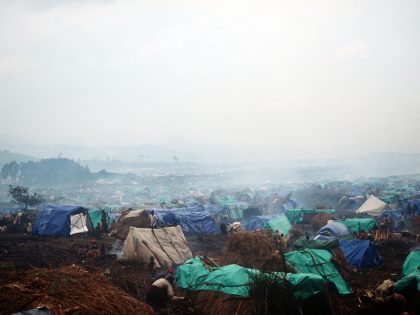
Blackwater’s “Rwanda”


I know we’ve been hearing about evil Erik Prince and his name-swapping mercenaries for years (Blackwater, Xe, my personal favorite Academi, and the latest, Greystone). But I only recently discovered how close all of this is to my hometown. Hell, from their “idyllic Dutch hamlet” in Holland (Michigan) the Prince family has formed and backed some of the biggest and most powerful militant Christian groups in the world. Just check out this interactive map.

[Read more...]

A ‘new wave’ of African film

“Sometimes I wonder: Will God ever forgive us for what we’ve done to each other?” says Leonardo DiCaprio, sullen and bleary-eyed, stoically staring just off camera.

“… I look around and I realize…” pause for emotion, “God left this place a long time ago.”

DiCaprio, as the white African “soldier of fortune,” leans back in the shadows, wiping away tears by rubbing his eyes as though he just woke up, and takes obvious care not to look directly at Jennifer Connelly, a do-gooder American journalist who dreams of exposing the real stories in Africa, not just the infomercial refugee children with flies in their eyes and distended bellies.

God has left the civil war-torn country of Sierra Leone in 1999, the setting for 2006s Blood Diamond.  Using the illegal diamond trade as the backdrop for the primarily character-driven storyline, the film carries a hefty social conscience for a big budget Hollywood action/drama.

Blood Diamond is one of Hollywood’s “message films” that allow Americans to leave the Cineplex feeling a little bit better about themselves after seeing an “educational” film about disenfranchised Africans.  And you can now impress your friends at parties with your knowledge of world events.

Don’t get me wrong, Hotel Rwanda, The Last King of Scotland, DiCaprio as the “bad guy with a heart” who helps the black man find his son—these are all good mainstream films.  Meaning they won numerous awards and only the best things win awards.

This is why I noticed Viva Riva!, the Congolese gangster film that won the “Best African Film” award at the 2011 MTV Movie Awards last month in Los Angeles, CA.

Yes, the MTV Movie Awards now has a “Best African Film” category.

I think it was presented while the stars of Twilight: Eclipse were shuffling back and forth from their seats with their golden popcorn statues. But, as Sean Jacobs pointed out on Africa is a Country last month, “That’s the kind of publicity African films can’t buy and should count for something when the film opens in [the US]…”

New York Magazine‘s brief review of Viva Riva! notes that the movie, “gives us reason to get excited for a new wave of films coming out of Africa: It’s well acted and slickly made, all while exposing a part of the world we haven’t really seen before.”

At the fashionable international film festivals like Cannes, Sundance, and the Toronto International Film Festival, and at regional venues like Austin, Texas’ South by Southwest and the New York African Film Festival, organizers are showcasing more African filmmakers.  This year, Cannes awarded the Chadian film A Screaming Man with the 2011 Jury Prize, and Viva Riva! was chosen as an Official Selection in Toronto and at SXSW.  Ultimately, demand for what the film industry aristocracy deems praise-worthy helps foreign filmmakers to land deals with US distributors.  Everyone is hoping to find the next “sleeper hit”; last year’s unexpected crowd-pleaser was the South African film District 9.  Released in August 2009, the faux-documentary sci-fi thriller earned four Academy Award nominations in 2010, including Best Picture.

The folks at MTV, who also honored DiCaprio’s Inception co-star Ellen Page in the “Best Scared-As-Sh*t Performance” category, may be onto something with their inaugural Best African Film award, pointing to a larger trend among Western audiences who are finding that there is more to Africa than what Hollywood tells us about in its “message films.”

[Read more...]

Do you know Omar al Bashir?

I recently ask students in a graduate class I teach on ‘media, culture and international affairs’ to do an experiment: take a camera, go outside (really downstairs on the New School ‘campus’) and test people’s knowledge of Darfur and Eastern Congo. Quick context: We had been reading and discussing Mahmood Mamdani’s Saviors and Survivors as well as viewing the film, “Darfur Now.” (The contrast between the two texts could not be more obvious of course. Mamdani’s book is a takedown of Save Darfur, while the film is essentially a fundraising and recruiting tool for the American activist group and its supporters.)

Anyway, we figured we should target students about their knowledge about Darfur (and Congo) since organizations like Safe Darfur (and the Enough Project) claim to have had the most success with young people. It also made practical sense.

[Read more...]

Follow

Get every new post delivered to your Inbox.

Join 2,265 other followers