February 11, 1990


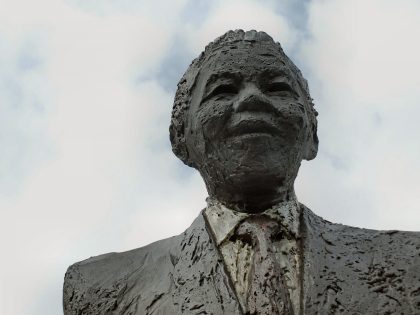
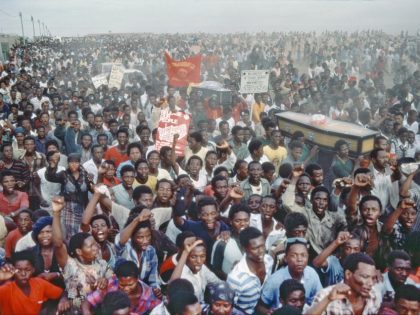
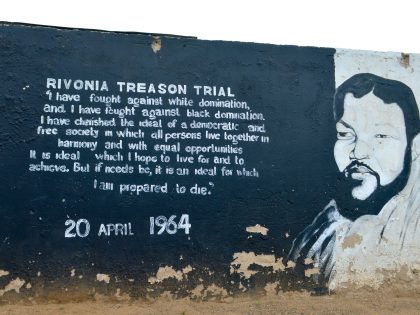
Today, 22 years ago, Nelson Mandela walked free from a prison outside Cape Town. Four years later, in April, the ANC won South Africa’s first democratic elections and in May 1994, Mandela was inaugurated as South Africa’s first black president. These were, however, only 22 years in the 100 year history of the ANC and in the long history of colonialism, Apartheid and now brief freedom in South Africa. Last month the ANC held a massive party in Mangaung, the place where it was founded in January 1912 by a small group of activists. Hundreds of thousands people headed to the capital of the now Free State province. But this is also a different ANC. Its legacy is not so clear cut anymore and we have covered the personalities that shape it as well as some of its calamities on this blog. Amongst the thousands at the ANC celebrations in Bloemfontein was Prexy Nesbitt, a trade unionist, college professor (he’s taught for years at Columbia College) and leading figure in the US anti-apartheid movement as well as the liberation struggles in Angola and Mozambique between the 1960s and the 1980s. He has a long association with Southern African freedom movements. When Prexy returned to his home in Chicago, he jotted down his impressions of the celebrations, of the ANC and South Africa. With his permission we republish it here. We think it is a fitting reflection on the commemoration of a momentous day. –Sean Jacobs [Read more...]

Tech Apartheid


Our tech posts never stray from tweeting new data on Twitter and Facebook usage on the continent–but now and then–as occasional readers of Gizmodo and Kotaku–we pause:

[Read more...]

Paul Simon’s Graceland Reconsidered

2011 was the 25th anniversary of Paul Simon’s “Graceland.” I don’t have to remind you of the album’s significance. It is hard to imagine now the impact of that album, but it did a lot of things: it resurrected Simon’s stalled career, was the first “World Music” album to be a crossover hit, won Simon a Grammy and sold millions of albums. The usual celebratory articles appeared in late August (which is when the album was released in 1985). I (!) was even interviewed for one by news agency AFP: Anyway, I think the album deserves a proper retrospective, not least because it was birthed in controversial circumstances [Read more...]

A Conversation on Apartheid


Keeping with our South Africa thread.

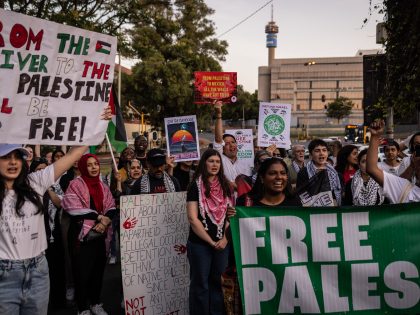
For our readers in Southern California, a very important conversation will be taking place at the University of Southern California on Thursday, 12 January. Omar Barghouti, one of the organizers of the Palestinian Campaign for the Academic and Cultural Boycott of Israel, will join legendary U.S.-based scholar-activists Angela Davis and Fred Moten to discuss the correlations between the divestment campaign against South Africa’s apartheid regime and the ongoing Boycott, Divestment and Sanctions (BDS) movement against Israel.

[Read more...]

The Dutch Disease

What is it with Dutch cultural elites and South Africa?

[Read more...]

The Nonviolent Transition in South Africa

The American philosopher Lewis Gordon, in an essay on affirmative action:

There are those who praise South Africa for making the transformation to a supposedly post-Apartheid society nonviolently. Without violence? The many blacks (in the Black Consciousness conception) and their supporters who were killed, tortured and imprisoned; the many protesters harmed; the tanks; the guns; the dogs; the 3 AM knock on the door; the many instances of trauma, none of them count? What is hidden in this misguided notion, as with what is suppressed about racism and sexism in the anti-affirmative action rhetoric of reverse discrimination and qualifications, is this: in a white supremacist state, violence is only recognized if it is waged against whites.

So, the hysteria about crime, about insecurity in South Africa is, as no doubt everyone knows, similar to the same in the United States. Even when the actual figures of violent crime declined, incarceration of blacks was high, because there was, in effect, the criminalization of a people. As violent appearance, black visibility was criminalized.

An odd feature of post-colonial states is that criminalization of black populations doesn’t require white institutional leadership. In so-called black countries, the phenomenon is there and it is color dependent, where darker-skin blacks are the most criminalized. The reasons for this are manifold, but most amount to the near isomorphic relationship between closed social options and skin color as a legacy of racialized slavery and colonialism in the midst of post-colonial environments heavily invested in keeping capital in the hands of the former governing population.

Source

Photo Credit.

Song and Dance

By Dan Moshenberg

Tuesday, August 9, 2011, was the annual celebration, in South Africa, of National Women’s Day. This public holiday commemorates August 9, 1956, the women’s march on the Union Buildings in Pretoria, in protest of the infamous pass laws. That day 20,000 or so women famously, and heroically, chanted, shouted, screamed: “Wathint’Abafazi Wathint’imbokodo!”. Translation: “Now you have touched the women, you have struck a rock!”

That was 55 years ago.

On Tuesday morning in South Africa (I am visiting here this week), the morning news talk shows, such as Morning Live on SABC2, celebrated with song, dance, some discussion. Women, and men, challenged the nation to do more, to do better. It was both festive and moving.

At the same time, there was a silence at the center and heart of the celebrations.

[Read more...]

The Life and Times of Harry Belafonte

Apart from his role in American racial and class struggles from the 1950s onwards, Harry Belafonte (now 83) played a central role in popularizing struggles for justice on the African continent, especially against white racism in South Africa. Not just by hosting and advancing the careers of South African artists (Miriam Makeba, Hugh Masekela), making music about South Africa’s dictatorship (herehere and here for example) but also leading protests, and speaking and fundraising here in the United States. Belatedly Belafonte–he apparently resisted for a long while–is now the subject of a documentary, “Sing Your Song,” about his life. The film will screen at the Human Rights Film Festival on Saturday, 25 June, at Lincoln Center here in New York City.   This link take you to some scenes from the film, here’s the film’s official site and its Facebook page. And below some video PR:

Belafonte  and the film’s director, Susanne Rostock, and producer, Gina Belafonte, interviewed on the Sundance Channel (the film premiered at the Sundance Film Festival):

[Read more...]

Putting up with being insulted by Malema

UPDATE: The South African Civil Society Information Service (SACSIS) keeps bringing it. This is not the handwringing of The Daily Maverick passing for insight. Most of the op-eds on the site go over the heads of the people its intended. Others dismiss it as partisan or ideological because they can’t take the truth.  Recently they carried an op-ed by Jane Duncan on the rightwing political ideology of the Democratic Alliance. (I cut and pasted it here.) Now there’s piece about the bargain between the ANC government and whites. It is by Cape Town trade unionist and educator Leonard Gentle:

The ANC’s role in achieving [a] state of existence [where there is a great deal of policy convergence between the ANC and the DA] cannot be underestimated and it has every right to be upset that its credentials to preside over this order – rather than the DA for instance – is so under-recognised by the media and the predominantly white middle classes.

Indeed, how much the ANC has transformed itself in the service of solving the great South African conundrum is remarkably unappreciated.

How is it possible to deliver (largely) white entitlement, wealth and security in a sea of (mostly) black poverty, and still emerge with political credibility and stability?

What commentators in 1994 used to call the South African “miracle” – the peaceful settlement to a seemingly intractable problem – lives on today in the form of apartheid ghettos, 40% unemployment and the extreme wealth and success of corporate South Africa.

In response to this potential powder keg, the ANC has successfully managed to keep the institutions of the current order intact and functional.

How could it do so?

[Read more...]

Jennifer Hudson is no Winnie Mandela

Follow

Get every new post delivered to your Inbox.

Join 1,912 other followers